Have you ever stopped while writing and wondered whether to use farther or further?
You are not alone. Many English speakers, writers, students, and professionals search for farther vs further because the two words look similar and are often used in the same situations.
The confusion comes from the fact that both words relate to distance or advancement. In some cases, they can be used interchangeably. In other cases, choosing the wrong word may make your writing seem less precise.
Understanding the farther vs further difference helps improve grammar, writing clarity, and professional communication.
Whether you are writing an email, creating content, preparing an academic paper, or posting on social media, knowing the correct usage matters.
In this guide, you will learn the farther vs further meaning, grammar rules, pronunciation differences, examples, common mistakes, and usage tips.
You will also discover how these words are used in American English, British English, and modern writing.
Farther vs Further means
The simplest rule is:
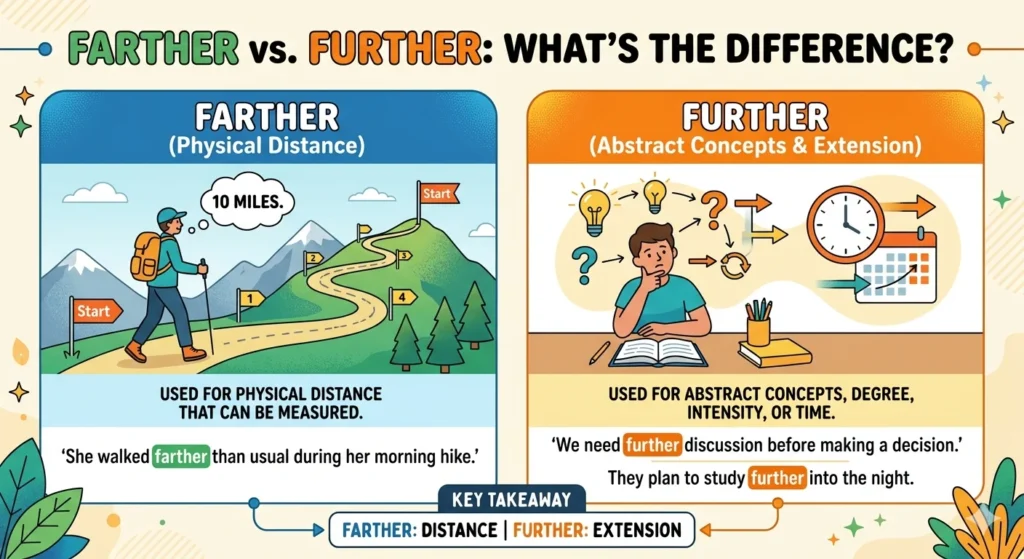
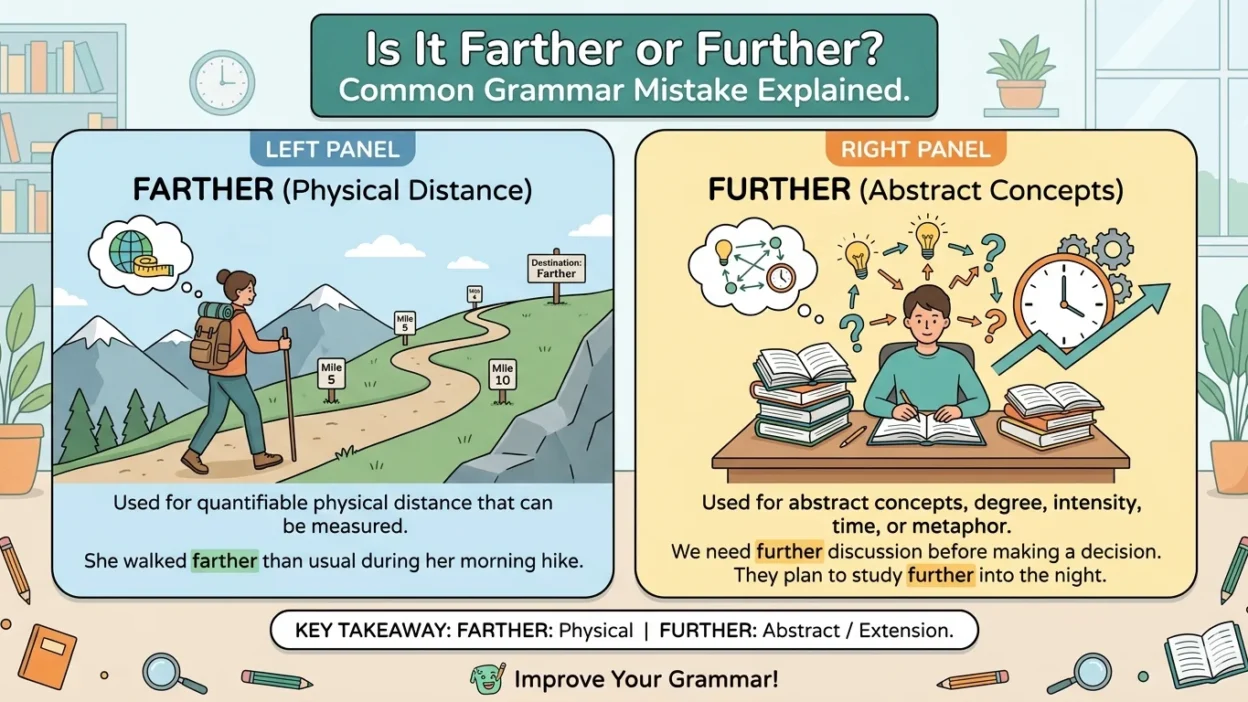
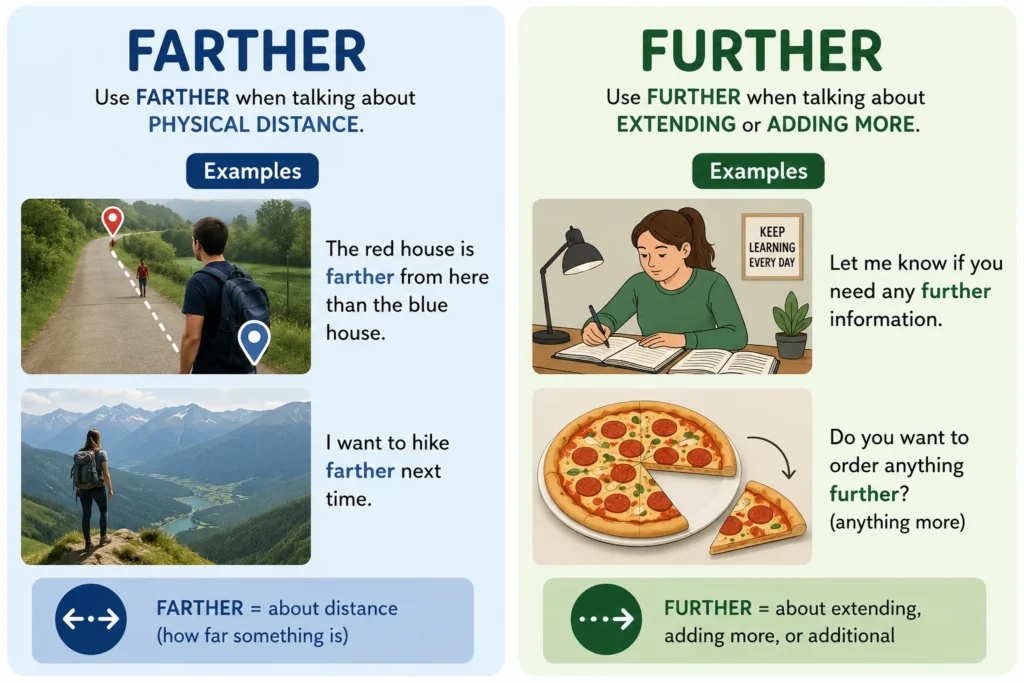
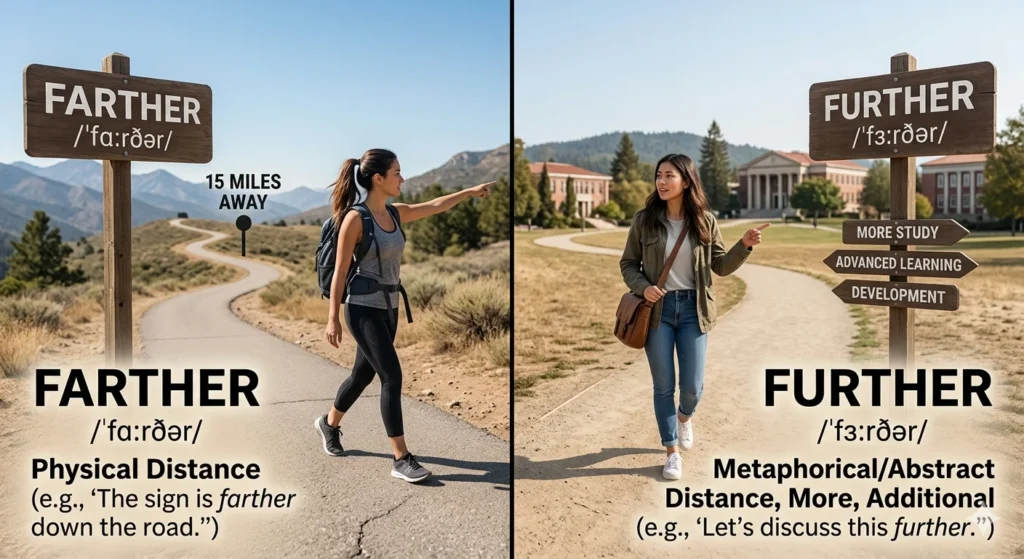
- Farther = physical distance.
- Further = figurative distance, time, degree, or additional information.
Examples
✅ The store is farther down the road.
✅ We need to discuss this further.
✅ She walked farther than anyone else.
✅ The meeting was postponed further into the future.
Further vs Farther Example
- Physical distance: The mountain is farther away than it looks.
- Time or progress: We cannot move further along without approval.
Although many people use them interchangeably, following this rule makes writing clearer.
The Origin of Farther vs Further
The history of farther vs further goes back hundreds of years.
Both words developed from the Old English word furthor, which meant “more forward” or “at a greater distance.”
Over time, English speakers began creating spelling variations. Eventually:
- Further became the standard form for many meanings.
- Farther developed as a variation specifically connected to measurable distance.
Because they share the same origin, modern dictionaries often accept overlap between the two words.
This shared history explains why the farther vs further difference meaning can seem confusing today.
British English vs American English Spelling
One common question is:
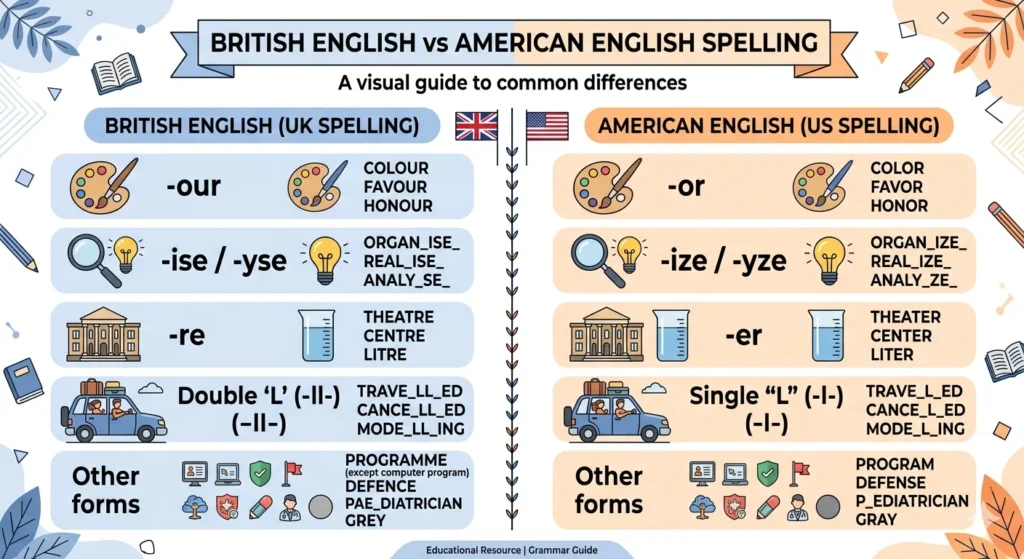
Is it further or farther in the UK?
In British English, further is generally more common. Many UK writers use further for both physical and figurative distance.
In American English, style guides often recommend:
- Farther for physical distance.
- Further for figurative distance and additional information.
Farther vs Further UK
British writers may say:
- The station is further down the road.
American writers may prefer:
- The station is farther down the road.
Comparison Table
| Context | American English | British English |
|---|---|---|
| Physical distance | Farther | Further or Farther |
| Additional information | Further | Further |
| Time progression | Further | Further |
| Formal writing | Distinction preferred | Further often preferred |
| Everyday speech | Both common | Further more common |
Farther vs Further American English Guideline
Most American style guides suggest maintaining a distinction between the two words to improve clarity.
Which Spelling Should You Use?
Your audience should guide your choice.
For US Audiences
Use:
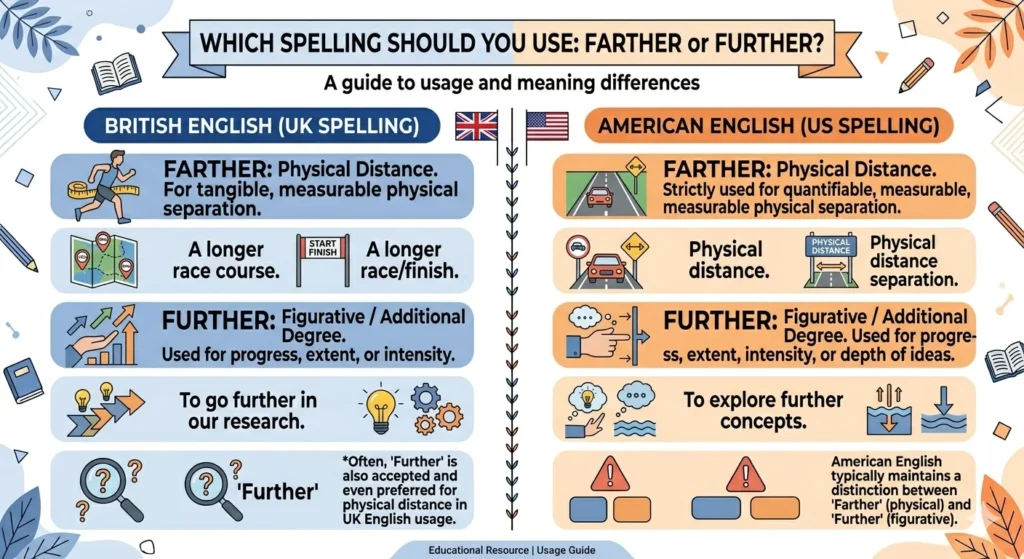
- Farther = physical distance
- Further = time, degree, or additional information
For UK and Commonwealth Audiences
Further is usually accepted in most situations.
For Global Audiences
Following the traditional distinction is safest:
- Physical distance → Farther
- Abstract ideas → Further
When to Use Farther vs Further
Ask yourself:
Can I measure the distance?
- Yes → Use farther
- No → Use further
Examples:
- The hotel is five miles farther away.
- We need further research.
Common Mistakes with Farther vs Further
Many writers make the same errors.
Mistake 1: Using Farther for Additional Information
❌ Please contact me for farther details.
✅ Please contact me for further details.
Mistake 2: Using Further for Measurable Distance
❌ The lake is ten miles further away.
✅ The lake is ten miles farther away.
Mistake 3: Confusing Distance and Time
❌ The project was pushed farther into next year.
✅ The project was pushed further into next year.
Farther vs Further Grammar Rules
Remember:
- Distance = Farther
- Time, degree, quantity, progress = Further
Farther vs Further in Everyday Examples
Email Example
“We require further information before approval.”
News Example
“The wildfire spread farther than expected.”
Social Media Example
“I can’t wait to see how this story develops further.”
Formal Writing Example
“Further research is necessary to support the findings.”
Farther vs Further Sentences
- She ran farther than her teammates.
- We need to investigate this further.
- The destination is farther away than expected.
- The discussion continued further into the evening.
- We moved further along in the process.
Farther vs Further in Time
When discussing time, use further.
Examples:
- The deadline was moved further into the future.
- The event was postponed further due to weather.
Farther vs Further Away
For physical distance:
- The beach is farther away than the park.
Farther or Further from the Truth
This common expression uses further because it refers to an idea, not physical distance.
Correct:
- Nothing could be further from the truth.
Farther vs Further – Google Trends & Usage Data
Search interest in farther vs further remains strong because many people struggle with the distinction.
Popular Countries
The keyword is frequently searched in:
- United States
- United Kingdom
- Canada
- Australia
- India
Why People Search It
Users often want answers to questions such as:
- When to use farther and further?
- Why do Americans say farther not further?
- Is it further or farther in the UK?
- Is using farther outdated?
Is Using Farther Outdated?
No.
While further has become more common in everyday speech, farther is still widely used and recommended in many American style guides for physical distance.
Farther vs Further Comparison Table
| Feature | Farther | Further |
|---|---|---|
| Physical distance | Yes | Sometimes |
| Time | No | Yes |
| Degree or extent | No | Yes |
| Additional information | No | Yes |
| American English preference | Physical distance | Abstract meaning |
| British English preference | Less common | More common |
| Formal writing | Accepted | Very common |
Farther vs Further Pronunciation
Farther Pronunciation
FAR-thər
Further Pronunciation
FUR-thər
The pronunciations are very similar in everyday speech, which contributes to the confusion.
Farther vs Further Pronunciation Difference
The first syllable changes slightly:
- Farther → sounds like “far”
- Further → sounds like “fur”
FAQs
1. What is the difference between farther and further?
Farther usually refers to physical distance, while further refers to time, degree, progress, or additional information.
2. When to use farther and further?
Use farther for measurable distance and further for abstract concepts, time, or advancement.
3. Why do Americans say farther not further?
Many American grammar guides recommend farther for physical distance and further for figurative meanings.
4. Is it further or farther in the UK?
British English commonly uses further for both physical and figurative meanings.
5. Is using farther outdated?
No. It remains a correct and widely accepted word, especially in American English.
6. Can farther and further be used interchangeably?
Sometimes, especially in casual speech. However, formal writing often follows the traditional distinction.
7. Which word should I use for time?
Use further when discussing time, progress, or future development.
8. Is there a farther vs further quiz rule to remember?
Yes. Ask:
“Can I measure it?”
- Yes → Farther
- No → Further
Conclusion
Understanding farther vs further is easier than many people think. The key difference is that farther generally refers to measurable physical distance, while further refers to abstract ideas such as time, degree, progress, and additional information.
Although both words share the same origin and are sometimes used interchangeably, following the traditional distinction helps make your writing more precise. American English usually maintains a stronger separation between the two words, while British English often favors further in most situations.
If you are unsure which word to choose, use a simple test: can the distance be physically measured? If yes, choose farther. If the meaning involves progress, time, explanation, or extent, choose further.
By applying these farther vs further grammar rules, you can avoid common mistakes, improve your writing, and communicate more clearly with readers around the world. Whether you write emails, reports, articles, or social media posts, knowing the correct usage will help you sound more confident and professional.

“Sylvia Townsend, a witty humorist at PunsBlast, crafting clever puns and playful wordplay that bring smiles to readers everywhere.”