Have you ever stopped while writing and wondered whether you should use faze or phase? You are not alone. Many people search for faze vs phase because these words sound alike but have very different meanings.
This confusion often leads to spelling mistakes in emails, social media posts, school assignments, and professional writing.
People frequently ask questions like “Are faze and phase the same?”, “Is it nothing phases or fazes me?”, and “I’m not fazed or phased?”.
Since both words are pronounced similarly, it is easy to mix them up. However, using the wrong spelling can change the meaning of your sentence completely.
This guide explains the difference between faze vs phase meaning, their origins, correct usage, common mistakes, and real-life examples.
By the end, you will know exactly when to use each word and avoid one of the most common English spelling errors.
Faze vs Phase means
The quick answer is simple:
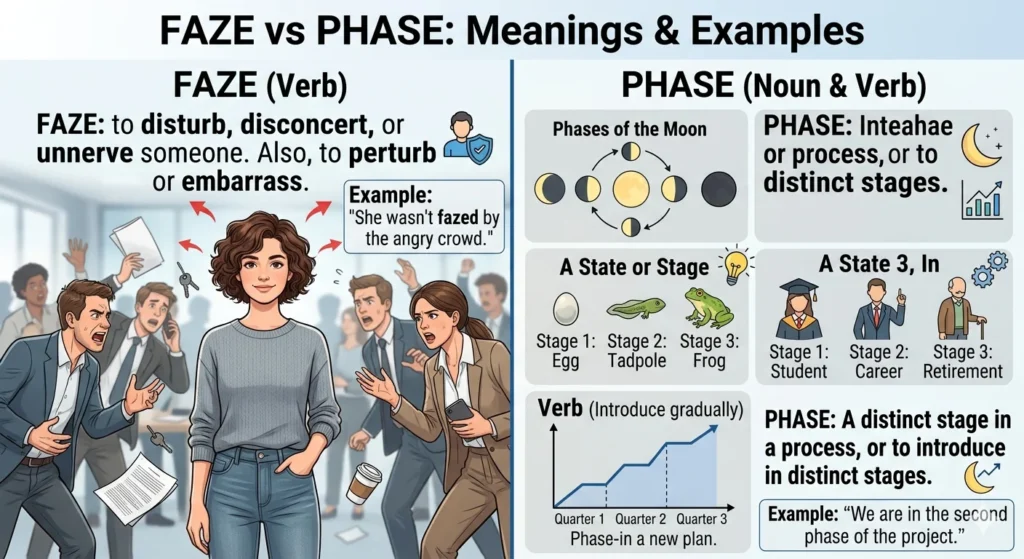
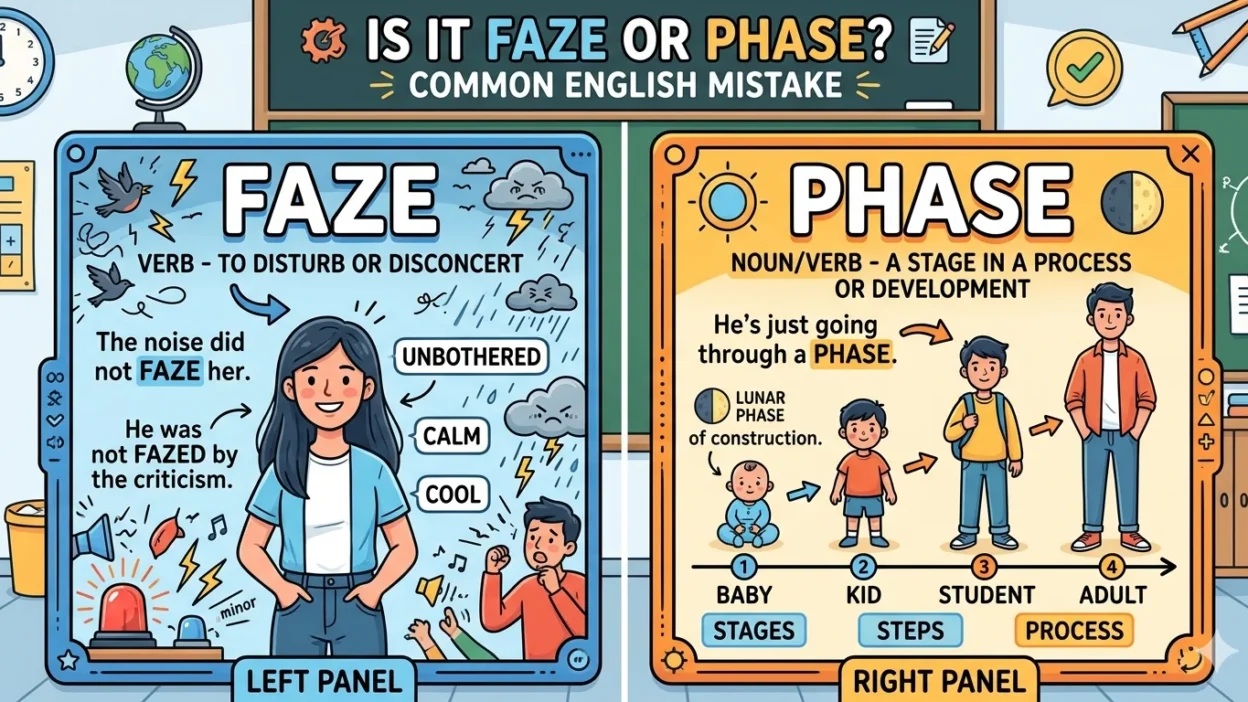
- Faze means to disturb, bother, or upset someone.
- Phase means a stage, period, or step in a process.
Examples
Faze
- The criticism did not faze her.
- Nothing can faze him.
Phase
- We are entering the next phase of the project.
- The moon is in a different phase tonight.
Comparison Table
| Word | Meaning | Part of Speech | Example |
|---|---|---|---|
| Faze | To disturb or upset | Verb | The bad news did not faze me. |
| Phase | A stage or period | Noun/Verb | We completed phase one. |
So when comparing faze vs phase, remember that faze affects emotions, while phase refers to stages or periods.
The Origin of Faze vs Phase
Understanding word origins helps explain why these spellings exist.
Faze Origin
The word faze appeared in English during the 1800s. It likely developed from older words meaning to frighten, disturb, or unsettle someone. Today, it almost always means to bother or affect a person’s confidence.
Example:
- The difficult questions did not faze the candidate.
Phase Origin
The word phase comes from the Greek word phasis, meaning appearance. It entered English through Latin and French. It was first used to describe the changing appearance of the moon and later expanded to mean any stage of development.
Example:
- The company is in a growth phase.
Why the Spelling Difference Exists
Although faze and phase sound similar, they come from different historical roots. That is why their meanings and spellings are completely different.
This is one reason many people search for faze vs phase definition and faze vs phase meaning.
British English vs American English Spelling
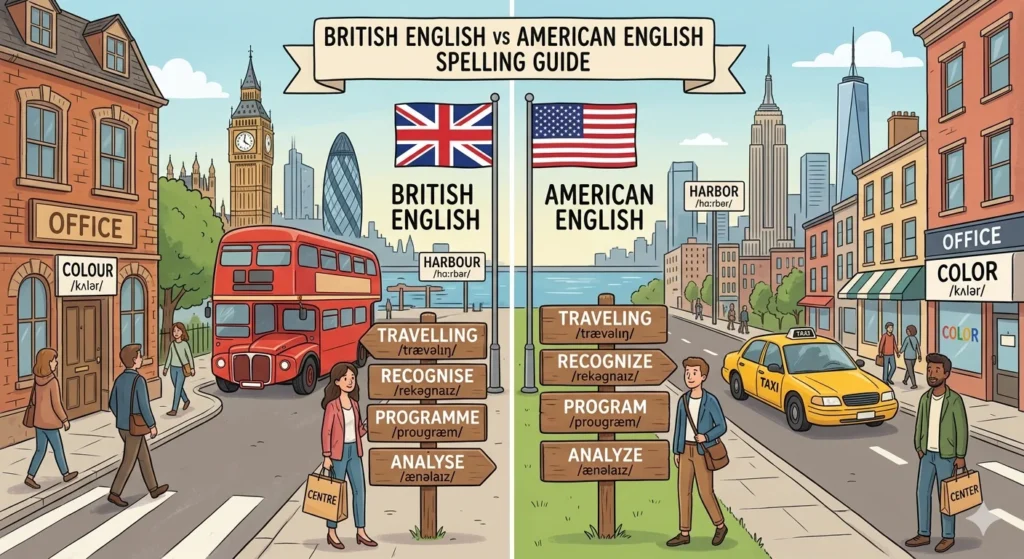
Unlike many English words, faze and phase are spelled the same in both British and American English.
Examples
| Meaning | American English | British English |
|---|---|---|
| To upset someone | Faze | Faze |
| Stage of development | Phase | Phase |
| Growth stage | Growth phase | Growth phase |
| Unaffected | Not fazed | Not fazed |
There is no British or American spelling variation here.
However, confusion often happens because people accidentally write:
- Phase me instead of faze me
- Phased instead of fazed
Correct Forms
| Incorrect | Correct |
|---|---|
| Nothing phases me | Nothing fazes me |
| I’m not phased | I’m not fazed |
| Fase | Faze or Phase (depending on meaning) |
Which Spelling Should You Use?
The correct spelling depends on your meaning.
Use “Faze” When
You mean:
- Bother
- Disturb
- Upset
- Unsettle
Examples
- The comments did not faze her.
- Don’t let criticism faze you.
Use “Phase” When
You mean:
- Stage
- Period
- Development step
- Transition
Examples
- We started the second phase.
- The project entered a testing phase.
Audience-Based Advice
| Audience | Recommended Usage |
|---|---|
| US Readers | Use faze and phase according to meaning |
| UK Readers | Use faze and phase according to meaning |
| Commonwealth Countries | Same spelling rules |
| Global Audience | Follow standard English definitions |
No matter where your audience lives, the distinction remains the same.
Common Mistakes with Faze vs Phase
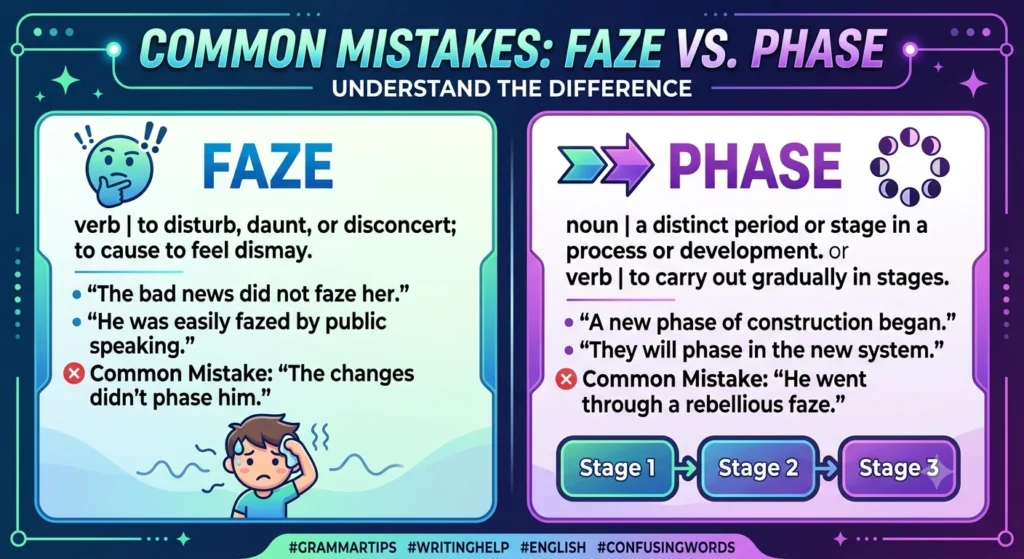
Many writers confuse these words because they sound alike.
Mistake #1: Is it nothing phases or fazes me?
✅ Correct: Nothing fazes me.
❌ Incorrect: Nothing phases me.
The sentence means “nothing bothers me,” so use fazes.
Mistake #2: I’m not fazed or phased
✅ Correct: I’m not fazed.
❌ Incorrect: I’m not phased.
You are saying you are not bothered, so fazed is correct.
Mistake #3: Is it fased or fazed?
✅ Correct: Fazed
❌ Incorrect: Fased
The past tense of faze is fazed.
Example:
- I was not fazed by the challenge.
Mistake #4: Is it phase out or faze out?
✅ Correct: Phase out
❌ Incorrect: Faze out
Phase out means to remove something gradually.
Example:
- The company will phase out old products.
Mistake #5: Faze you or phase you
✅ Correct: Faze you
Example:
- Don’t let negative comments faze you.
Faze vs Phase in Everyday Examples
Emails
Correct
- The delay should not faze our team.
- We are moving into the final phase of development.
News Writing
Correct
- The athlete was not fazed by criticism.
- The government announced phase two of the plan.
Social Media
Correct
- Haters don’t faze me.
- Starting a new phase of my life today.
Formal Writing
Correct
- The organization entered a new growth phase.
- Unexpected challenges did not faze management.
Faze Me Meaning
When someone says:
“It doesn’t faze me.”
They mean:
“It doesn’t bother me.”
Faze You Meaning
When someone says:
“Don’t let it faze you.”
They mean:
“Don’t let it upset you.”
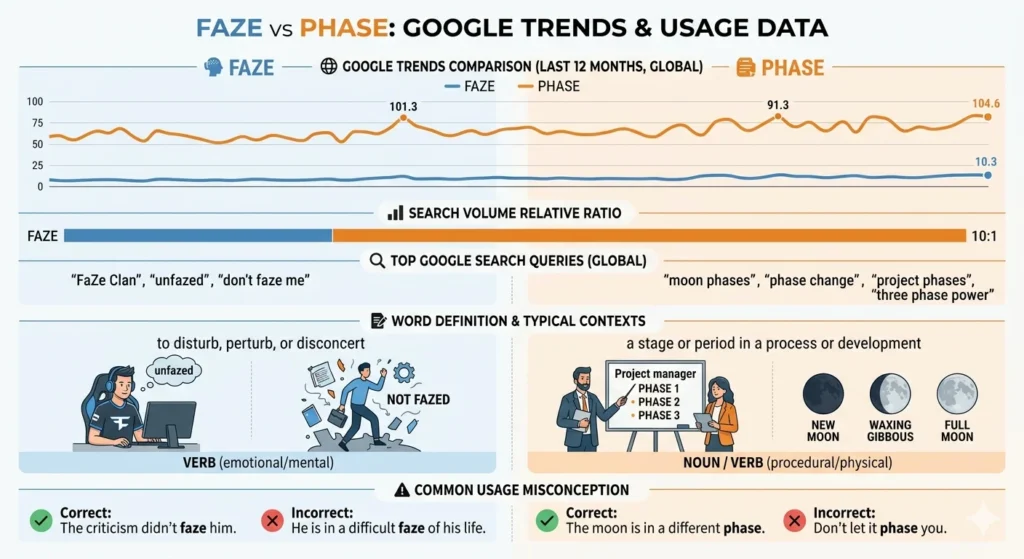
Faze vs Phase – Google Trends & Usage Data
Search interest for faze vs phase remains steady because these words are commonly confused.
Countries with Frequent Searches
- United States
- United Kingdom
- Canada
- Australia
- India
Common Search Queries
- Are faze and phase the same?
- Faze vs phase meaning
- Faze vs phase definition
- Faze or phase me
- Faze you or phase you
- Is it nothing phases or fazes me?
- Is it fased or fazed?
- I’m not fazed or phased
- Phase out or faze out
- Faze vs phase reddit
- Faze vs phase vs fase
Why People Search This Topic
Most searches come from people who hear the words in conversation but are unsure which spelling to use when writing.
Faze vs Phase vs Fase
Many learners also search for faze vs phase vs fase.
| Word | Correct? | Meaning |
|---|---|---|
| Faze | Yes | To upset or disturb |
| Phase | Yes | A stage or period |
| Fase | No (in standard English) | Misspelling of faze or phase |
In standard English writing, fase is usually incorrect.
FAQs
1. Are faze and phase the same?
No. Faze means to disturb someone, while phase means a stage or period.
2. Is it nothing phases or fazes me?
The correct phrase is nothing fazes me.
3. Is it fased or fazed?
The correct spelling is fazed.
4. Is it phase out or faze out?
The correct phrase is phase out, meaning to remove something gradually.
5. Faze or phase me?
Use faze me when you mean bother or upset me.
6. Faze you or phase you?
Use faze you when talking about affecting someone’s emotions.
7. I’m not fazed or phased?
The correct expression is I’m not fazed.
8. What is faze meaning?
Faze meaning: to disturb, upset, bother, or unsettle someone.
9. What does phase mean?
Phase means a stage, period, or step in a process.
Conclusion
The difference between faze vs phase is easy to remember once you know their meanings. Faze relates to emotions and means to disturb, bother, or upset someone. Phase refers to a stage, period, or step in a process. Although they sound similar, they should never be used interchangeably.
If you are writing about feelings, reactions, or confidence, use faze. Examples include “Nothing fazes me” and “Don’t let criticism faze you.” If you are discussing development, progress, or stages, use phase. Examples include “phase one of the project” and “a new phase of life.”
Many common mistakes come from confusing phrases such as I’m not fazed or phased, faze you or phase you, and phase out or faze out. Remember that fazed relates to being bothered, while phase relates to stages and growth.
Mastering this distinction will make your writing clearer, more professional, and easier for readers to understand.

“George Gissing, a humor-loving writer at PunsBlast, crafting witty puns and playful word magic to make readers laugh every single day.”