Have you ever wondered whether you should say “fewer items” or “less items”?
Many English learners and even native speakers get confused about fewer vs less because both words talk about smaller amounts. However, they are not always interchangeable.
People often search questions like “Is pizza less or fewer?”, “Is it fewer money or less money?”, and “Is it fewer or less people?” because the rule can seem confusing in everyday conversations.
You may hear both forms used in stores, advertisements, social media posts, and even professional writing.
Understanding the fewer vs less grammar rule helps you communicate clearly and avoid common mistakes.
Whether you are writing an email, preparing for a grammar test, studying for the GMAT, or simply improving your English, knowing when to use fewer vs less is important.
This guide explains the difference in simple terms, provides practical examples, compares usage styles, and answers common questions. By the end, you’ll know exactly which word to choose in any situation.
Fewer vs Less means
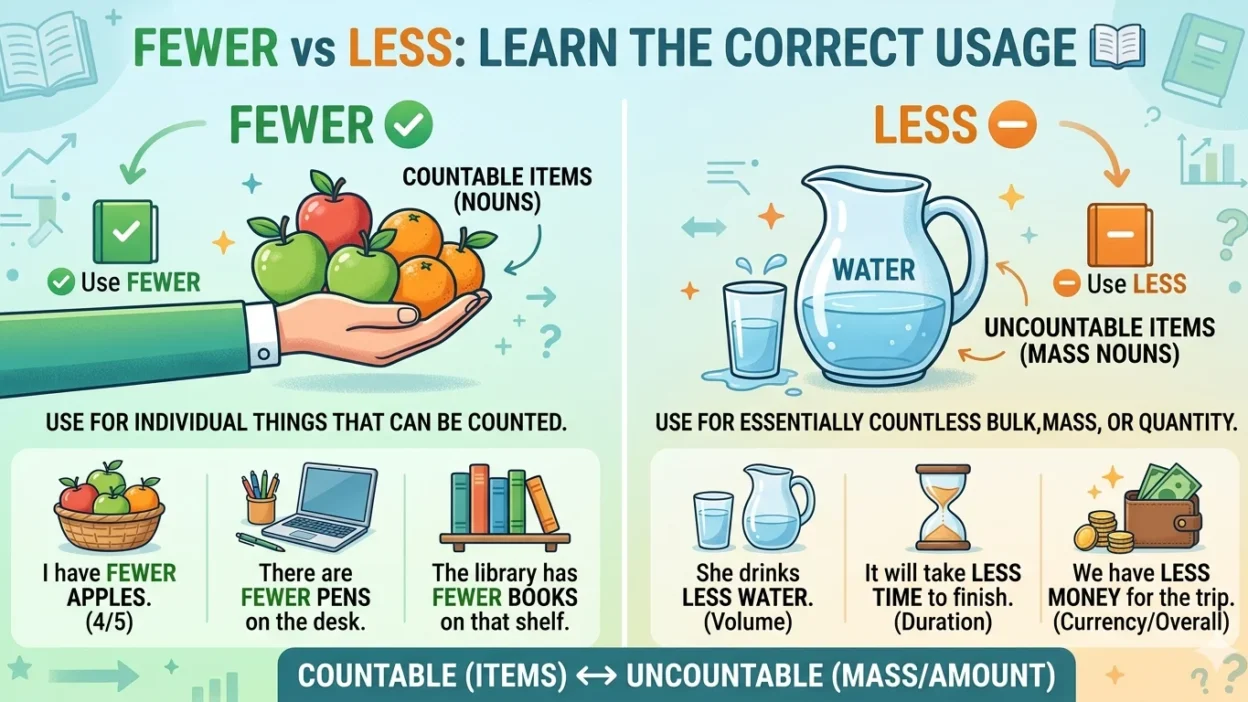
The basic rule is simple:
- Fewer is used with things you can count.
- Less is used with things you cannot count.
Examples
✅ Fewer books
✅ Fewer students
✅ Fewer cars
✅ Less water
✅ Less sugar
✅ Less money
Quick Comparison
| Use Fewer | Use Less |
|---|---|
| Countable nouns | Uncountable nouns |
| Fewer apples | Less juice |
| Fewer people | Less time |
| Fewer mistakes | Less stress |
Common Questions
Is pizza less or fewer?
Usually, use less pizza because pizza is treated as an uncountable food.
Is it fewer money or less money?
Correct: less money
Money is considered an uncountable amount.
Is it fewer or less people?
Correct: fewer people
People can be counted individually.
The Origin of Fewer vs Less
The words fewer and less come from Old English.
- Less comes from the Old English word læssa, meaning “smaller” or “not as much.”
- Fewer developed later from the word few, which refers to a small number.
Historically, English speakers sometimes used less with countable nouns. Over time, grammar experts created a clearer distinction:
- Countable things → fewer
- Uncountable things → less
This distinction became common in formal English and is now considered the standard fewer vs less grammar rule.
British English vs American English Spelling
Unlike many English words, fewer and less have the same spelling in both British and American English.
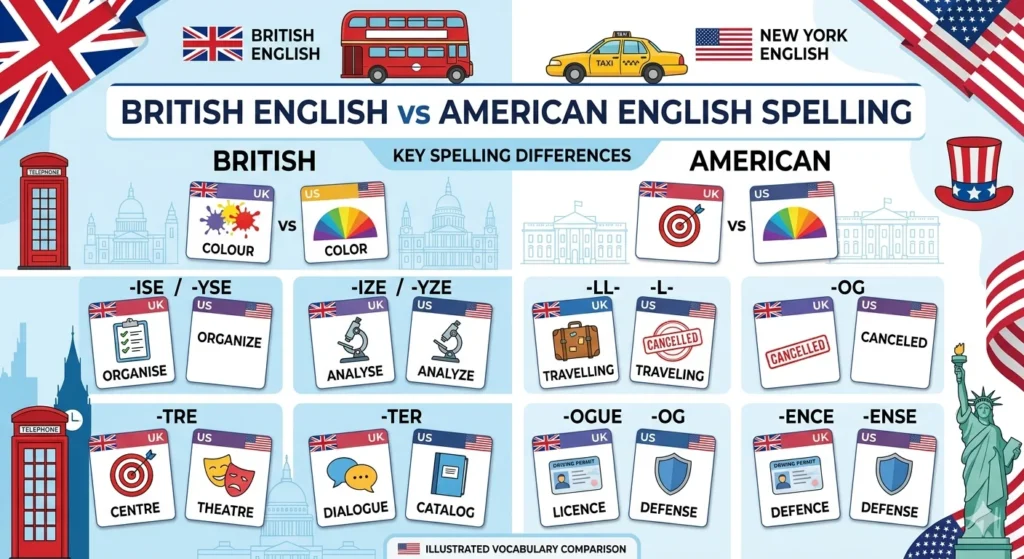
The difference is not spelling but usage preferences.
British English speakers are sometimes more flexible in everyday speech, while American style guides often follow the grammar rule more strictly.
Comparison Table
| Situation | British English | American English |
|---|---|---|
| Formal writing | Fewer people | Fewer people |
| Formal writing | Less water | Less water |
| Everyday speech | Sometimes less people | Sometimes less people |
| Style guides | Prefer fewer people | Strongly prefer fewer people |
Examples
British:
- There are fewer cars on the road today.
American:
- There are fewer cars on the road today.
Both versions are correct.
Which Spelling Should You Use?
Since there is no spelling difference, your choice depends on grammar and audience.
For American Audiences
Follow the traditional rule:
- Fewer cars
- Fewer students
- Less traffic
- Less money
For UK and Commonwealth Audiences
The same rule is preferred in formal writing, though informal speech may be more flexible.
For Global Audiences
Use the standard grammar rule:
- Countable nouns → fewer
- Uncountable nouns → less
This approach is understood everywhere and looks professional.
Common Mistakes with Fewer vs Less
Many people know the rule but still make mistakes.
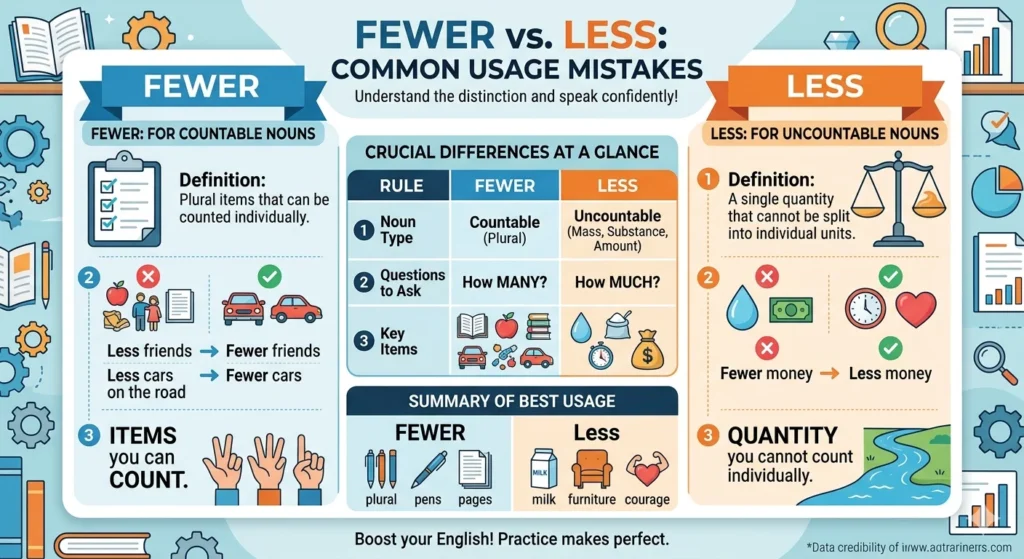
Mistake 1
❌ Less people attended the meeting.
✅ Fewer people attended the meeting.
Mistake 2
❌ Fewer money was spent.
✅ Less money was spent.
Mistake 3
❌ Less books on the shelf.
✅ Fewer books on the shelf.
Mistake 4
❌ Fewer water is needed.
✅ Less water is needed.
Mistake 5
❌ Less employees worked today.
✅ Fewer employees worked today.
These examples show the key fewer vs less difference usage rule in action.
Fewer vs Less in Everyday Examples
Understanding real-life usage makes the rule easier.
Emails
- We received fewer applications this month.
- The project required less funding than expected.
News Articles
- Fewer voters participated this year.
- The region experienced less rainfall.
Social Media
- I have fewer followers than last year.
- I’m spending less time online.
Formal Writing
- The company reported fewer complaints.
- The study showed less pollution in urban areas.
Fewer vs Less Example Sentences
- There are fewer cookies in the jar.
- We have less milk in the fridge.
- Fewer students passed the exam.
- Less energy was used this month.
- Fewer people attended the event.
- Less traffic made the trip faster.
These fewer vs less examples sentences help reinforce the grammar rule.
Fewer vs Less – Google Trends & Usage Data
Search interest for fewer vs less remains strong because many writers want to improve grammar accuracy.
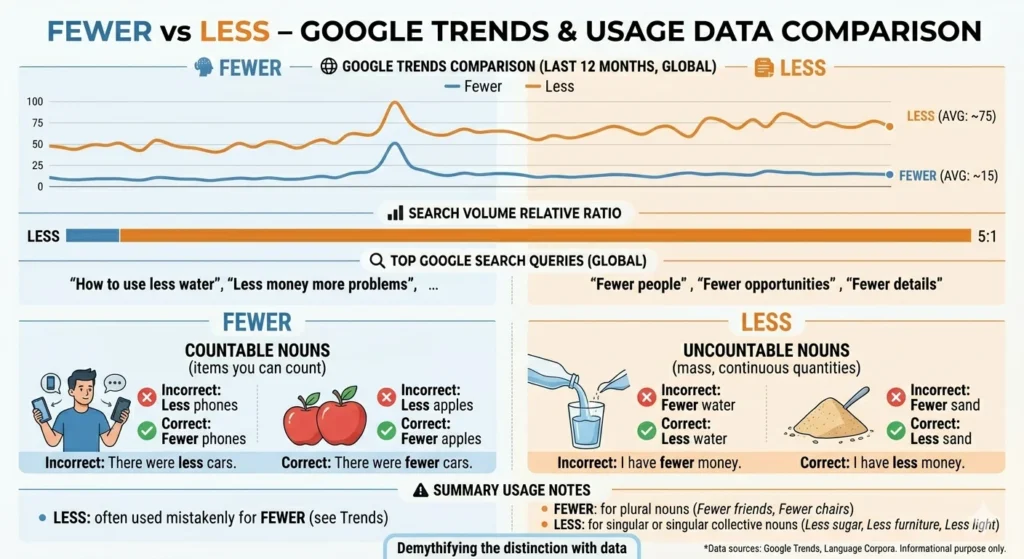
Countries with High Interest
- United States
- United Kingdom
- Canada
- Australia
- India
Common Search Queries
- fewer vs less
- fewer vs less grammar
- fewer vs less rule
- fewer vs less people
- fewer vs less than
- fewer vs less quiz
- fewer vs less worksheet
- define fewer vs less
- fewer vs less meaning
- fewer vs less grammar rule difference
Why People Search This Topic
- School assignments
- GMAT preparation
- Professional writing
- AP Style questions
- Everyday communication
Fewer vs Less Comparison Table
| Feature | Fewer | Less |
|---|---|---|
| Meaning | Smaller number | Smaller amount |
| Used with | Countable nouns | Uncountable nouns |
| Example | Fewer books | Less water |
| Example | Fewer people | Less money |
| Example | Fewer mistakes | Less stress |
| Opposite | More | More |
| Related word | Few | Little |
Fewer vs Few
- Few = adjective
- Fewer = comparative form
Example:
- Few students arrived early.
- Fewer students arrived today than yesterday.
Fewer vs More
- Fewer = smaller number
- More = larger number
Example:
- We need fewer meetings.
- We need more productivity.
FAQs About Fewer vs Less
1. What is the difference between fewer and less?
Fewer is used with countable nouns, while less is used with uncountable nouns.
2. Is it fewer people or less people?
The correct form is fewer people because people can be counted.
3. Is it less money or fewer money?
The correct phrase is less money because money is treated as an amount.
4. Is it 2 or less or 2 or fewer?
Grammatically, 2 or fewer is preferred because the number can be counted.
5. Is pizza less or fewer?
Usually, say less pizza because pizza is considered an uncountable food item.
6. What is the fewer vs less AP Style rule?
AP Style generally follows the traditional rule:
- Fewer for countable items
- Less for uncountable amounts
7. How can I practice fewer vs less?
You can use a fewer vs less worksheet, complete a fewer vs less quiz, or try grammar exercises with countable and uncountable nouns.
Fewer vs Less Exercises
Choose the correct word.
- There are _____ cars today.
- We need _____ water.
- _____ people attended the concert.
- She spent _____ money this month.
- There were _____ mistakes in the report.
Answers
- Fewer
- Less
- Fewer
- Less
- Fewer
These simple fewer vs less exercises help improve grammar accuracy.
Conclusion
The fewer vs less rule is one of the most useful grammar rules in English. While both words describe a reduction, they are used differently. Use fewer when talking about things that can be counted, such as books, people, students, or cars. Use less when referring to amounts that cannot easily be counted, such as water, money, time, or stress.
Many common questions, including “Is it fewer money or less money?”, “Is it fewer or less people?”, and “Is pizza less or fewer?”, become easy to answer once you understand the difference between countable and uncountable nouns.
For professional writing, academic work, AP Style, and business communication, following the standard fewer vs less grammar rule is the safest choice. Although informal speech sometimes breaks the rule, correct usage helps your writing appear more polished and credible.
Remember this simple formula: countable equals fewer, uncountable equals less. Mastering this rule will help you avoid mistakes and communicate with greater confidence in every situation.

“Margaret Oliphant, a witty wordsmith at PunsBlast, blending charm and clever humor to turn everyday moments into laugh-worthy puns.”