
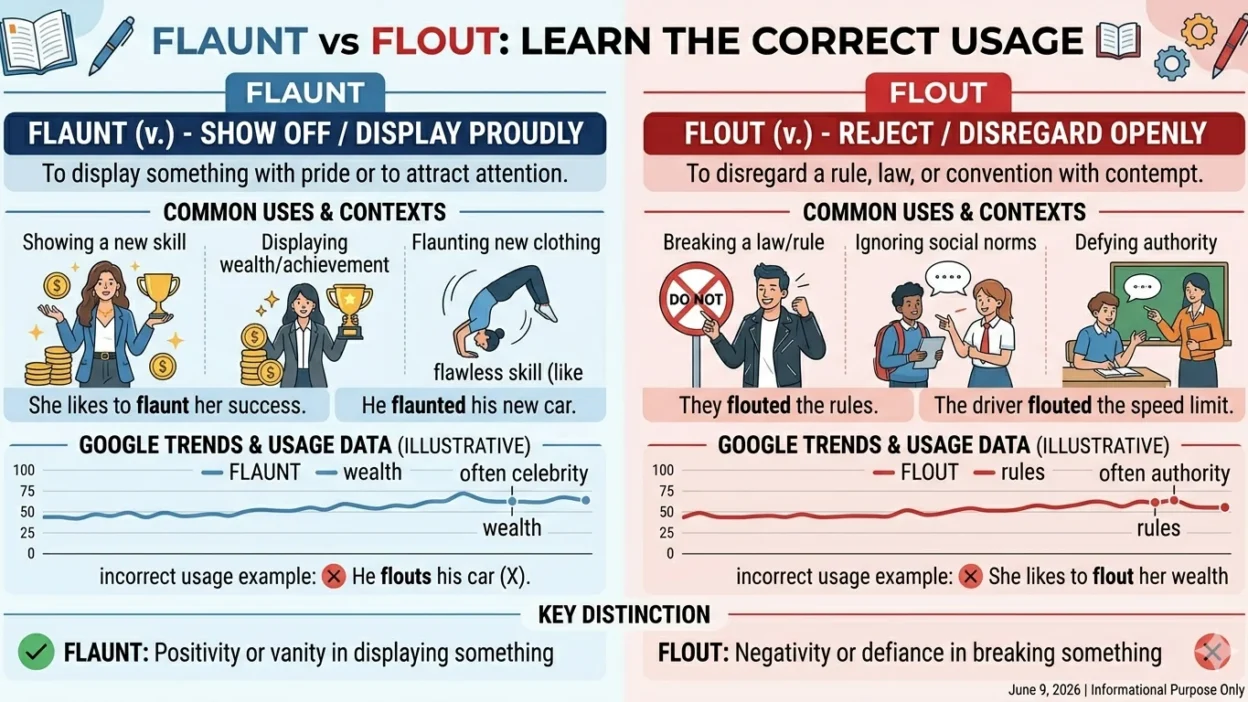
Have you ever read a sentence and wondered whether the correct word is flaunt or flout? You are not alone.
Many English speakers confuse these two words because they sound somewhat similar, yet their meanings are very different.
People often search for questions like “Is it flout or flaunt?”, “Is it flout or flaunt the law?”, and “How do you use flaunt and flout in a sentence?”
because using the wrong word can completely change the meaning of a sentence.
For example, someone may flaunt their new car by showing it off proudly. However, a person may flout the law by openly ignoring legal rules.
These actions are not the same, even though the words look and sound alike.
In this guide, you will learn the flaunt vs flout meaning, see real examples, discover their origins, understand spelling differences, and learn which word fits your writing.
By the end, you will know exactly when to use each term with confidence.
Flaunt vs Flout means
The main difference is simple:
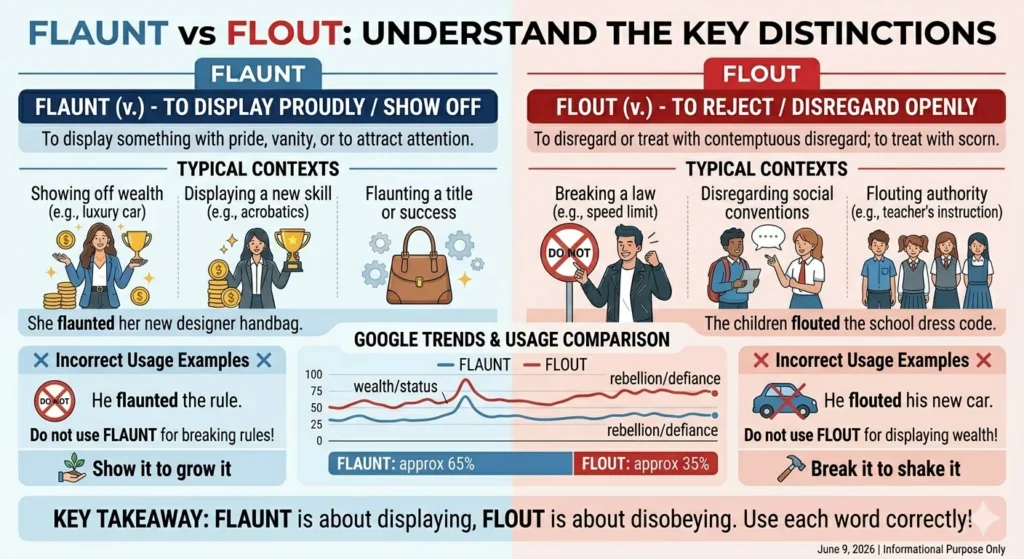
- Flaunt means to show something off proudly.
- Flout means to openly ignore or disobey a rule, law, or convention.
Examples
✅ She likes to flaunt her designer handbags.
✅ The company continued to flout safety regulations.
✅ He flaunted his success on social media.
✅ Some drivers flout the speed limit every day.
Is it flout or flaunt the law?
The correct phrase is:
✅ Flout the law
Because flout means to ignore or break rules.
❌ Flaunt the law
This is usually incorrect unless someone is literally showing off the law, which is uncommon.
The Origin of Flaunt vs Flout
Understanding the history of these words helps explain why people mix them up.
Flaunt Meaning and Origin
The word flaunt appeared in English during the 16th century. It originally referred to displaying something in a flashy or attention-seeking way.
Over time, the meaning became:
To show off proudly or boastfully.
Flout Meaning and Origin
The word flout comes from an older English verb meaning “to mock” or “to show contempt.”
Today, it means:
To openly disregard or ignore rules, laws, or accepted standards.
Why Are They Confused?
People confuse them because:
- They sound similar.
- They have similar spelling.
- Both often appear in formal writing.
However, their meanings are completely different.
| Word | Meaning | Example |
|---|---|---|
| Flaunt | Show off proudly | She flaunted her new watch. |
| Flout | Ignore or disobey | He flouted company policy. |
British English vs American English Spelling
Unlike many English words, flaunt and flout are spelled the same in both British and American English.
There is no UK vs US spelling difference.
Comparison Table
| Usage | British English | American English |
|---|---|---|
| Show off proudly | Flaunt | Flaunt |
| Ignore rules | Flout | Flout |
| Flaunt meaning | Same | Same |
| Flout meaning | Same | Same |
| Flout the rules | Correct | Correct |
| Flout the law | Correct | Correct |
Examples
British English
- The celebrity flaunted her wealth.
- The company flouted environmental laws.
American English
- He flaunted his expensive car.
- They flouted federal regulations.
Which Spelling Should You Use?
Since both words have different meanings, your choice depends on what you want to say.
Use “Flaunt” When:
- Showing off success
- Displaying wealth
- Drawing attention to something
Examples:
- She flaunted her promotion.
- He flaunted his luxury lifestyle.
Use “Flout” When:
- Ignoring rules
- Breaking laws
- Disregarding standards
Examples:
- They flouted safety rules.
- The driver flouted traffic laws.
Audience-Based Advice
| Audience | Recommended Usage |
|---|---|
| US Readers | Use flaunt or flout based on meaning |
| UK Readers | Use flaunt or flout based on meaning |
| Australia | Same usage |
| Canada | Same usage |
| Global Audience | Use the word that matches your intended meaning |
Common Mistakes with Flaunt vs Flout
Many writers accidentally replace one word with the other.
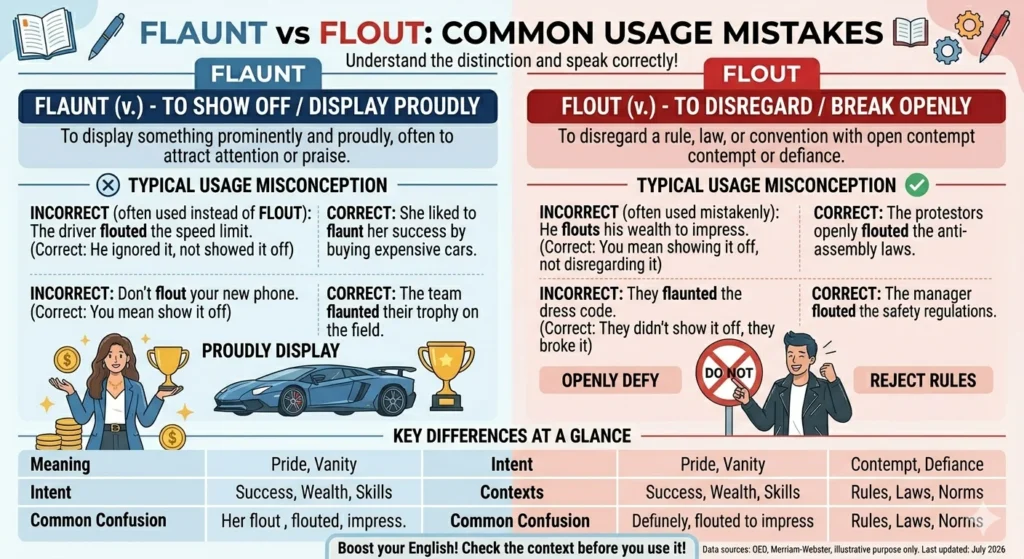
Mistake 1
❌ He flaunted the law.
✅ He flouted the law.
Mistake 2
❌ She flouted her new jewelry.
✅ She flaunted her new jewelry.
Mistake 3
❌ The company flaunted regulations.
✅ The company flouted regulations.
Easy Memory Trick
- Flaunt = Flashy
- Flout = Break Rules
This trick helps many writers remember the difference quickly.
Flaunt vs Flout in Everyday Examples
Here are practical examples showing how each word is used.
Email Example
Flaunt
The brand continues to flaunt its premium image through luxury advertising.
Flout
Several employees were warned for flouting company policies.
News Example
Flaunt
The actor flaunted a new fashion collection during the event.
Flout
Officials accused businesses of flouting environmental regulations.
Social Media Example
Flaunt
Influencers often flaunt expensive vacations online.
Flout
Some users openly flout platform guidelines.
Formal Writing Example
Flaunt
The company flaunted its achievements in the annual report.
Flout
Organizations that flout regulations may face penalties.
Flaunt vs Flout in a Sentence
- She flaunted her award during the ceremony.
- The group flouted local laws.
- He flaunted his wealth on Instagram.
- The company flouted safety standards.
These are excellent flaunt vs flout examples for everyday writing.
Flaunt vs Flout – Google Trends & Usage Data
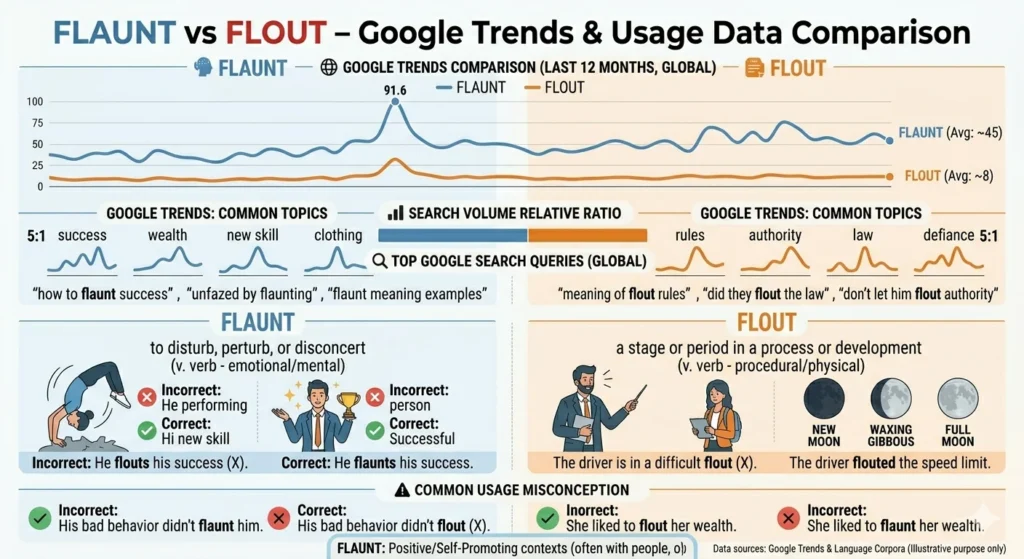
Search behavior shows that many users frequently look for:
- Is it flout or flaunt?
- What does flaunt mean?
- Flout meaning
- Flaunt vs flout difference
- Flaunt vs flout examples
Usage by Context
| Context | Common Word |
|---|---|
| Wealth | Flaunt |
| Fashion | Flaunt |
| Luxury | Flaunt |
| Rules | Flout |
| Laws | Flout |
| Regulations | Flout |
Popular Countries
Searches for flaunt vs flout are common in:
- United States
- United Kingdom
- Canada
- Australia
- India
Most searches come from students, writers, bloggers, and professionals looking to avoid grammar mistakes.
Flaunt vs Flout Meaning Comparison Table
| Feature | Flaunt | Flout |
|---|---|---|
| Meaning | Show off proudly | Ignore rules |
| Part of Speech | Verb | Verb |
| Positive or Negative | Usually neutral | Usually negative |
| Related Idea | Display | Disobey |
| Common Phrase | Flaunt wealth | Flout the rules |
| Common Phrase | Flaunt success | Flout the law |
Flaunt vs Flout Synonym
| Word | Synonyms |
|---|---|
| Flaunt | Show off, display, parade, boast |
| Flout | Ignore, violate, defy, disregard |
FAQs
1. What does flaunt mean?
Flaunt meaning is to display something proudly or show it off to attract attention.
2. What is flout meaning?
Flout meaning is to openly ignore, disobey, or disregard rules, laws, or standards.
3. Is it flout or flaunt the law?
The correct phrase is flout the law because laws are ignored or violated, not shown off.
4. How do you use flaunt and flout in a sentence?
- She flaunted her new car.
- They flouted company regulations.
5. What is the difference between flaunt and flout?
The flaunt vs flout difference is that flaunt means showing off, while flout means ignoring rules.
6. Is flout always negative?
Generally, yes. Flouting rules or laws usually carries a negative meaning.
7. Can flaunt be negative?
Sometimes. If someone is showing off excessively, flaunt can sound critical.
Conclusion
The distinction between flaunt vs flout is important because the two words have very different meanings. Flaunt means to show something off proudly, while flout means to openly ignore or disobey rules, laws, or accepted standards.
If you are talking about wealth, achievements, fashion, or success, use flaunt. If you are discussing laws, regulations, policies, or rules, use flout. This is why the correct phrase is “flout the law” and “flout the rules,” not flaunt.
A simple way to remember the difference is that flaunt relates to showing, while flout relates to breaking rules. Keeping this distinction in mind will help you avoid one of the most common English vocabulary mistakes.
Whether you are writing emails, articles, social media posts, academic papers, or business documents, using the correct word improves clarity and professionalism. The next time you encounter these words, you can confidently choose the right one based on the meaning you want to express.

“Margaret Oliphant, a witty wordsmith at PunsBlast, blending charm and clever humor to turn everyday moments into laugh-worthy puns.”