
Have you ever written “here” when you meant “hear”? You’re not alone. These two words sound exactly the same, which makes them easy to confuse.
Many students, writers, and English learners search for hear vs here because they want to avoid spelling mistakes and improve their grammar.
The confusion happens because hear and here are homophones. Homophones are words that sound alike but have different meanings and spellings.
Using the wrong word can change the meaning of a sentence and make your writing look less professional.
In this guide, you’ll learn the difference between hear vs here meaning, their pronunciation, spelling differences, common mistakes, and real-world examples.
You’ll also discover when to use each word, how they are used in British and American English, and practical tips to remember the correct spelling every time.
Whether you’re writing an email, social media post, school assignment, or business document, this article will help you use hear and here correctly.
Hear vs Here means
Hear means to listen to or perceive sound.
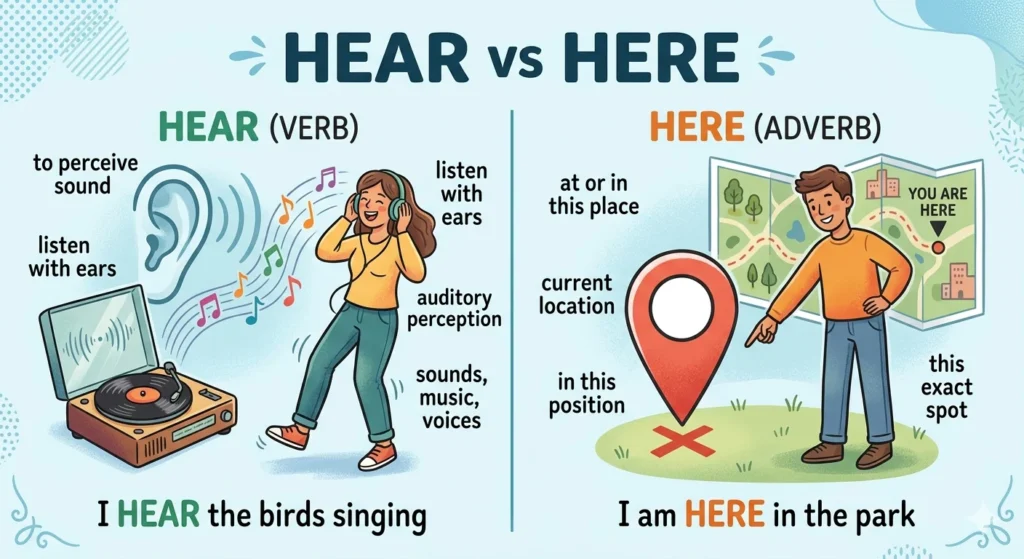
Here means in, at, or to this place.
Examples
- I can hear music from the next room.
- Please come here for a moment.
- Did you hear the news?
- Your package is here.
Quick Memory Trick
- Hear relates to your ears.
- Here relates to a place.
The Origin of Hear vs Here
The words hear and here come from different Old English roots.
Hear
The word hear comes from the Old English word hieran, meaning “to perceive sound” or “listen.”
Here
The word here comes from the Old English word her, meaning “in this place.”
Although the words developed from different origins, changes in English pronunciation over time caused them to sound alike. This is why they are considered hear here homophones today.
Why the Spelling Difference Exists
English spelling often preserves historical word origins. Even though hear and here sound the same, their spellings reflect their different meanings and histories.
British English vs American English Spelling
Unlike many English words, hear and here are spelled the same way in both British and American English.
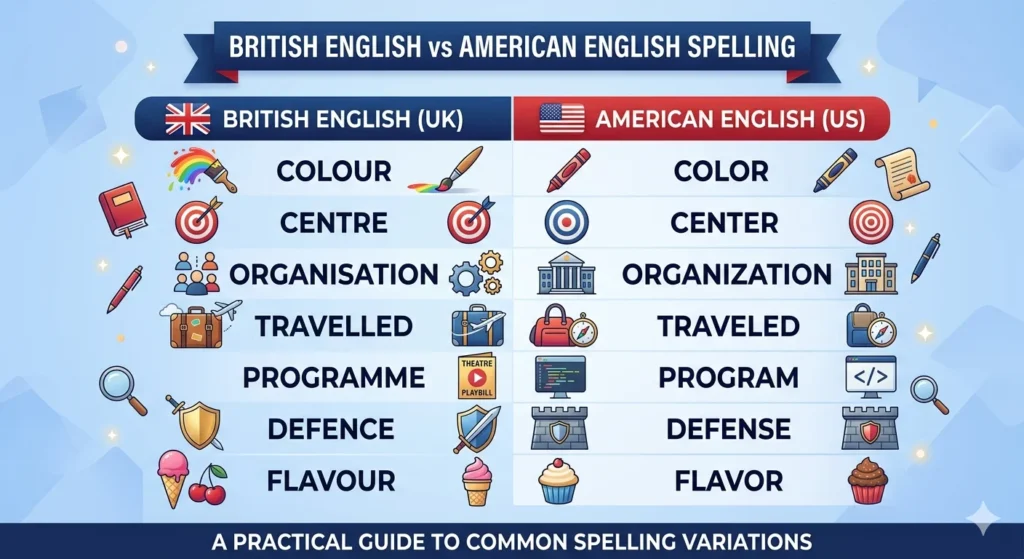
The main difference is not spelling but pronunciation accents.
Comparison Table
| Word | Meaning | British English | American English |
|---|---|---|---|
| Hear | To listen or perceive sound | Hear | Hear |
| Here | In this place | Here | Here |
Examples
| British Usage | American Usage |
|---|---|
| I can hear the train. | I can hear the train. |
| Come here, please. | Come here, please. |
| Did you hear that announcement? | Did you hear that announcement? |
| Your order is here. | Your order is here. |
The spelling remains identical in both regions.
Which Spelling Should You Use?
Choosing between hear and here depends entirely on the meaning you want.
Use “Hear” When:
- Talking about sound
- Listening to someone
- Receiving information through hearing
Examples:
- Can you hear me?
- I hear birds singing.
- We hear good things about your company.
Use “Here” When:
- Referring to a location
- Indicating presence
- Showing a position
Examples:
- Sit here.
- We are here today.
- Your documents are here.
Audience-Based Advice
| Audience | Recommended Usage |
|---|---|
| US Readers | Use hear and here based on meaning |
| UK Readers | Use hear and here based on meaning |
| Commonwealth Countries | Same usage rules |
| Global Audience | Focus on meaning, not location |
Common Mistakes with Hear vs Here
Many writers confuse these homophones because they sound alike.
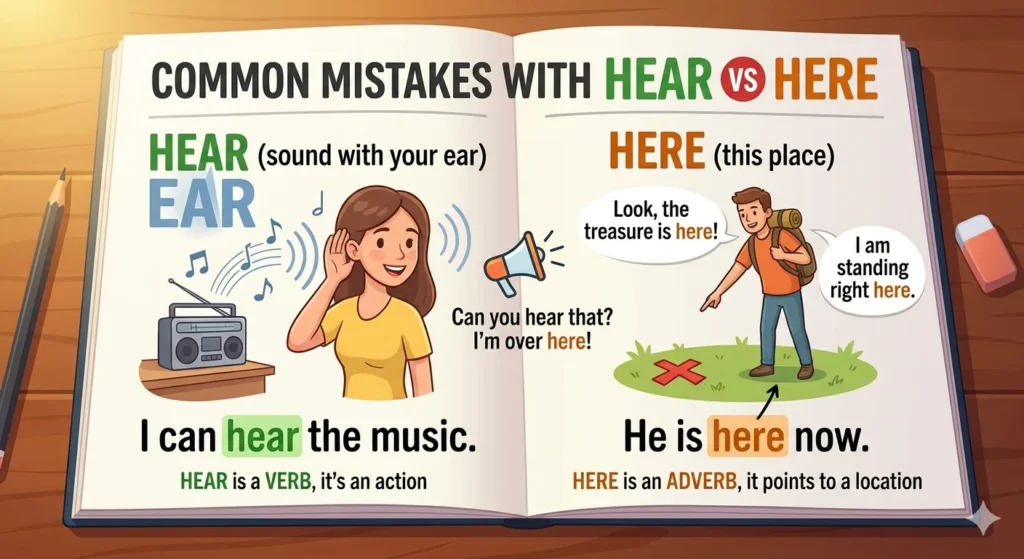
Mistake #1
❌ I can here the music.
✅ I can hear the music.
Mistake #2
❌ Please come hear.
✅ Please come here.
Mistake #3
❌ Did you here the news?
✅ Did you hear the news?
Mistake #4
❌ Your keys are hear.
✅ Your keys are here.
Correction Tip
Ask yourself:
- Are you talking about sound? → Use hear
- Are you talking about location? → Use here
Hear vs Here in Everyday Examples
Understanding hear vs here examples becomes easier when you see them in daily situations.
Emails
- I did not hear back from the client.
- The report is attached here.
News
- Citizens could hear the emergency sirens.
- Officials gathered here for the press conference.
Social Media
- Did you hear the latest update?
- Click here to learn more.
Formal Writing
- Participants could clearly hear the speaker.
- The required information is provided here.
Hear vs Here Sentences
- I can hear your voice.
- Please wait here.
- Did you hear the announcement?
- The answer is here on the page.
Hear vs Here – Google Trends & Usage Data
Search interest in hear vs here remains strong because these words are frequently confused.

Popular Search Queries
- When to use here or hear?
- How can I use hear?
- Hear and here meaning
- Hear vs here grammar
- Hear vs here examples
- Hear vs here pronunciation
- Hear vs here spelling difference
- Hear vs here worksheet
- Hear vs here quiz
Countries Where Searches Are Common
- United States
- United Kingdom
- Canada
- Australia
- India
These searches are especially popular among students, teachers, content writers, and English learners.
Hear vs Here Comparison Table
| Feature | Hear | Here |
|---|---|---|
| Part of Speech | Verb | Adverb |
| Meaning | Perceive sound | In this place |
| Related To | Hearing | Location |
| Pronunciation | Same as “here” | Same as “hear” |
| Example | I hear music. | Come here. |
| Common Error | Used instead of here | Used instead of hear |
Hear vs Here Pronunciation
One reason for confusion is that both words have identical pronunciation.
hear vs here pronunciation
Hear = /hɪr/
Here = /hɪr/
Many learners ask:
How do you pronounce “hear”?
It is pronounced exactly like here.
Because they sound the same, context is the only way to know which spelling is correct.
Hear Hear vs Here Here
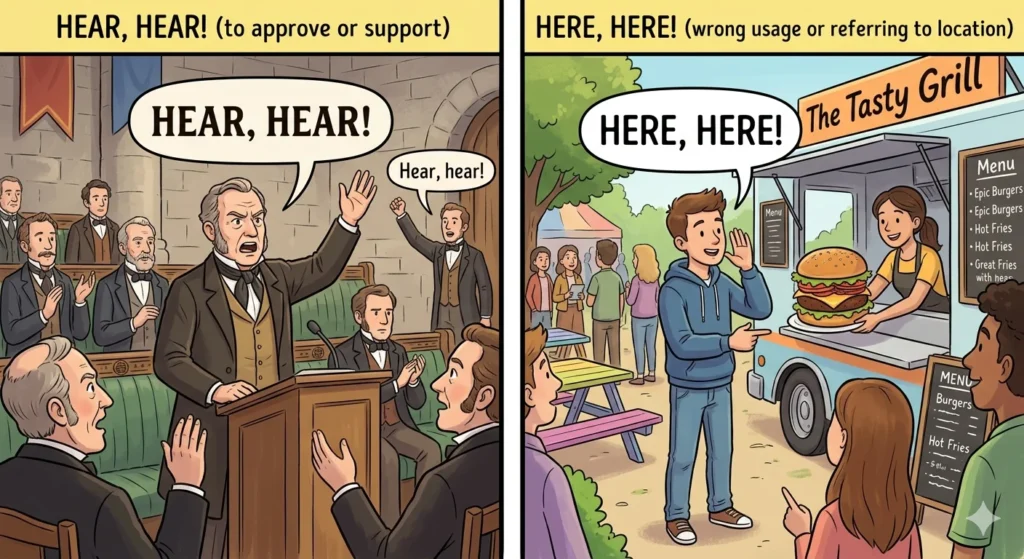
People often ask about hear hear vs here here.
Hear, Hear
“Hear, hear!” is a traditional expression used to show agreement with a speaker.
Example:
- “We should improve education.”
- “Hear, hear!”
Here, Here
“Here, here” is usually considered incorrect when someone means the expression “hear, hear.”
What is Correct: Here Here or Hear Hear?
✅ Correct: Hear, hear!
❌ Incorrect: Here, here!
Hear vs Here Grammar
Hear
Verb
Examples:
- I hear music.
- We hear the teacher speaking.
Here
Adverb
Examples:
- Stay here.
- Come here.
Understanding the grammar role helps avoid mistakes.
Hear vs Here Quiz
Choose the correct word.
1.
Can you ___ me?
Answer: hear
2.
Please sit ___.
Answer: here
3.
Did you ___ the announcement?
Answer: hear
4.
Your bag is ___.
Answer: here
5.
I can ___ birds singing.
Answer: hear
Hear vs Here Worksheet
Fill in the blanks:
- Come _____ and look at this.
- Can you _____ what she is saying?
- The package is _____.
- I could not _____ the speaker.
Answers
- here
- hear
- here
- hear
Frequently Asked Questions (FAQs)
1. What is the difference between hear and here?
Hear relates to sound, while here refers to a place or location.
2. When to use here or hear?
Use hear when talking about listening or sound. Use here when referring to a location.
3. How can I use hear?
You can use hear when someone listens to sounds, speech, music, or information.
Example:
- I hear the radio playing.
4. When to use “I hear you”?
“I hear you” means either:
- I can physically hear your voice.
- I understand what you are saying.
5. Are hear and here homophones?
Yes. Hear here homophones are words that sound alike but have different meanings and spellings.
6. What is correct: here here or hear hear?
The correct expression is hear, hear!
7. Why do people confuse hear and here?
Because they have identical pronunciation but different meanings and spellings.
Conclusion
Understanding hear vs here is simple once you remember the key difference. Hear relates to listening and sound, while here refers to a place or location. Even though the words sound exactly the same, their meanings are completely different.
Because hear and here are homophones, they are among the most commonly confused words in English. The easiest way to choose the correct spelling is to ask yourself whether you’re talking about sound or location. If the sentence involves listening, use hear. If it points to a place, use here.
Writers, students, and professionals can avoid mistakes by practicing with real examples, quizzes, and worksheets. Understanding hear vs here grammar, pronunciation, and everyday usage will help improve both writing accuracy and confidence.
Whether you’re sending emails, posting on social media, writing reports, or completing school assignments, using the correct word makes your message clearer and more professional. Remember: ears help you hear, and places are here.

“Margaret Oliphant, a witty wordsmith at PunsBlast, blending charm and clever humor to turn everyday moments into laugh-worthy puns.”