
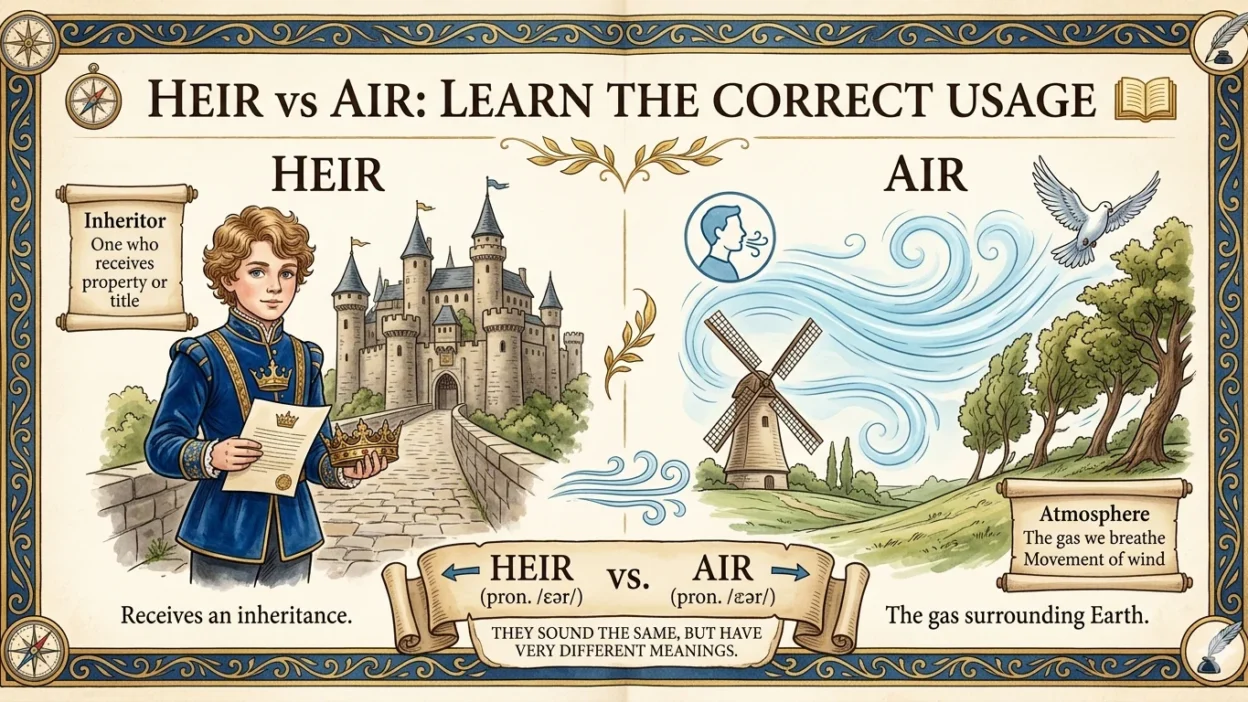
Many English learners and native speakers get confused by heir vs air because the two words sound exactly the same when spoken.
If you have ever wondered, “Is it air or heir?”, you are not alone. These words are classic examples of English homophones—words that share the same pronunciation but have different meanings and spellings.
The confusion becomes even greater in phrases like “air or heir of confidence”, “air or heir of superiority”, or “Is it air or heir of mystery?”.
Since both words sound alike, writers often choose the wrong spelling, especially when typing quickly.
This guide explains the difference between heir vs air meaning, their origins, pronunciation, usage, and common mistakes.
You will also learn when to use each word in formal writing, emails, social media posts, and everyday conversations.
By the end, you’ll know exactly what heir means, why heir vs air pronunciation sounds identical, and how to avoid making mistakes.
Heir vs Air means
The difference is simple:
| Word | Meaning | Example |
|---|---|---|
| Heir | A person who inherits money, property, or a title | She is the heir to the family fortune. |
| Air | The invisible mixture of gases around us, or a manner/appearance | The room needs fresh air. |
Examples
- Heir: The prince is the heir to the throne.
- Air: Open the window and let some fresh air in.
- Air: She had an air of confidence.
So if you are talking about inheritance, use heir. If you are talking about atmosphere, appearance, or attitude, use air.
The Origin of Heir vs Air
Understanding the history of these words helps explain why they sound alike.
Heir Meaning and Origin
The word heir comes from the Old French word heir and the Latin word heres, meaning “one who inherits.”
Over time, English kept the spelling but changed the pronunciation. The “h” became silent, which is why heir pronunciation sounds exactly like “air.”
Air Meaning and Origin
The word air comes from the Old French word air and the Latin word aer, meaning atmosphere or sky.
Unlike heir, the spelling remained closer to its pronunciation.
Why the Spelling Difference Exists
English borrowed both words from French and Latin. Although their spellings evolved differently, they eventually came to share the same pronunciation.
This is why air and heir homophones are common examples in English lessons.
British English vs American English Spelling
Unlike many English words, heir and air are spelled the same way in both British and American English.
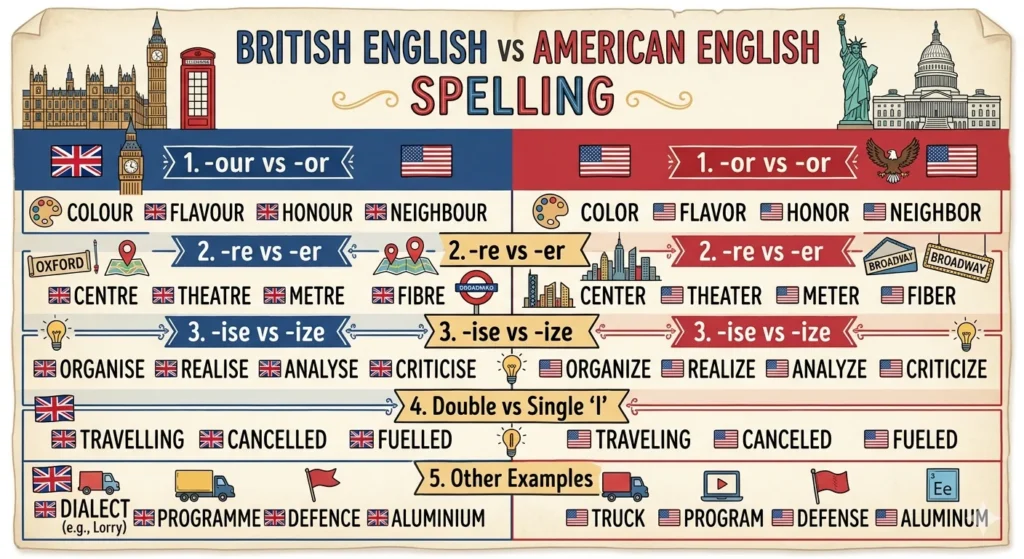
The difference is not regional spelling but meaning.
Comparison Table
| Feature | Heir | Air |
|---|---|---|
| Pronunciation | Air | Air |
| Meaning | Person who inherits | Atmosphere, attitude, appearance |
| Part of Speech | Noun | Noun |
| British English | Heir | Air |
| American English | Heir | Air |
| Common Phrase | Heir to the throne | Air of confidence |
Examples
British English
- William was once an heir to the throne.
American English
- She became the heir to her father’s estate.
Both
- There was fresh air in the garden.
Which Spelling Should You Use?
Choose the spelling based on meaning.
Use “Heir” When:
- Talking about inheritance
- Referring to family wealth
- Discussing titles or kingdoms
- Naming a successor
Examples:
- The heir inherited the company.
- She is the heir to a large estate.
Use “Air” When:
- Talking about the atmosphere
- Referring to breathing
- Describing appearance or attitude
Examples:
- The mountain air felt clean.
- He walked with an air of confidence.
Audience-Based Advice
| Audience | Recommended Usage |
|---|---|
| United States | Use standard meanings of heir and air |
| United Kingdom | Same usage rules |
| Australia | Same usage rules |
| Canada | Same usage rules |
| Global Audience | Follow meaning, not pronunciation |
Common Mistakes with Heir vs Air
Many writers make these mistakes:
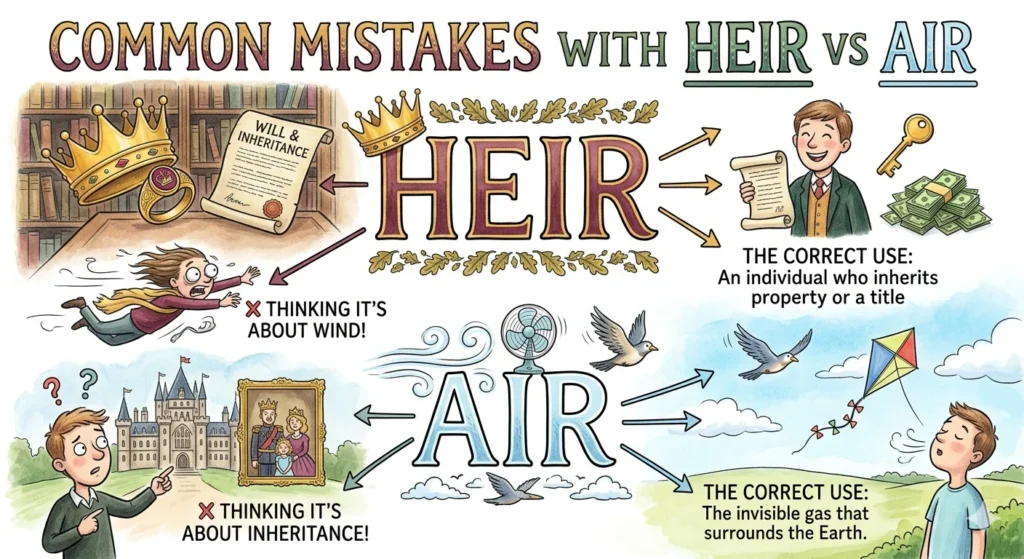
Incorrect:
❌ She is the air to the family fortune.
Correct:
✅ She is the heir to the family fortune.
Incorrect:
❌ He is the heir of confidence.
Correct:
✅ He has an air of confidence.
Incorrect:
❌ The king’s air will become ruler.
Correct:
✅ The king’s heir will become ruler.
Incorrect:
❌ Fresh heir entered the room.
Correct:
✅ Fresh air entered the room.
Heir vs Air in Everyday Examples
Emails
Correct:
John is the heir to the company and will take over next year.
The office needs more fresh air.
News Writing
The young prince is the heir to the throne.
Air pollution levels increased this month.
Social Media
She carries an air of confidence wherever she goes.
The billionaire’s heir attended the event.
Formal Writing
The heir received ownership of the estate.
The speaker maintained an air of professionalism.
Heir vs Air Pronunciation
One reason for confusion is that heir vs air pronunciation is identical.
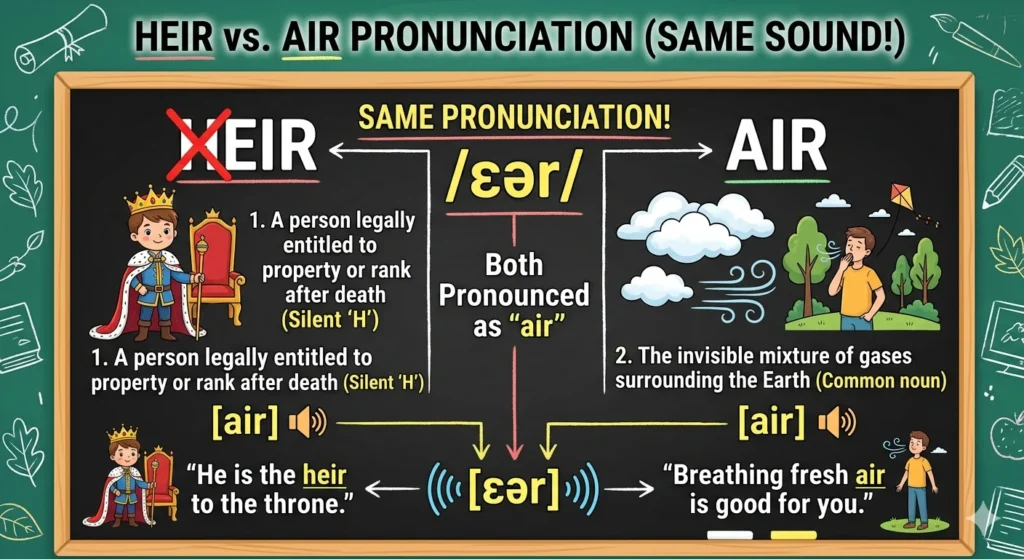
Pronunciation Guide
| Word | Pronunciation |
|---|---|
| Heir | /er/ |
| Air | /er/ |
Does Heir Sound Like Air?
Yes.
Does heir sound like air? Absolutely. Both words are pronounced exactly the same in modern English.
This makes them perfect examples of homophones.
Air Heir Homophones Sentences
- The heir inherited a castle.
- Fresh air filled the castle.
- The heir arrived at the ceremony.
- The cool air felt refreshing.
These examples show how context determines meaning.
Heir vs Air Meaning
A quick reminder:
| Word | Meaning |
|---|---|
| Heir | A person who inherits something |
| Air | Atmosphere, appearance, attitude |
What Does “Heir” Mean?
Heir meaning: a person legally entitled to receive property, money, a title, or a position after someone’s death.
Example:
She is the sole heir to the estate.
Is It Air or Heir of Mystery?
The correct phrase is:
✅ Air of mystery
Why?
Because the phrase refers to an appearance, feeling, or impression—not inheritance.
Examples:
- She had an air of mystery.
- The actor maintained an air of secrecy.
Air or Heir of Superiority
The correct phrase is:

✅ Air of superiority
This phrase means someone appears to think they are better than others.
Example:
He spoke with an air of superiority.
Using heir of superiority would be incorrect.
Heir or Air of Confidence
The correct phrase is:
✅ Air of confidence
Example:
The speaker entered the room with an air of confidence.
Since the phrase describes attitude and appearance, air is the correct choice.
Heir vs Air – Google Trends & Usage Data
Search data shows that people often search:

- heir vs air
- heir vs air pronunciation
- what does heir mean
- is it air or heir
- does heir sound like air
- air or heir of confidence
- air or heir of superiority
Countries with High Interest
- United States
- United Kingdom
- Canada
- Australia
- India
The confusion usually comes from pronunciation because both words sound identical despite having different meanings.
Usage Context
| Context | More Common Word |
|---|---|
| Inheritance | Heir |
| Royal Families | Heir |
| Atmosphere | Air |
| Weather | Air |
| Attitude | Air |
| Personality Description | Air |
FAQs
1. Is it air or heir?
It depends on meaning. Use heir for inheritance and air for atmosphere or appearance.
2. Does heir sound like air?
Yes. Both words have the same pronunciation.
3. What does “heir” mean?
An heir is a person who inherits property, money, a title, or a position.
4. Is it air or heir of mystery?
The correct phrase is air of mystery.
5. What is the difference between heir and air?
Heir refers to inheritance. Air refers to atmosphere, attitude, or appearance.
6. Are air and heir homophones?
Yes. Air and heir are homophones because they sound the same but have different meanings.
7. Is it heir or air of confidence?
The correct phrase is air of confidence.
Conclusion
Understanding heir vs air is easier once you remember their meanings. Although the words sound exactly the same, they serve very different purposes. Heir refers to someone who inherits property, wealth, titles, or responsibilities. Air, on the other hand, refers to the atmosphere around us or the appearance, attitude, and impression someone gives.
The reason people often search “Is it air or heir?” or “Does heir sound like air?” is because both words share the same pronunciation. This makes them classic English homophones. When writing, focus on the meaning rather than the sound. If inheritance is involved, choose heir. If you are describing confidence, mystery, superiority, atmosphere, or appearance, choose air.
Remember common expressions such as air of confidence, air of mystery, and air of superiority. These always use air, never heir. By understanding the context, you can confidently choose the correct word every time and avoid one of the most common homophone mistakes in English.

“Sylvia Townsend, a witty humorist at PunsBlast, crafting clever puns and playful wordplay that bring smiles to readers everywhere.”