Have you ever wondered whether to write idle or idol? These two words sound exactly alike, which makes them easy to confuse.
Many people search for idle vs idol because they want to know which spelling is correct in a sentence. Others ask questions like What’s the meaning of idle?, What is idol meaning?, Is it ideal or idol?, or even Is it i dle or gi dle?
The confusion happens because idle and idol are homophones. Homophones are words that sound the same but have different meanings and spellings. Using the wrong one can change the meaning of your sentence completely.
For example, saying “He sat idle all day” means he did nothing. But saying “He is my idol” means he is someone you admire. One small spelling change creates a very different message.
In this guide, you’ll learn the meanings, origins, pronunciation, usage examples, common mistakes, and professional advice on when to use each word correctly.
Idle vs Idol means
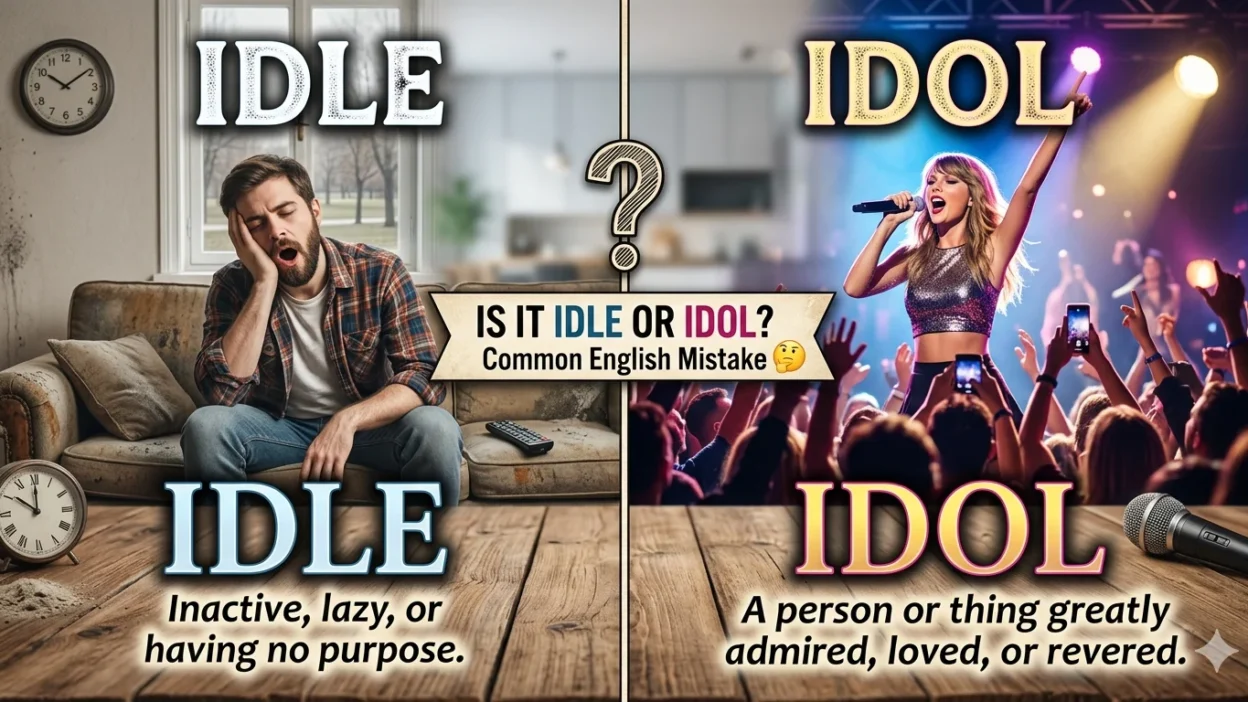
The difference between idle and idol is simple:
| Word | Meaning | Example |
|---|---|---|
| Idle | Not active, not working, doing nothing | The machine remained idle all day. |
| Idol | A person or thing greatly admired | She is my favorite idol. |
Quick Examples
- The workers were idle during the power outage.
- The singer became a national idol.
- My car engine was left idle.
- The athlete is an idol for many young fans.
Idle vs Idol Meaning
- Idle meaning: inactive, unused, lazy, or not working.
- Idol meaning: a person, celebrity, object, or image that people admire or worship.
The Origin of Idle vs Idol
Although they sound alike, these words come from different origins.
Origin of Idle
The word idle comes from Old English idel, meaning empty, useless, or inactive. Over time, it became associated with being inactive or not working.
Origin of Idol
The word idol comes from Greek eidolon, meaning image, figure, or representation. Later, it came to mean a person who is greatly admired or worshipped.
Why the Spelling Difference Exists
English borrowed these words from different languages. Even though they developed similar pronunciations, their spellings remained different because they have separate histories and meanings.
British English vs American English Spelling
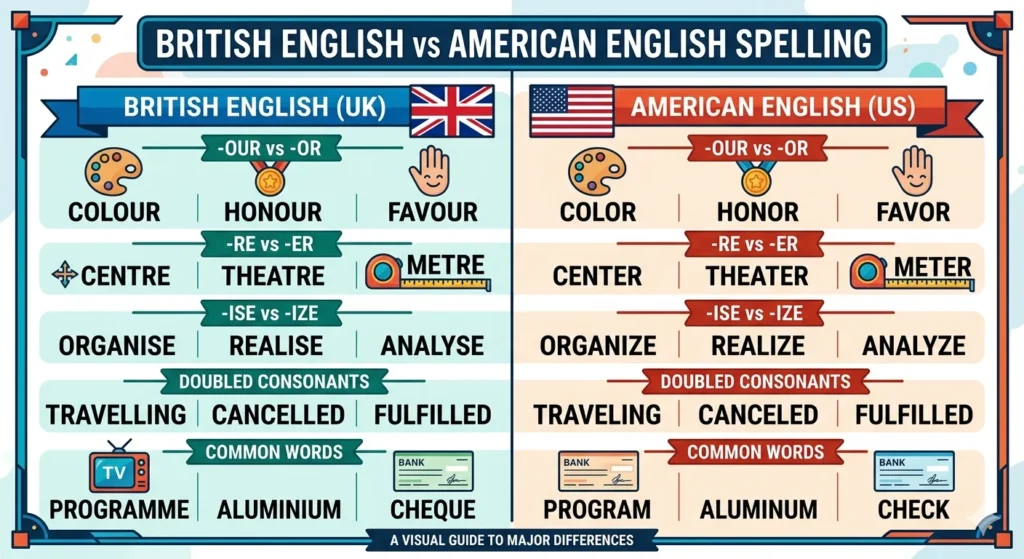
Unlike many English words, idle and idol have the same spelling in both British and American English.
Comparison Table
| Feature | British English | American English |
|---|---|---|
| Idle | Idle | Idle |
| Idol | Idol | Idol |
| Pronunciation | Same | Same |
| Meaning | Same | Same |
Examples
British English:
- The factory stood idle for months.
- The musician became a teenage idol.
American English:
- The engine was left idle.
- He is a sports idol.
There is no spelling difference between the two versions of English.
Which Spelling Should You Use?
The correct spelling depends on the meaning you want.
Use “Idle” When:
- Talking about inactivity.
- Describing something not working.
- Referring to unused time.
Examples:
- The workers were idle.
- The machine remained idle.
- He spent an idle afternoon reading.
Use “Idol” When:
- Talking about admiration.
- Referring to a celebrity or hero.
- Describing someone people look up to.
Examples:
- She is my idol.
- The actor became a global idol.
- The athlete is an idol for young fans.
Advice by Audience
| Audience | Recommended Usage |
|---|---|
| US readers | Use the word based on meaning |
| UK readers | Use the word based on meaning |
| Commonwealth countries | Use the word based on meaning |
| Global audience | Use the word that matches the intended meaning |
Common Mistakes with Idle vs Idol
Many people accidentally use the wrong spelling.
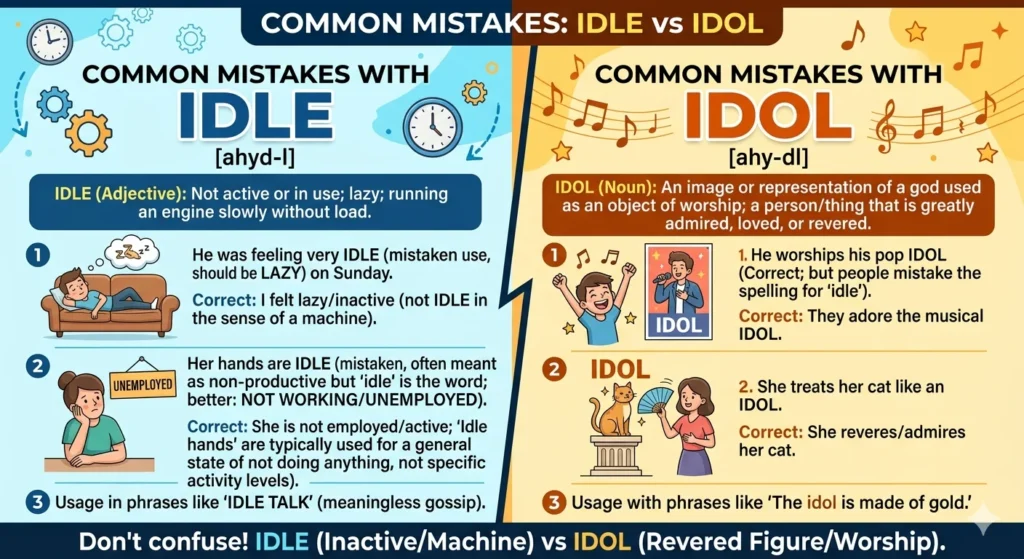
Mistake 1
❌ He is my idle.
✔ He is my idol.
Reason: A person you admire is an idol.
Mistake 2
❌ The car stayed idol for an hour.
✔ The car stayed idle for an hour.
Reason: The car was inactive.
Mistake 3
❌ You are my idle meaning.
✔ You are my idol.
Reason: The phrase means you admire someone.
Mistake 4
❌ The workers were idol all morning.
✔ The workers were idle all morning.
Reason: The workers were inactive, not admired.
Idle vs Idol in Everyday Examples
In Emails
Idle
The equipment remained idle due to maintenance.
Idol
You have been my professional idol for years.
In News Articles
Idle
Hundreds of trucks remained idle during the strike.
Idol
The singer continues to be a youth idol.
On Social Media
Idle
Sitting idle at home today.
Idol
My favorite idol released a new song!
In Formal Writing
Idle
The organization sought to reduce idle resources.
Idol
The author became a literary idol for many readers.
Idle Pronunciation and Meaning

Idle Pronunciation
Idle is pronounced:
/ˈaɪ.dəl/
It sounds like:
EYE-duhl
Idle Meaning
The word means:
- Not active
- Not working
- Unused
- Doing nothing
Examples:
- An idle machine
- Idle workers
- Idle time
Idle vs Idol Pronunciation
Interestingly, idle vs idol pronunciation is exactly the same.
| Word | Pronunciation |
|---|---|
| Idle | /ˈaɪ.dəl/ |
| Idol | /ˈaɪ.dəl/ |
Because they sound identical, context is the only way to know which word is intended.
Idle vs Idol Meaning in Urdu
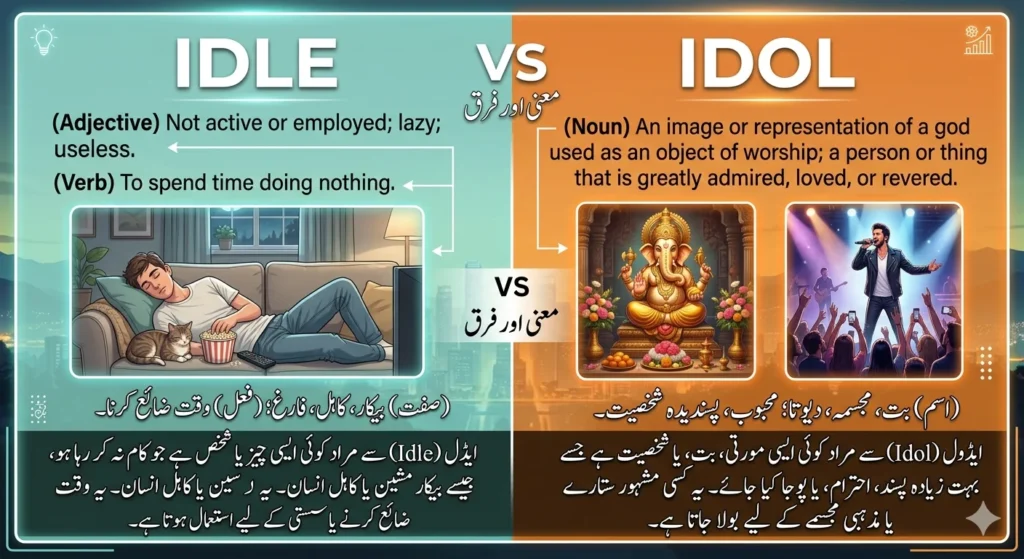
Idle Meaning in Urdu
Idle = بےکار، غیر فعال، فارغ
Examples:
- The machine is idle.
- مشین غیر فعال ہے۔
Idol Meaning in Urdu
Idol = بت، محبوب شخصیت، آئیڈیل شخصیت
Examples:
- He is my idol.
- وہ میری پسندیدہ شخصیت ہے۔
Idle vs Idol in Urdu
| English Word | Urdu Meaning |
|---|---|
| Idle | بےکار، غیر فعال |
| Idol | بت، قابلِ تعریف شخصیت |
Idle vs Idol – Google Trends & Usage Data
Search interest shows that people often look for:
- idle vs idol
- idle vs idol meaning
- idle vs idol pronunciation
- idle vs idol examples
- idle meaning
- what is idol meaning
Popular Contexts
Idle
Commonly used in:
- Business
- Manufacturing
- Vehicles
- Technology
- Employment discussions
Idol
Commonly used in:
- Entertainment
- Sports
- Religion
- Social media
- Celebrity culture
Countries with High Interest
The terms are frequently searched in:
- United States
- United Kingdom
- India
- Pakistan
- Canada
- Australia
Many searches come from learners trying to understand homophones in English.
Comparison Table: Idle vs Idol
| Feature | Idle | Idol |
|---|---|---|
| Part of Speech | Adjective/Verb | Noun |
| Meaning | Inactive, not working | Person or thing admired |
| Pronunciation | /ˈaɪ.dəl/ | /ˈaɪ.dəl/ |
| Urdu Meaning | بےکار، غیر فعال | بت، محبوب شخصیت |
| Example | The machine is idle. | She is my idol. |
| Related Topic | Work, activity | Admiration, fame |
FAQs
1. What’s the meaning of idle?
Idle means inactive, not working, unused, or doing nothing.
2. What is idol meaning?
An idol is a person, object, or figure that is admired, loved, or worshipped.
3. Is it ideal or idol?
Use idol when talking about someone you admire. Use ideal when talking about something perfect or most suitable.
Example:
- She is my idol.
- This is the ideal solution.
4. Is idle and idol pronounced the same?
Yes. Both words are pronounced /ˈaɪ.dəl/.
5. What does “You are my idol” mean?
It means you are someone I admire and look up to.
6. What does idle time mean?
Idle time refers to periods when a person, machine, or resource is not being used.
7. Can idle and idol be used interchangeably?
No. They have completely different meanings and should never be substituted for each other.
Conclusion
Understanding idle vs idol is easier once you know their meanings. Although the two words share the same pronunciation, they serve very different purposes in English. Idle refers to being inactive, unused, or not working, while idol refers to a person or thing that is admired or worshipped.
Many learners confuse these words because they are homophones. This often leads to mistakes in writing, emails, social media posts, and professional communication. A simple way to remember the difference is that idle relates to inactivity, while idol relates to admiration.
If you’re talking about a machine, worker, vehicle, or time that is not being used, choose idle. If you’re describing a celebrity, athlete, role model, or someone you admire, choose idol.
By understanding the meanings, pronunciation, Urdu translations, and real-world examples, you can confidently use the correct spelling every time. Whether you write for work, school, or online content, mastering idle vs idol will help you communicate more clearly and professionally.

“Margaret Oliphant, a witty wordsmith at PunsBlast, blending charm and clever humor to turn everyday moments into laugh-worthy puns.”