Have you ever stopped while writing and wondered whether to use lay vs lie? You are not alone.
Many English speakers struggle with these two verbs because they sound similar but have different meanings and grammar rules.
Questions like “Do you lie in bed or lay in bed?”, “Is the cat lying or laying?”, and “Do you lay or lie on the couch?” are searched thousands of times online.
The confusion gets even bigger when past tense forms such as lie lay lain and lay vs laid enter the picture.
This guide explains the lay vs lie grammar difference in simple words. You’ll learn the meanings, tenses, common mistakes, and real-life examples.
We will also cover lay vs lie past tense, compare British and American usage, and provide an easy lay vs lie chart to help you remember the rules.
By the end of this article, you’ll know exactly when to use lay vs lie and avoid one of the most common grammar mistakes in English.
Lay vs Lie means
The difference is simple:
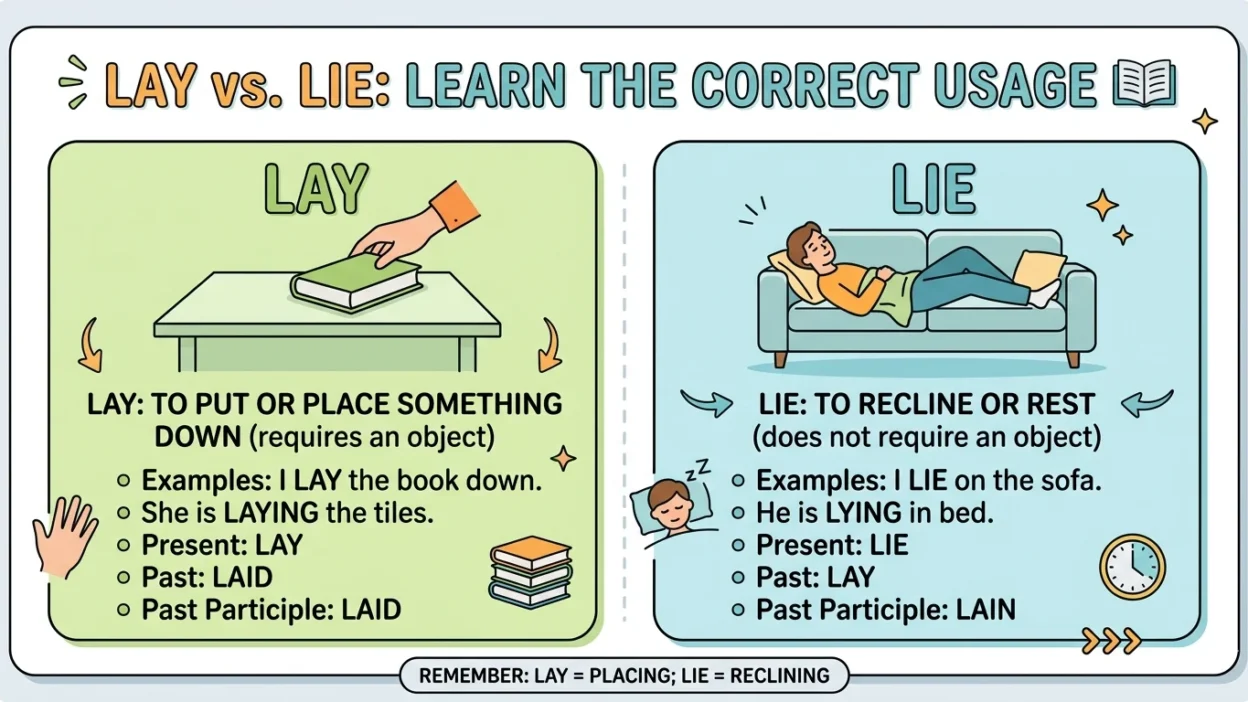
- Lie means to rest or recline.
- Lay means to put or place something down.
Examples
✅ I lie on the couch every evening.
✅ Please lay the book on the table.
Think of it this way:
- If there is no object, use lie.
- If there is an object being placed somewhere, use lay.
Quick Comparison
| Verb | Meaning | Example |
|---|---|---|
| Lie | To recline or rest | I lie down after work. |
| Lay | To place something down | I lay the keys on the desk. |
This is the basic rule behind lay vs lie grammar.
The Origin of Lay vs Lie
The confusion around lay vs lie meaning goes back hundreds of years.
The word lie comes from the Old English word licgan, meaning “to recline” or “be in a resting position.”
The word lay comes from the Old English word lecgan, meaning “to put” or “place.”
Over time, English changed, but the two verbs stayed very similar in spelling and pronunciation.
The biggest source of confusion is that the past tense of lie down is lay.
Example
Present: I lie down.
Past: Yesterday I lay down.
This makes many people mix up lay vs lie past tense forms.
British English vs American English Spelling
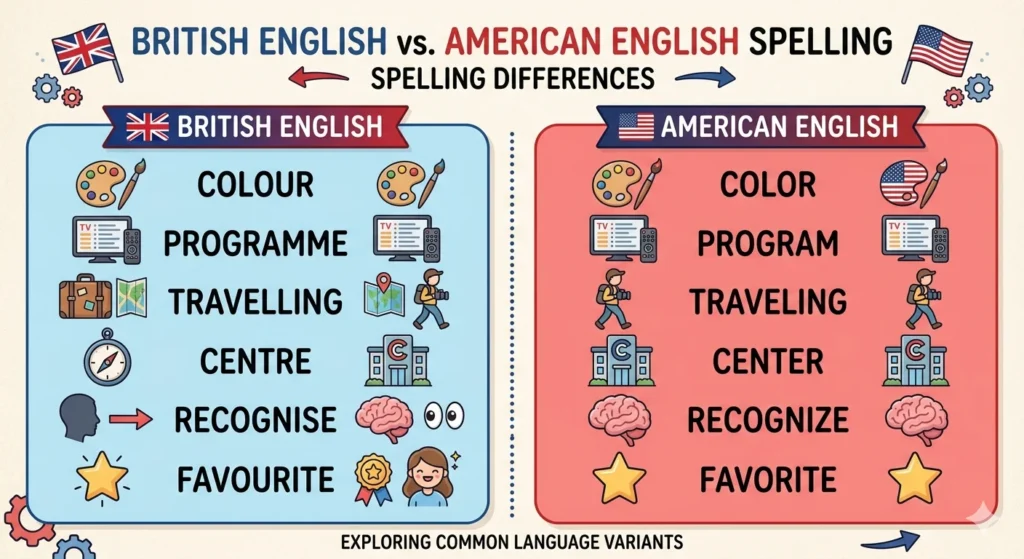
Unlike words such as color/colour or organize/organise, lay vs lie is not mainly a spelling difference between British and American English.
The grammar rules are the same in both regions.
Examples
American English:
- I lie down after lunch.
- She laid the blanket on the bed.
British English:
- I lie down after lunch.
- She laid the blanket on the bed.
Comparison Table
| Usage | American English | British English |
|---|---|---|
| Present tense | Lie down | Lie down |
| Past tense of lie | Lay down | Lay down |
| Present tense | Lay the book down | Lay the book down |
| Past tense of lay | Laid the book down | Laid the book down |
The rules remain the same across both versions of English.
Which Spelling Should You Use?
Since lay vs lie is a grammar issue rather than a spelling issue, your choice depends on meaning.
For US Audiences
Use:
- Lie = recline
- Lay = place something
For UK and Commonwealth Audiences
Use the same rule:
- Lie = rest
- Lay = put
For Global Audiences
Follow standard grammar:
- Lie when no object follows.
- Lay when an object follows.
This is the safest choice for blogs, business writing, emails, and academic work.
Common Mistakes with Lay vs Lie
Many people make the same mistakes repeatedly.
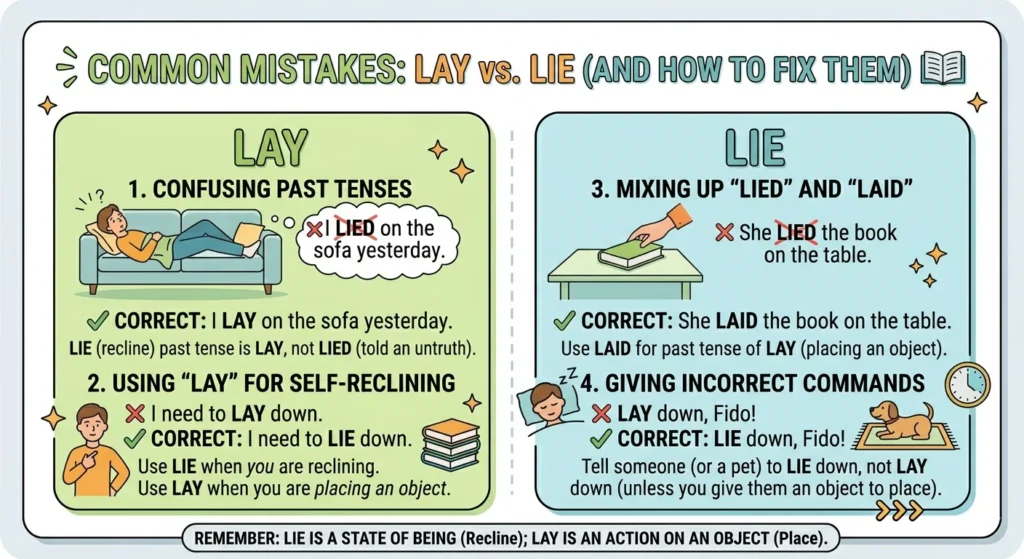
Mistake #1
❌ I am laying on the couch.
✅ I am lying on the couch.
Mistake #2
❌ Yesterday I laid down for an hour.
✅ Yesterday I lay down for an hour.
Mistake #3
❌ Please lie the book on the table.
✅ Please lay the book on the table.
Mistake #4
❌ Is it lay with me or lie with me?
✅ It is lie with me.
Mistake #5
❌ The cat is laying on the rug.
✅ The cat is lying on the rug.
This answers the common question:
Is the cat lying or laying?
If the cat is resting, it is lying.
Lay vs Lie in Everyday Examples
Understanding real situations makes grammar easier.
Email Example
✅ Please lay the documents on my desk before leaving.
News Example
✅ The injured player lay on the field for several minutes.
Social Media Example
✅ I’m going to lie in bed all day and watch movies.
Formal Writing Example
✅ Researchers laid the samples on a sterile surface.
Everyday Questions
Do you lie in bed or lay in bed?
Present tense:
✅ I lie in bed.
Past tense:
✅ Yesterday I lay in bed.
Do you lay or lie on the couch?
✅ I lie on the couch.
Is it lay with me or lie with me?
✅ Lie with me.
Lay vs Lie – Google Trends & Usage Data
Search interest for lay vs lie remains high because English learners and native speakers often struggle with the grammar.

Countries with strong interest include:
- United States
- United Kingdom
- Canada
- Australia
- India
The most searched questions include:
- Do you lie in bed or lay in bed?
- Lay vs laid
- Lie past tense
- Past tense of lie down
- Lay vs lie grammar quiz
- Lay vs lie verb
- Lay vs lie examples
Educational websites, grammar blogs, and writing guides continue to publish content explaining this topic because confusion remains widespread.
Lay vs Lie Chart
This easy lay vs lie chart can help you remember the forms.
| Tense | Lie (Recline) | Lay (Place) |
|---|---|---|
| Present | Lie | Lay |
| Past | Lay | Laid |
| Past Participle | Lain | Laid |
| Present Participle | Lying | Laying |
Lie vs Lie
Sometimes people search lie vs lie because the word “lie” has two meanings:
- Lie = recline
- Lie = tell an untruth
Examples:
- I lie down every afternoon.
- Never lie to your friends.
Lay vs Lie vs Laid
| Word | Meaning |
|---|---|
| Lie | Recline |
| Lay | Place something |
| Laid | Past tense of lay |
Examples:
- I lie down.
- I lay the book down.
- Yesterday I laid the book down.
Lay vs Lie vs Laid vs Lain
| Word | Function |
|---|---|
| Lie | Present tense |
| Lay | Past tense of lie OR present tense of lay |
| Laid | Past tense of lay |
| Lain | Past participle of lie |
Example:
- I have lain in bed all morning.
- She has laid the keys on the table.
Lay vs Lie Sentences
Lie Examples
- I lie on the sofa after dinner.
- They lie in the sun.
- We lie down when tired.
Lay Examples
- Lay the phone on the desk.
- Please lay the cards face down.
- Farmers lay seed in prepared soil.
These are simple lay vs lie examples you can copy and practice.
Lay vs Lie Practice
Choose the correct word:
- I want to ___ down.
- Please ___ the towel on the chair.
- Yesterday I ___ down for two hours.
- She has ___ in bed all morning.
Answers
- Lie
- Lay
- Lay
- Lain
This mini lay vs lie quiz helps reinforce the rules.
FAQs
1. What is the difference between lay vs lie?
Lie means to recline or rest. Lay means to place something down.
2. What is the past tense of lie?
The lie past tense is lay.
Example: Yesterday I lay down.
3. What is the past tense of lay?
The past tense of lay is laid.
Example: She laid the book on the table.
4. Do you lie in bed or lay in bed?
Use lie in the present tense.
Example: I lie in bed.
5. Is the cat lying or laying?
If the cat is resting, it is lying.
6. What is the difference between lay vs laid?
Lay is present tense. Laid is past tense.
Example:
- I lay the blanket down.
- Yesterday I laid the blanket down.
7. How can I remember when to use lay vs lie?
Remember:
- Lie = rest.
- Lay = place.
If there is an object, use lay.
Conclusion
The debate over lay vs lie confuses many English speakers, but the rule becomes easy once you understand the difference. Lie means to recline, rest, or be in a horizontal position. Lay means to put or place something somewhere. The biggest challenge comes from verb tenses because the past tense of lie is lay, while the past tense of lay is laid.
When deciding when to use lay vs lie, look for an object. If something is being placed, use lay. If someone is simply resting, use lie. Remember the important forms: lie, lay, lain and lay, laid, laid. Keeping this pattern in mind will help you avoid common grammar mistakes.
Whether you’re writing emails, blog posts, academic papers, or social media updates, using the correct verb improves clarity and professionalism. Review the lay vs lie chart, practice the examples, and take a quick lay vs lie grammar quiz whenever you need a refresher. With a little practice, choosing between lay vs lie will become second nature.

“M.R. James, a playful storyteller at PunsBlast, crafting sharp puns and clever humor that turn everyday words into unforgettable laughs.”