Have you ever typed hole vs whole into Google because you were unsure which word to use? You are not alone.
These two words sound exactly the same, but they have very different meanings. Because they are homophones, many people confuse them in writing.
A small spelling mistake can change the meaning of an entire sentence. For example, “I worked the whole day” means all day, while “I worked the hole day” is incorrect.
This confusion often appears in school assignments, emails, social media posts, and even professional writing.
In this guide, you will learn the difference between hole vs whole meaning, pronunciation, grammar, spelling, and usage.
We will also cover common mistakes, examples from everyday life, and tips for choosing the correct word every time. Whether you are a student, writer, teacher, or English learner, this article will help you understand these commonly confused words clearly and confidently.
Hole vs Whole means
The difference between hole vs whole is simple:
- Hole = an opening, gap, or empty space.
- Whole = complete, entire, or all of something.
Examples
- There is a hole in my shirt.
- She dug a hole in the garden.
- I spent the whole day reading.
- He ate the whole pizza.
Quick Comparison
| Word | Meaning | Example |
|---|---|---|
| Hole | An opening or gap | The dog dug a hole. |
| Whole | Complete or entire | I watched the whole movie. |
The Origin of Hole vs Whole
Understanding the history of these words makes them easier to remember.
Hole
The word hole comes from Old English hol, meaning a hollow place, cavity, or opening. For centuries, it has been used to describe empty spaces in objects, land, or surfaces.
Whole
The word whole comes from Old English hal, meaning complete, healthy, or unbroken. It is related to words such as “health” and “heal.”
Why Are They Spelled Differently?
Although they sound alike today, they developed from different roots. Over time, English pronunciation changed, but the spellings remained. This is why hole vs whole pronunciation is identical even though the words have different meanings.
British English vs American English Spelling
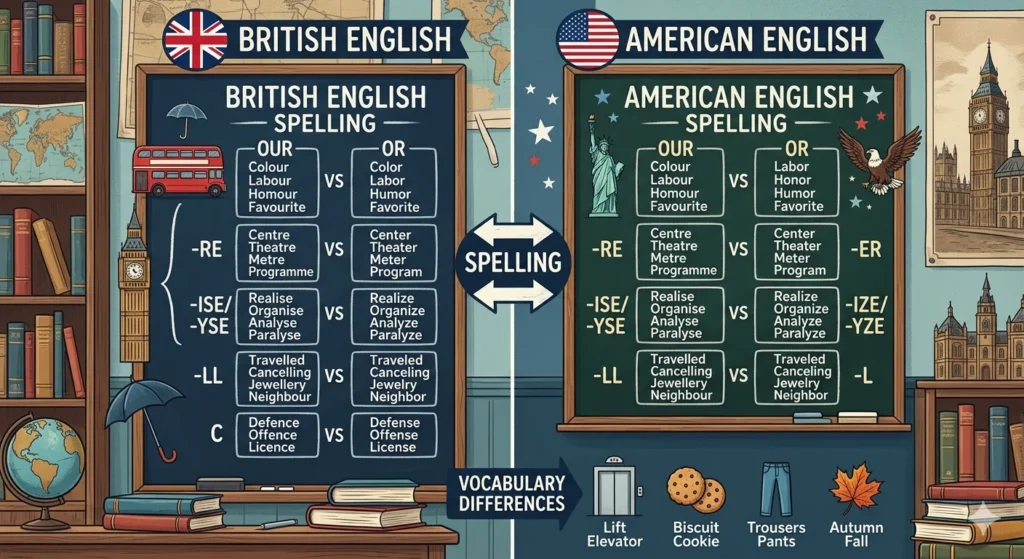
Unlike many English words, hole and whole have the same spelling in both British and American English.
Examples
| British English | American English | Meaning |
|---|---|---|
| hole | hole | Opening or gap |
| whole | whole | Entire or complete |
There is no spelling difference between regions. The only challenge is choosing the correct word based on meaning.
Comparison Table
| Feature | Hole | Whole |
|---|---|---|
| Part of Speech | Noun | Adjective, Noun |
| Meaning | Gap, opening | Complete, entire |
| Pronunciation | /hoʊl/ | /hoʊl/ |
| Homophone | Yes | Yes |
| Common Mistake | Used instead of whole | Used instead of hole |
Which Spelling Should You Use?
Choose the word based on meaning, not location.
Use “Hole” When:
- Talking about an opening.
- Referring to a gap.
- Describing a hollow space.
Examples:
- The mouse escaped through a hole.
- There is a hole in the wall.
Use “Whole” When:
- Talking about everything.
- Referring to a complete amount.
- Meaning entire or full.
Examples:
- I stayed home the whole weekend.
- She read the whole book.
Audience-Based Advice
| Audience | Recommended Usage |
|---|---|
| United States | Use hole and whole according to meaning |
| United Kingdom | Use hole and whole according to meaning |
| Australia | Use hole and whole according to meaning |
| Canada | Use hole and whole according to meaning |
| Global Audience | Follow the meaning of each word |
Common Mistakes with Hole vs Whole
Many learners make these mistakes because the words sound identical.
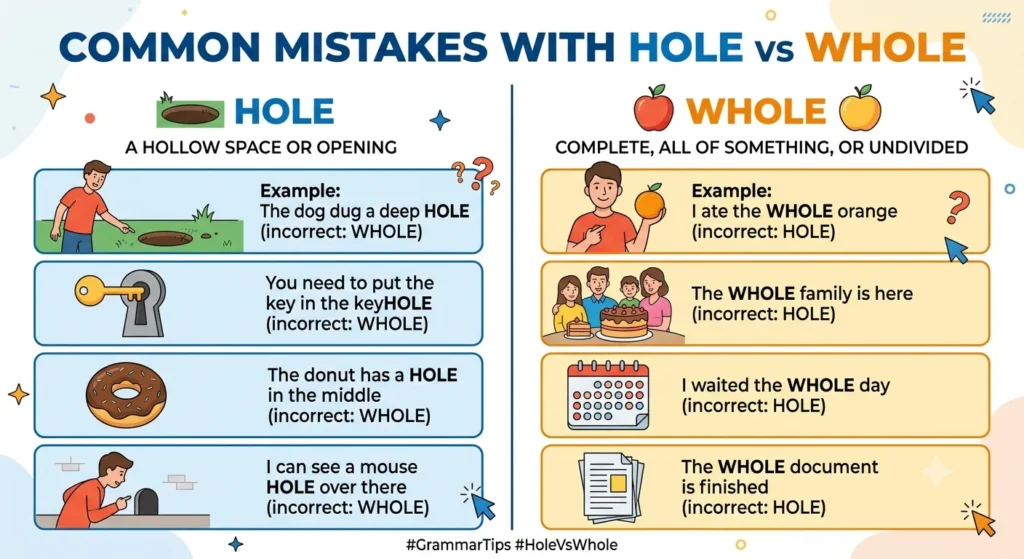
Incorrect:
❌ I worked the hole day.
Correct:
✅ I worked the whole day.
Incorrect:
❌ There is a whole in my sock.
Correct:
✅ There is a hole in my sock.
Incorrect:
❌ Is it hole time or whole time?
Correct:
✅ It is whole time when you mean “entire time.”
Common Questions
Is it whole day or hole day?
✅ Correct: whole day
Is it hole time or whole time?
✅ Correct: whole time
Hole vs Whole in Everyday Examples
Emails
- I was busy the whole day.
- Please repair the hole in the fence.
News Writing
- A large hole appeared in the road after heavy rain.
- The whole community joined the event.
Social Media
- I watched the whole series in one weekend!
- My dog dug a huge hole in the backyard.
Formal Writing
- The researchers studied the whole population.
- The construction team filled the hole safely.
Hole vs Whole Examples
- The rabbit jumped into a hole.
- I spent the whole afternoon studying.
- A hole appeared in the roof.
- She cleaned the whole house.
Whole and Hole Homophones Sentences
These words are examples of whole homophones.
- The golfer hit the ball into the hole.
- The golfer played the whole course.
- There is a hole in my pocket.
- I wore the jacket for the whole winter.
Whole and Hole in a Sentence Brainly Style Examples
- The child dug a hole in the sand.
- We spent the whole day at the beach.
Hole vs Whole Pronunciation
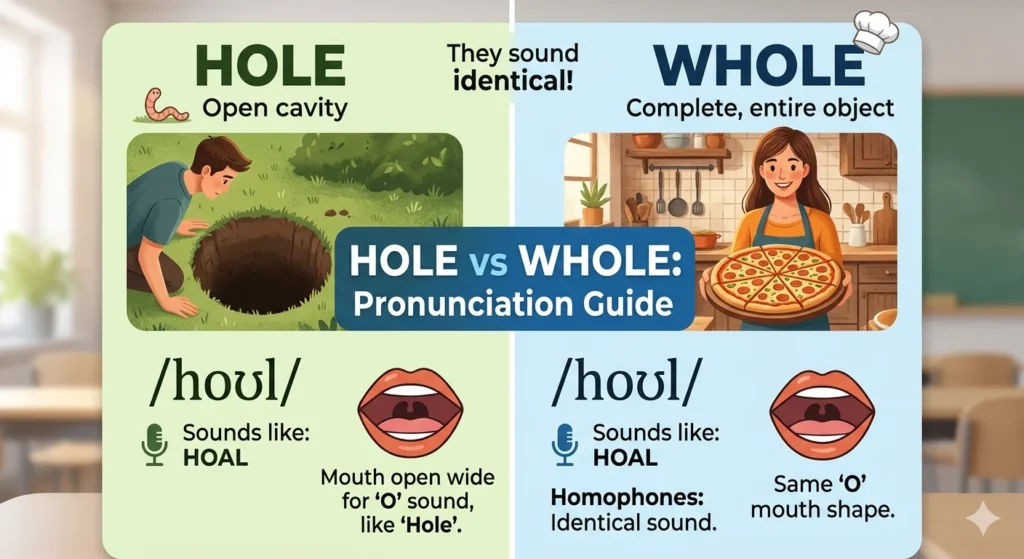
Hole vs Whole Pronunciation
Both words are pronounced exactly the same:
/hoʊl/
This is why many writers confuse them.
Pronunciation Examples
- Hole → “hohl”
- Whole → “hohl”
Even though the spelling is different, the sound is identical.
Many learners search for:
- Hole vs whole pronunciation
- Whole pronunciation audio
A pronunciation audio dictionary will pronounce both words the same way because they are homophones.
Hole vs Whole Grammar
Hole
Usually functions as a noun.
Examples:
- The hole is deep.
- We filled the hole.
Whole
Usually functions as an adjective.
Examples:
- The whole class attended.
- I read the whole article.
It can also function as a noun:
- The whole is greater than the sum of its parts.
Hole vs Whole Worksheet Practice
Choose the correct word.
- I watched the _____ movie.
- There is a _____ in the road.
- She spent the _____ evening studying.
- The rabbit hid in a _____.
- We searched the _____ building.
Answers
- whole
- hole
- whole
- hole
- whole
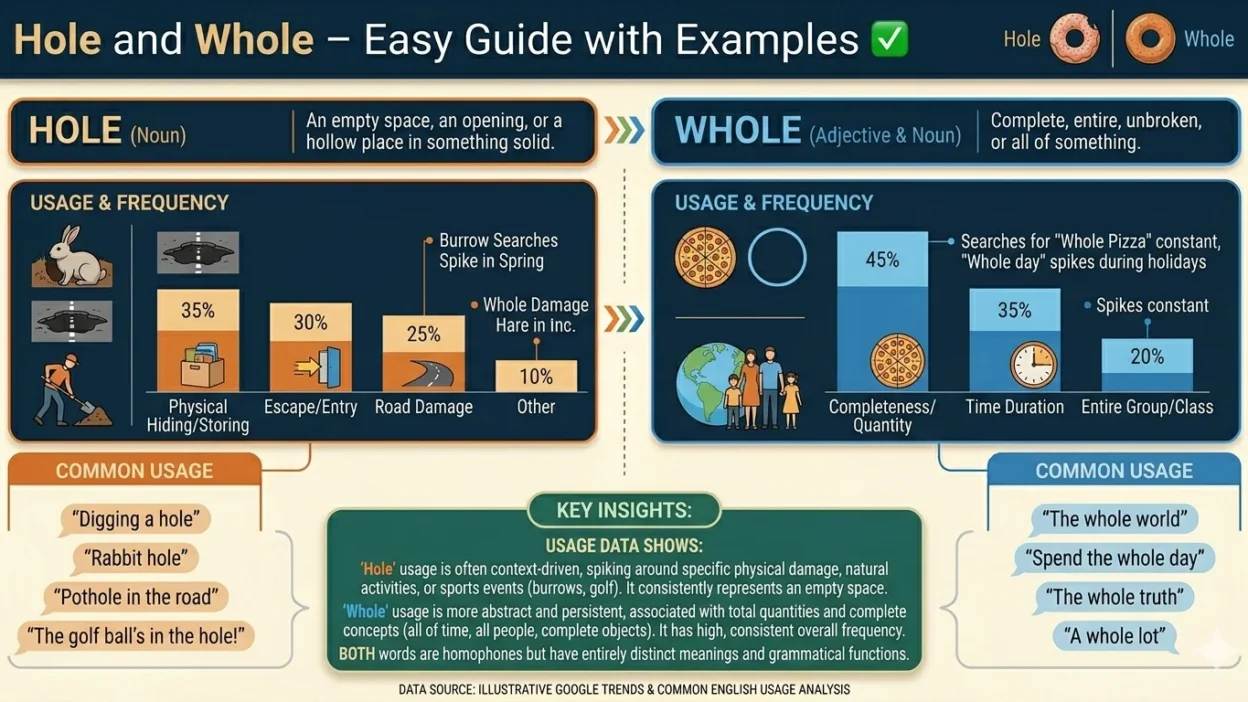
Hole vs Whole – Google Trends & Usage Data
Search interest in hole vs whole remains steady because English learners frequently confuse these homophones.
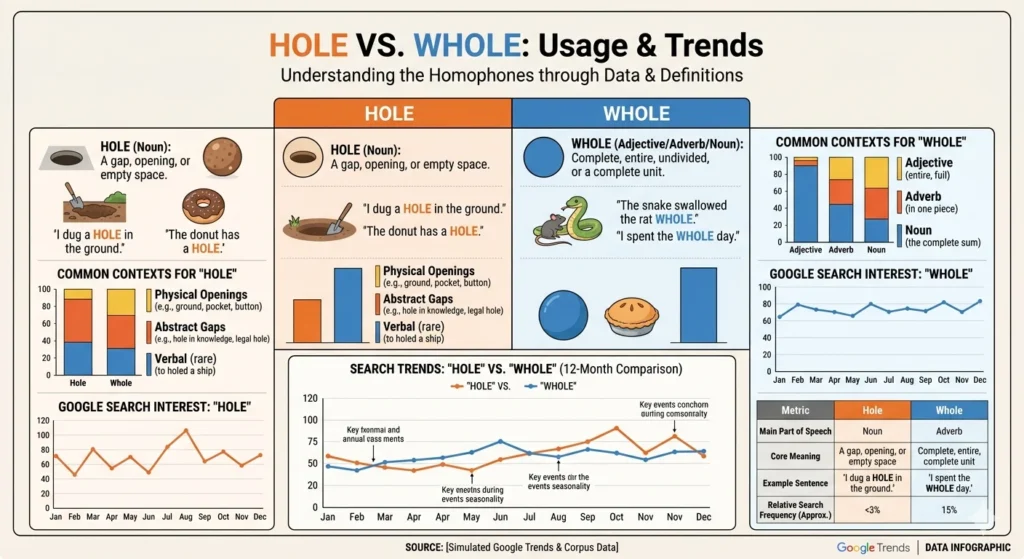
Countries Where Searches Are Common
- United States
- United Kingdom
- Canada
- Australia
- India
- Pakistan
Common Search Queries
- hole vs whole
- hole vs whole meaning
- hole vs whole pronunciation
- hole vs whole grammar
- hole vs whole examples
- How do you spell whole?
- What do you mean by hole?
- Is it whole day or hole day?
- Is it hole time or whole time?
- hole vs whole worksheet
People usually search these terms when writing essays, school assignments, emails, or social media posts.
FAQs
1. What do you mean by hole?
A hole is an opening, gap, hollow space, or cavity in something.
2. How do you spell whole?
The correct spelling is W-H-O-L-E.
3. How do you use hole and whole in a sentence?
- There is a hole in my shoe.
- I wore these shoes the whole year.
4. Is it whole day or hole day?
The correct phrase is whole day because it means the entire day.
5. Is it hole time or whole time?
The correct phrase is whole time because it means the entire time.
6. Are hole and whole homophones?
Yes. They are homophones because they sound the same but have different meanings and spellings.
7. What is the difference between hole vs whole meaning?
Hole means an opening or gap. Whole means complete or entire.
Conclusion
Understanding hole vs whole is easier once you know their meanings. Although these words share the same pronunciation, they serve very different purposes in English. A hole is an opening, gap, or hollow space, while whole means complete, entire, or all of something.
Because they are homophones, many people accidentally use one in place of the other. This can create confusion in emails, school assignments, social media posts, and professional documents. A simple way to remember the difference is to think about meaning first. If you are talking about a gap or opening, use hole. If you mean everything, all, or complete, use whole.
Whether you are learning English, improving grammar skills, or writing professionally, mastering hole vs whole grammar, pronunciation, and usage will help you communicate more clearly. When in doubt, check whether the sentence refers to an opening or to the entire thing. That quick test will help you choose the correct spelling every time.

“Witty McGiggles, PunsBlast’s resident pun master, spins clever wordplay and playful humor to turn every moment into a laugh.”