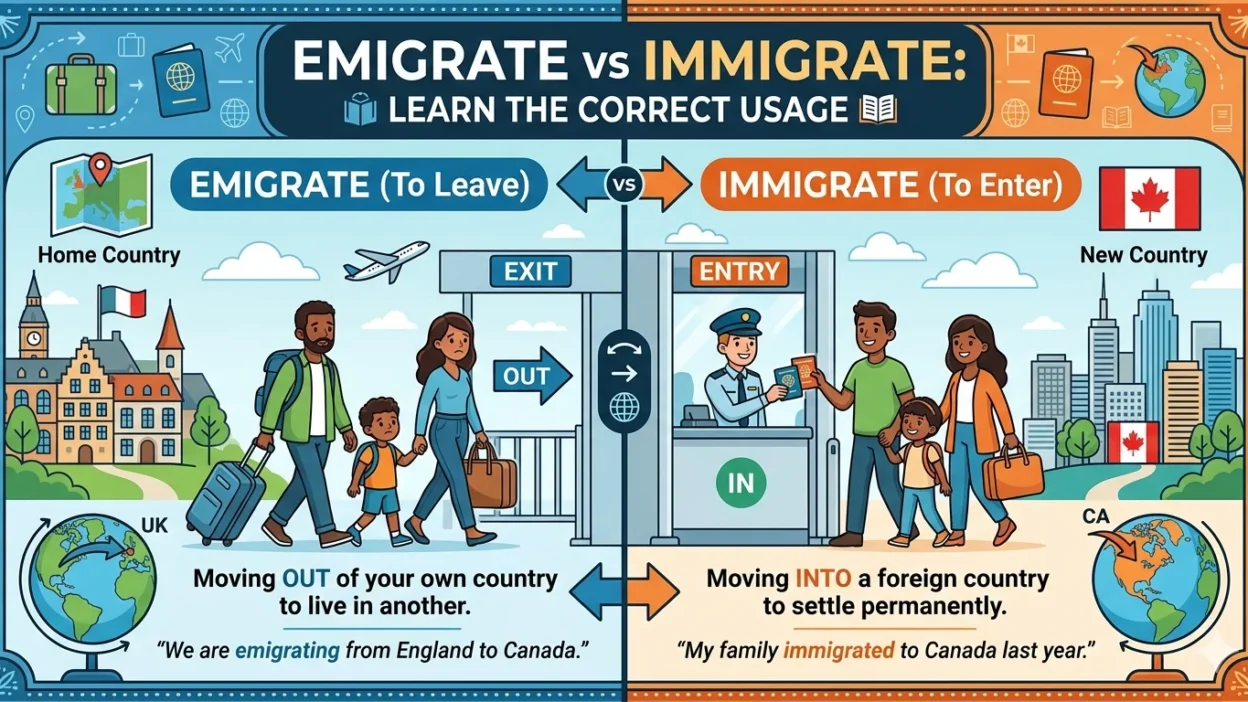
Have you ever wondered whether someone emigrates or immigrates when moving to another country?
Many English learners, writers, students, and even native speakers get confused by these two words.
That is why people often search for terms like emigrate vs immigrate, what is the difference between emigrating and immigrating, and when should I use emigrate.
The confusion happens because both words describe moving from one country to another. However, they focus on different points of view. Using the wrong word can make your writing unclear, especially in formal documents, academic work, news articles, and immigration discussions.
In this guide, you will learn the exact emigrate vs immigrate meaning, how to use each word correctly, and simple tricks to remember the difference.
We will also cover emigrate vs immigrate examples, pronunciation, grammar rules, common mistakes, Google Trends insights, and comparisons with the word migrate. By the end, you’ll know exactly when to use emigrate vs immigrate in any situation.
Emigrate vs Immigrate means
The simplest way to understand emigrate vs immigrate is this:
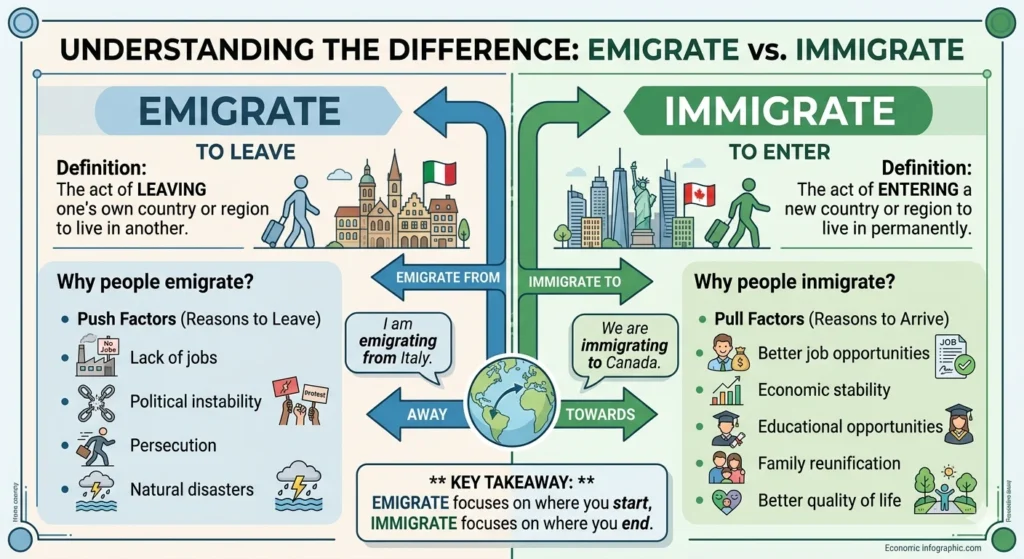
- Emigrate = Leave a country.
- Immigrate = Enter a new country to live there.
Example
- Maria emigrated from Mexico.
- Maria immigrated to Canada.
The same person can do both actions:
- She emigrated from Mexico.
- She immigrated to Canada.
If you ask, “Do you immigrate or emigrate to another country?”, the answer is both. You emigrate from one country and immigrate to another.
Quick Comparison
| Word | Meaning | Example |
|---|---|---|
| Emigrate | Leave a country | He emigrated from India. |
| Immigrate | Move into a country | He immigrated to Australia. |
| Migrate | Move from one place to another | Birds migrate seasonally. |
This simple explanation answers the common question: What is the difference between emigrating and immigrating?
The Origin of Emigrate vs Immigrate
Understanding the history of these words makes them easier to remember.
Emigrate
The word comes from the Latin word emigrare, meaning “to move away” or “depart.”
- E- means “out of.”
- Migrate means “move.”
So, emigrate literally means “move out.”
Immigrate
The word comes from the Latin word immigrare, meaning “move into.”
- Im- means “into.”
- Migrate means “move.”
So, immigrate literally means “move into.”
Why Do the Spellings Differ?
The prefixes change the direction of movement:
- E = Exit
- Im = Into
This difference creates the entire emigrate vs immigrate definition.
British English vs American English Spelling
Unlike many English words, emigrate and immigrate have the same spelling in both British and American English.
However, usage styles may vary slightly in different countries.
Comparison Table
| Feature | British English | American English |
|---|---|---|
| Emigrate | Emigrate | Emigrate |
| Immigrate | Immigrate | Immigrate |
| Emigration | Emigration | Emigration |
| Immigration | Immigration | |
| Common Usage | Commonwealth countries | United States |
Examples
British English:
- Many people emigrated from the UK during the 20th century.
American English:
- Many families immigrated to the United States seeking opportunity.
There is no major spelling difference, making emigrate vs immigrate grammar straightforward.
Which Spelling Should You Use?
Because the spelling remains the same, your focus should be on choosing the correct word.
For US Audiences
Use:
- Emigrate from
- Immigrate to
Example:
- They immigrated to the United States.
For UK and Commonwealth Audiences
The same rule applies:
- Emigrate from
- Immigrate to
Example:
- They emigrated from South Africa.
For Global Audiences
Use whichever perspective fits your sentence:
- Leaving = Emigrate
- Arriving = Immigrate
This answers the common search query: when to use emigrate vs immigrate?
Common Mistakes with Emigrate vs Immigrate
Many writers mix these words up.
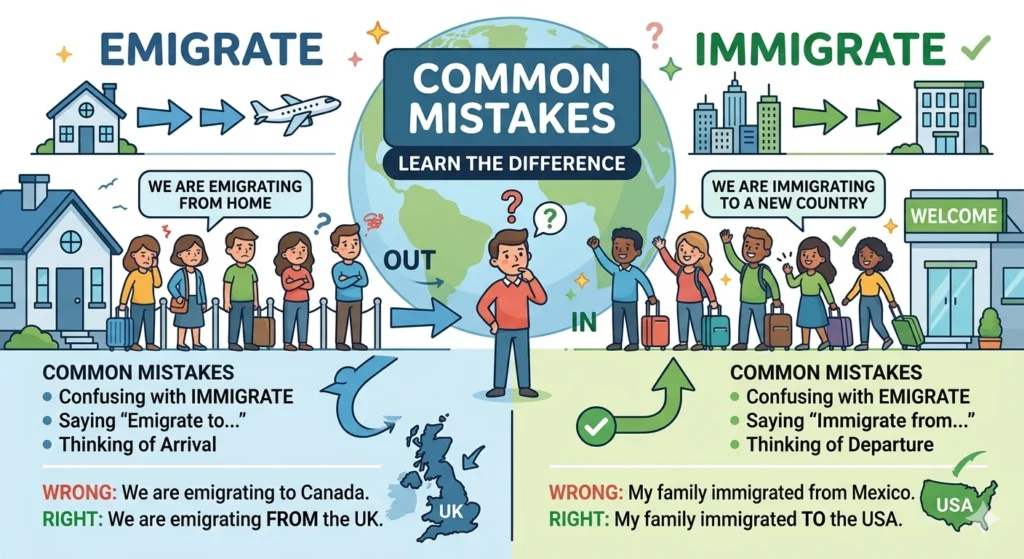
Mistake 1
❌ He immigrated from France.
✅ He emigrated from France.
Mistake 2
❌ She emigrated to Canada.
✅ She immigrated to Canada.
Mistake 3
❌ They immigrated out of Spain.
✅ They emigrated from Spain.
Easy Memory Trick
Think:
- E = Exit
- Im = Into
This helps remember the emigrate vs immigrate difference instantly.
Emigrate vs Immigrate in Everyday Examples
Here are practical emigrate vs immigrate examples from everyday communication.
Email Example
“We immigrated to New Zealand last year and are enjoying life there.”
News Example
“Thousands of workers emigrated from the country in search of better jobs.”
Social Media Example
“My grandparents immigrated to Canada in the 1980s.”
Formal Writing Example
“The family emigrated from Germany before immigrating to the United States.”
Immigrate Sentence Example
- My parents immigrated to Australia in 2005.
Emigrate in a Sentence
- Many skilled workers emigrate for better opportunities.
Emigrate in Spanish
The word emigrate in Spanish is emigrar.
Example:
- Decidió emigrar a Canadá.
- (He decided to emigrate to Canada.)
Immigrate vs Emigrate vs Migrate
Many people also search for immigrate vs emigrate vs migrate.
Migrate
Migrate is a broader term.
It means moving from one place to another.
Examples:
- Birds migrate south during winter.
- Workers migrate between cities for jobs.
Comparison Table
| Word | Direction | Example |
|---|---|---|
| Emigrate | Out of a country | Emigrate from Brazil |
| Immigrate | Into a country | Immigrate to Canada |
| Migrate | Move generally | Migrate for work |
This explains migrate vs emigrate vs immigrate and immigrate emigrate and migrate clearly.
Emigrate vs Immigrate Pronunciation
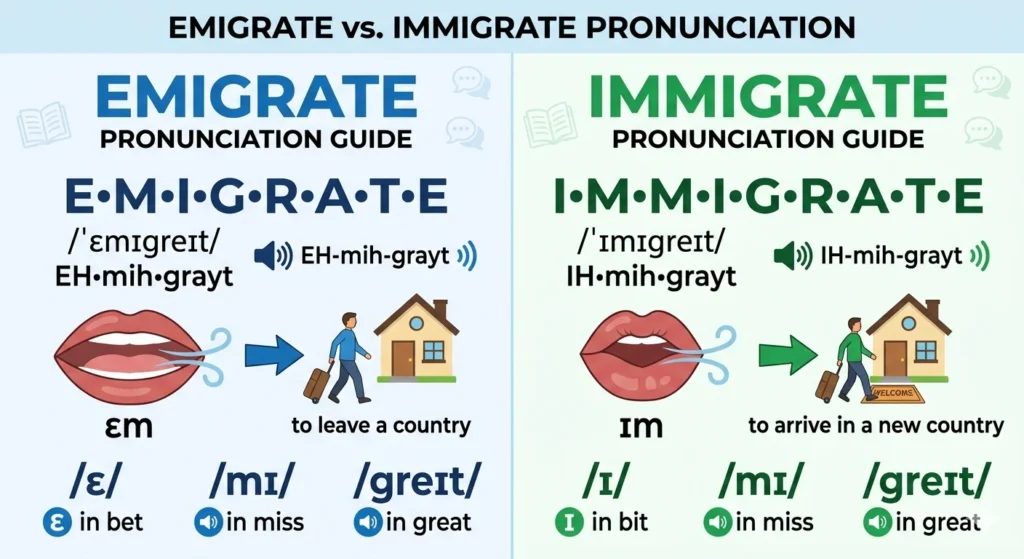
Emigrate
Pronunciation:
EM-i-grate
/ˈemɪɡreɪt/
Immigrate
Pronunciation:
IM-i-grate
/ˈɪmɪɡreɪt/
The endings sound the same. The first syllable changes.
This addresses the common search term emigrate vs immigrate pronunciation and immigrate vs emigrate pronunciation.
Emigrate vs Immigrate – Google Trends & Usage Data
Search data shows that immigrate is often searched more frequently than emigrate, especially in countries discussing immigration policies.
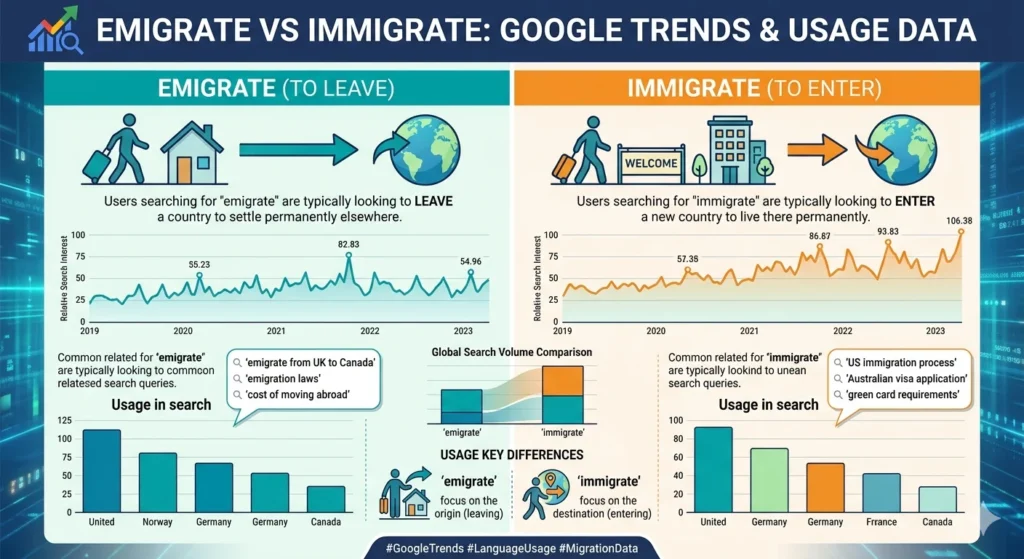
Popular Countries
- United States
- Canada
- Australia
- United Kingdom
Common Search Queries
- What is the difference between emigrating and immigrating?
- What’s the difference between emigration and immigration?
- Define emigrate vs immigrate
- Emigrate vs immigrate examples
- Emigrate vs immigrate Reddit
Why People Search It
Most users want:
- A quick explanation.
- Grammar help.
- Writing examples.
- Immigration-related clarification.
Online communities, including searches for emigrate vs immigrate Reddit, often discuss memory tricks and real-world examples.
Emigrate vs Immigrate Comparison Table
| Feature | Emigrate | Immigrate |
|---|---|---|
| Meaning | Leave a country | Enter a country |
| Focus | Departure | Arrival |
| Common Preposition | From | To |
| Example | Emigrate from Italy | Immigrate to Canada |
| Direction | Out | In |
| Verb Type | Movement away | Movement toward |
FAQs
What is the difference between emigrating and immigrating?
Emigrating means leaving a country. Immigrating means entering another country to live there.
What’s the difference between emigration and immigration?
Emigration focuses on departure, while immigration focuses on arrival.
When should I use emigrate?
Use emigrate when talking about leaving a country.
Do you immigrate or emigrate to another country?
Both. You emigrate from one country and immigrate to another.
What is emigrate vs immigrate for kids?
A simple way to remember:
- Emigrate = Exit
- Immigrate = Into
How do I use emigrate vs immigrate in a sentence?
Example:
- She emigrated from India.
- She immigrated to Canada.
Is there an emigrate vs immigrate quiz trick?
Yes. Ask yourself:
- Leaving? Use emigrate.
- Arriving? Use immigrate.
Conclusion
Understanding emigrate vs immigrate is easier than many people think. The key difference is perspective. When someone leaves a country, they emigrate. When they arrive and settle in a new country, they immigrate. The same move can involve both actions depending on which side of the journey you describe.
A useful memory trick is to remember that E in emigrate stands for Exit, while Im in immigrate means Into. This simple rule helps avoid many common grammar mistakes. Whether you are writing an academic paper, a news article, a social media post, or an immigration document, choosing the correct word improves clarity and professionalism.
When comparing emigrate vs immigrate vs migrate, remember that migrate is the broader term, while emigrate and immigrate describe specific international movement. By using the examples, pronunciation tips, and comparison tables in this guide, you can confidently decide when to use emigrate vs immigrate in any context.

“Sylvia Townsend, a witty humorist at PunsBlast, crafting clever puns and playful wordplay that bring smiles to readers everywhere.”