Many people search for “either or whether” because these words look simple—but they confuse even fluent English users. You may wonder: Should I say “either or” or “whether”? Or what is the difference between either or whether or if?
This confusion happens because both are used to talk about choices. But they are not the same. Using the wrong one can make your sentence unclear or incorrect. That’s why learners often ask: How do you use whether correctly? and How to use either, neither, and whether?
This guide solves that problem in a simple way. You will learn the either or whether meaning, see real either and whether examples, and understand the difference between either or whether. We will also explain either or whether grammar rules, common mistakes, and give easy either or whether sentences you can use every day.
Either or Whether means
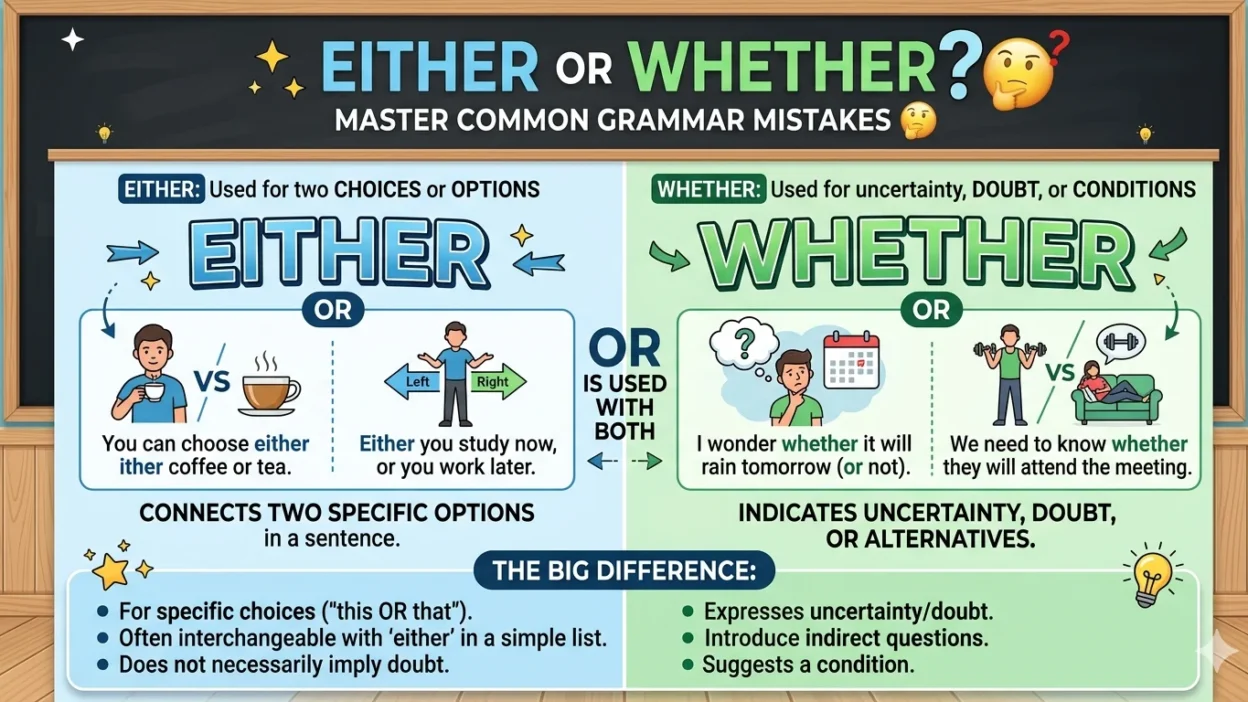
Quick rule:
- Use either…or to show a choice between two options
- Use whether to show doubt, possibility, or a condition
Examples:
- I will eat either pizza or pasta. ✔ (choice)
- I don’t know whether it will rain. ✔ (uncertainty)
👉 Simple idea:
- Either or = choice
- Whether = doubt or question
This helps answer: How to use whether or either?
The Origin of Either or Whether
Either
“Either” comes from Old English ǣgther, meaning one of two. It has always been about choice.
Whether
“Whether” comes from Old English hwæther, meaning which of two. Over time, it started to mean uncertainty or possibility.
👉 That’s why today:
- Either or whether meaning is different
- One shows choice, the other shows uncertainty
British English vs American English Spelling
Good news: there is no spelling difference between British and American English for either or whether.
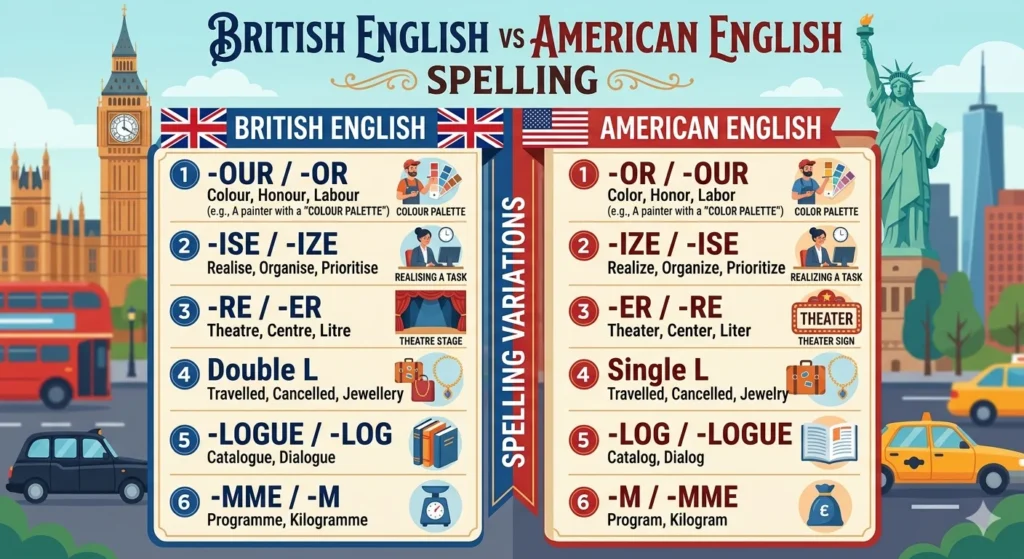
Comparison Table
| Feature | British English | American English |
|---|---|---|
| Either | Either | Either |
| Whether | Whether | Whether |
| Usage | Same | Same |
👉 The difference is not spelling—it is usage and grammar.
Which Spelling Should You Use?
Since spelling is the same, focus on context:
- 🇺🇸 US audience → Use clear sentences:
“Do you want either tea or coffee?” - 🇬🇧 UK/Commonwealth → Same rule applies
- 🌍 Global audience → Keep it simple
Avoid long sentences with both words together
👉 Best advice:
Follow either or whether grammar rules, not spelling differences.
Common Mistakes with Either or Whether
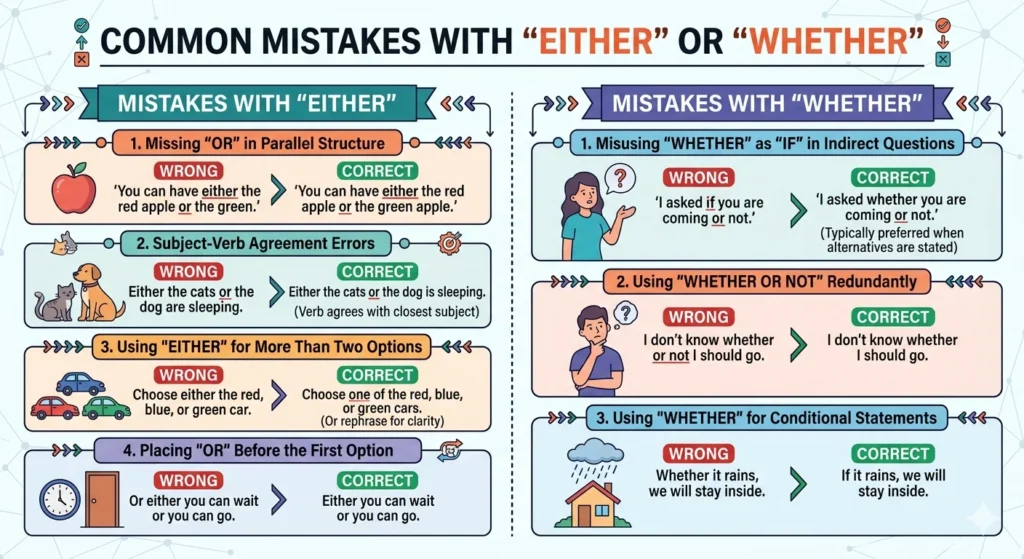
❌ Mistake 1
“I don’t know either he will come.”
✔ Correct: “I don’t know whether he will come.”
❌ Mistake 2
“You can choose whether tea or coffee.”
✔ Correct: “You can choose either tea or coffee.”
❌ Mistake 3
Using both incorrectly:
“I don’t know whether either he will come or not.”
✔ Better: “I don’t know whether he will come or not.”
👉 This helps avoid errors in either or whether grammar.
Either or Whether in Everyday Examples
Emails
- Please confirm whether you will attend the meeting.
News
- The government will decide whether to increase taxes.
Social Media
- Should I watch a movie or sleep? I can’t decide either way.
Formal Writing
- The study examines whether climate change affects crops.
👉 These are simple either or whether sentences you can use daily.
Either or Whether – Google Trends & Usage Data
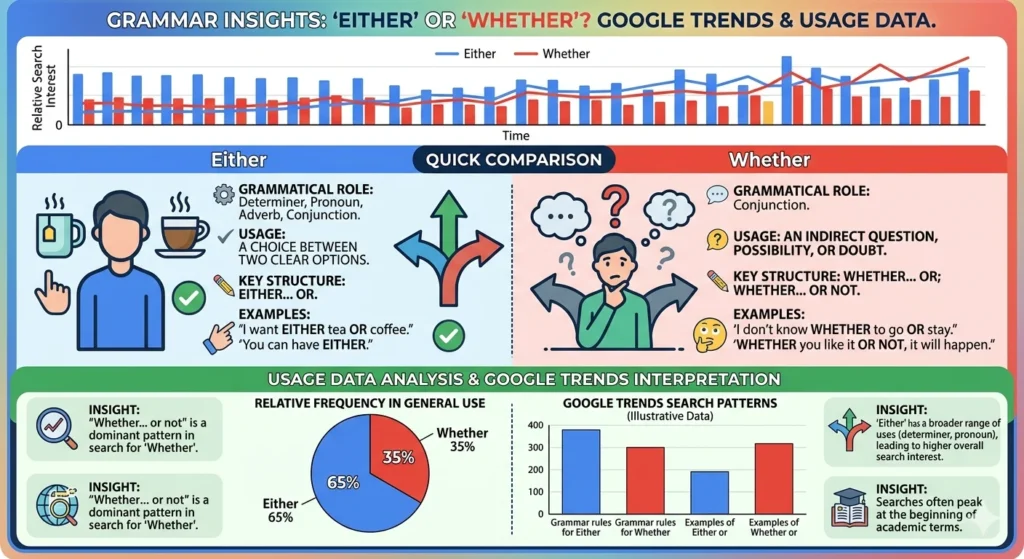
- “Whether” is more common in formal writing, news, and academic texts
- “Either or” is more common in daily conversation
Popular Usage by Context
- 🇺🇸 USA → Both used equally
- 🇬🇧 UK → “Whether” more in formal English
- 🌍 Global → “Either or” easier for beginners
👉 This explains the difference between either or whether or if in real usage.
Comparison Table: Either vs Whether
| Feature | Either…Or | Whether |
|---|---|---|
| Meaning | Choice between two | Doubt or possibility |
| Use | Options | Questions/uncertainty |
| Example | Either tea or coffee | Whether it rains |
| Grammar Type | Conjunction (pair) | Conjunction |
FAQs
1. How do you use whether correctly?
Use “whether” when you are unsure:
“I don’t know whether it will rain.”
2. How to use either, neither, and whether?
- Either = one choice
- Neither = none of the choices
- Whether = doubt
3. What is the difference between either or whether?
- Either or = choice
- Whether = uncertainty
4. Can I use whether instead of if?
Sometimes yes, but “whether or not” is more formal and correct in many cases.
5. What are common either or whether exercises?
Practice like:
- Choose: either tea or coffee
- Fill: I don’t know whether he will come
6. What is either or whether definition?
- Either or: shows choice
- Whether: shows doubt
7. What is whether vs either exercises?
Example:
- Correct the sentence: “I don’t know either he is coming.”
✔ Answer: “I don’t know whether he is coming.”
Conclusion
Understanding either or whether is simple when you remember one key idea: choice vs doubt. “Either…or” helps you pick between options, while “whether” shows uncertainty or a question. This clear difference makes it easier to avoid common grammar mistakes.
Many learners mix them because both deal with two possibilities. But their roles are different. By using the right structure, your sentences will sound natural and correct. Practice with real-life examples like emails, conversations, and writing tasks. This will help you master either or whether in a sentence quickly.
Also remember, there is no spelling difference in British or American English. The real focus should be on usage and meaning. If you follow the simple rules in this guide, you will confidently use both words in any situation.
Keep practicing with either or whether exercises, and soon you will never confuse them again.

“M.R. James, a playful storyteller at PunsBlast, crafting sharp puns and clever humor that turn everyday words into unforgettable laughs.”