Many English learners and even native speakers get confused between discreet vs discrete. These two words look almost the same, but their meanings are completely different.
Because of their similar spelling and sound, people often mix them in writing, emails, and exams. This leads to mistakes in grammar, professional communication, and even SEO content writing.
When someone searches “What is the difference between discreet and discrete?”, they are usually trying to fix this confusion quickly.
Some want to know which word means “careful or secret,” while others are looking for the math or technical meaning of “separate or distinct.” This confusion is very common in schools, offices, and online writing.
In simple terms, discreet is about being careful, private, or not drawing attention.
Discrete means separate, distinct, or not connected. This article will clearly explain both words with examples, history, pronunciation, grammar usage, and real-life sentences.
By the end, you will never confuse them again and will know exactly how to use each word correctly in writing and speech.
Discreet vs Discrete means
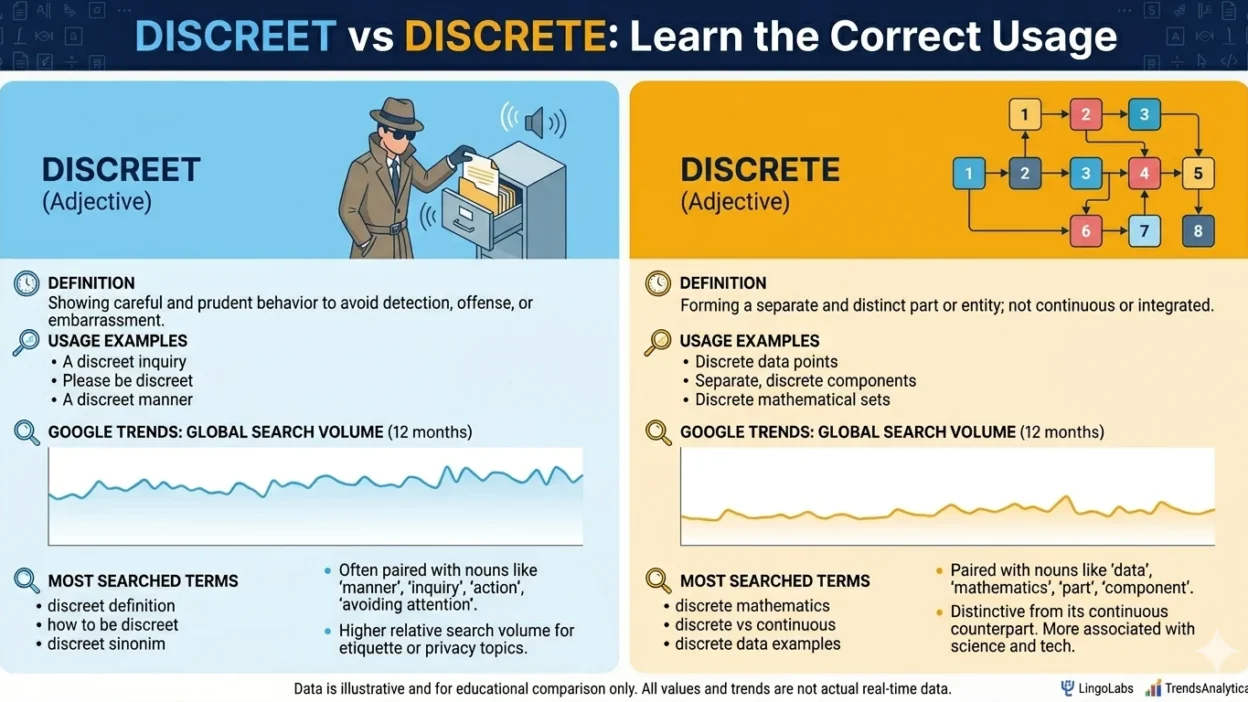
The discreet vs discrete meaning is simple:
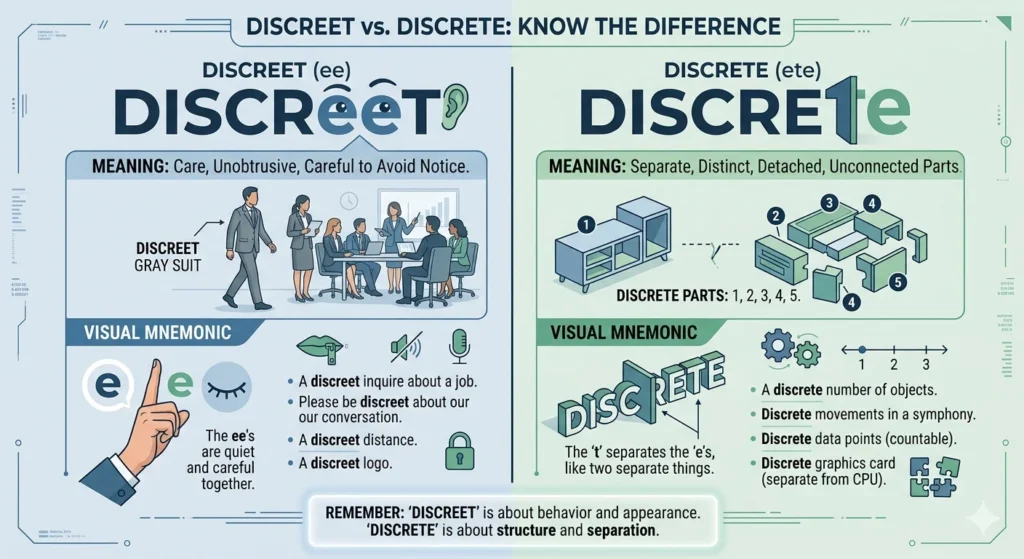
- Discreet = careful, private, not attracting attention
- Discrete = separate, distinct, individual units
Examples:
- She was very discreet about her personal life.
- The data is divided into discrete categories.
👉 What is the difference between discreet and discrete?
One is about behavior (careful), the other is about separation (individual parts).
👉 Does discreet mean secret?
Yes, it is close to “secret” but more about being careful or tactful.
👉 What does it mean to be discrete?
It means things are separate and not connected.
The Origin of Discreet vs Discrete
The discreet vs Discrete etymology shows why the confusion exists.
- Discreet comes from Latin “discretus” meaning “separated, careful, wise.”
- Discrete also comes from Latin “discretus”, but its meaning evolved into “separate or distinct.”
Over time:
- Discreet kept the meaning of careful behavior.
- Discrete focused on separation and individuality.
👉 This shared origin is the reason both words look and sound similar.
British English vs American English Spelling
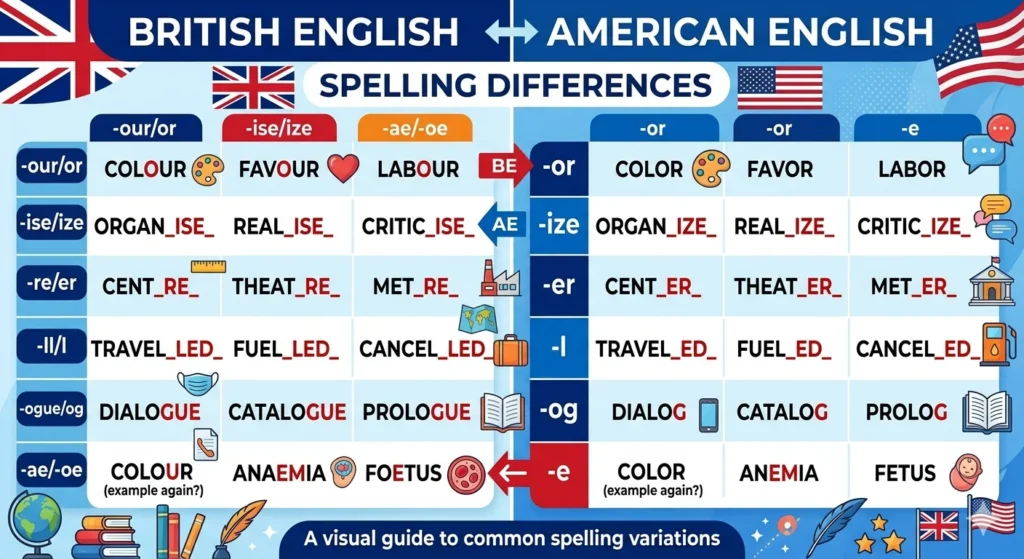
The discreet vs discrete english spelling is the same in both UK and US English. The difference is not spelling, but usage confusion.
Comparison Table
| Word | Meaning (UK/US) | Usage Type | Example |
|---|---|---|---|
| Discreet | Careful, private | Behavior/Person | He was discreet in conversation. |
| Discrete | Separate, distinct | Math/Data/Science | The system has discrete parts. |
👉 So, discreet vs discrete meaning UK is the same as global English.
Which Spelling Should You Use?
There is no UK vs US spelling difference. The choice depends on meaning:
- Use discreet when talking about privacy, behavior, or tact.
- Use discrete when talking about separation, math, or categories.
Audience guide:
- Students → use both correctly in exams
- Writers → avoid mixing in blogs or articles
- Business → use “discreet” for confidentiality
- Science/Math → always use “discrete”
Common Mistakes with Discreet vs Discrete
Many people confuse these words in writing:
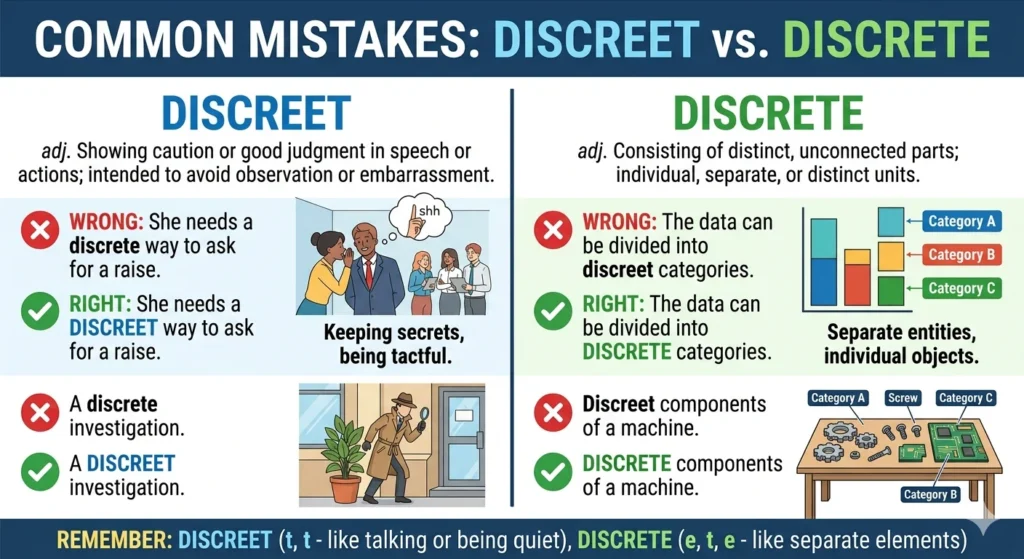
❌ She is very discrete with secrets.
✔ She is very discreet with secrets.
❌ The data is discreet into groups.
✔ The data is discrete into groups.
👉 Other common errors:
- Mixing pronunciation
- Using “discrete” for privacy
- Using “discreet” in math
Discreet vs Discrete in Everyday Examples
Emails:
- Please keep this information discreet.
Social Media:
- She handles fame in a very discreet way.
Academic Writing:
- The study uses discrete variables.
News:
- Authorities took discreet action during the investigation.
👉 These show discreet vs discrete in sentence usage clearly.
Discreet vs Discrete – Google Trends & Usage Data
Search behavior shows:
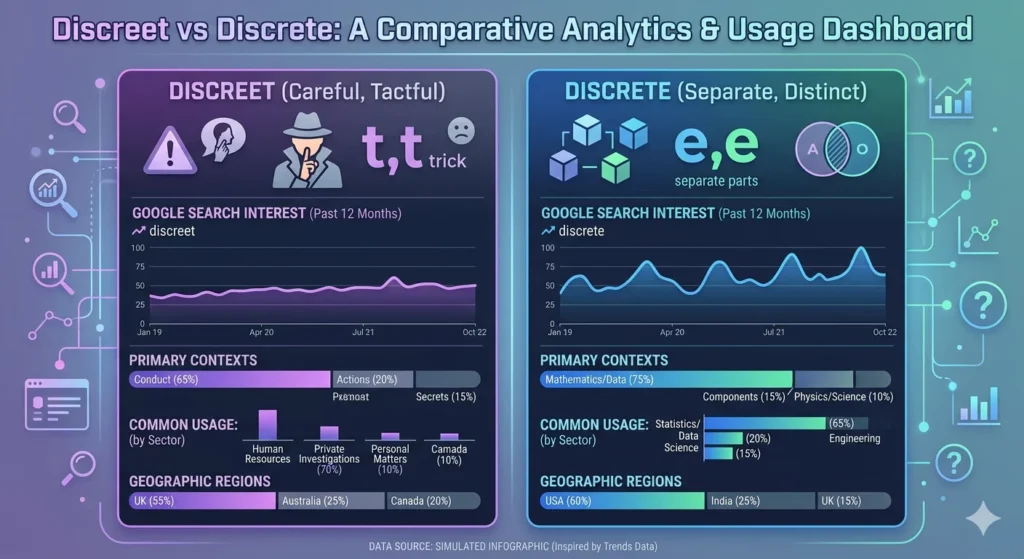
- “discreet” is more common in everyday writing and business communication.
- “discrete” is more common in academic, math, and science searches.
- Confusion queries like “discreet vs discrete difference meaning” are high in students and writers.
Usage insight:
- High confusion in English learners
- Common in grammar correction searches
- Often checked before exams or writing tasks
Discreet vs Discrete Comparison Table
| Feature | Discreet | Discrete |
|---|---|---|
| Meaning | Careful, private | Separate, distinct |
| Usage | Behavior, privacy | Math, science, data |
| Context | Social, professional | Academic, technical |
| Example | A discreet message | Discrete values |
| Opposite idea | Open, obvious | Continuous, connected |
FAQs
1. What is the difference between discreet and discrete?
Discreet means careful or private. Discrete means separate or distinct.
2. What does it mean to be discrete?
It means something is individual or not connected.
3. Does discreet mean secret?
Not exactly. It means careful and not attracting attention.
4. How to remember discreet vs discrete?
Think: discreet = secret behavior, discrete = separate things.
5. Discreet vs discrete pronunciation?
Both sound similar, but “discreet” relates to behavior and “discrete” to separation.
6. Discreet vs discrete in math?
In math, discrete means separate values, not continuous.
7. Discreet vs discretion?
“Discreet” is the adjective; “discretion” is the noun meaning careful judgment.
Conclusion
The confusion between discreet vs discrete meaning is very common, but now it should be clear. Even though the words look similar, their meanings are completely different. Discreet is about privacy, care, and tactful behavior. Discrete is about separation, individuality, and distinct units.
If you remember one simple rule, you will never mix them again: discreet = careful people, discrete = separate things. This difference is important in writing emails, academic work, exams, and professional communication. Many errors happen because people rely only on spelling instead of meaning. Understanding context is the key.
So next time you write, pause and check: Are you talking about behavior or separation? That simple question will guide you to the correct word every time.

“George Gissing, a humor-loving writer at PunsBlast, crafting witty puns and playful word magic to make readers laugh every single day.”