Many people confuse cue vs queue because the words sound the same. They are homophones, but they have very different meanings.
This spelling mix-up is common in emails, school work, social media posts, and even professional writing.
People often ask questions like: “Is it in the cue or queue?”, “Queue or cue the music?”, and “Which is correct, que or queue?”
The confusion grows because both words appear in everyday English. One relates to signals or prompts, while the other relates to lines or waiting.
This guide explains the full cue vs queue meaning in very simple words. You will learn the difference, pronunciation, spelling rules, and proper usage.
We will also cover common mistakes, real-life examples, and trends in how people search these words online.
If you have ever wondered “What does my cue mean?” or searched for a quick cue vs queue example, this article will help you use the correct word with confidence.
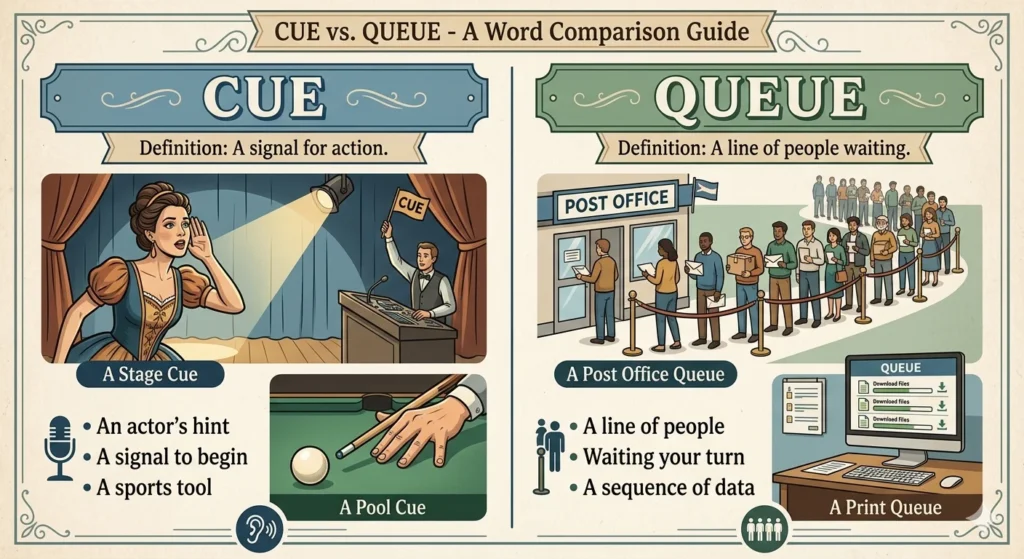
Cue vs Queue means
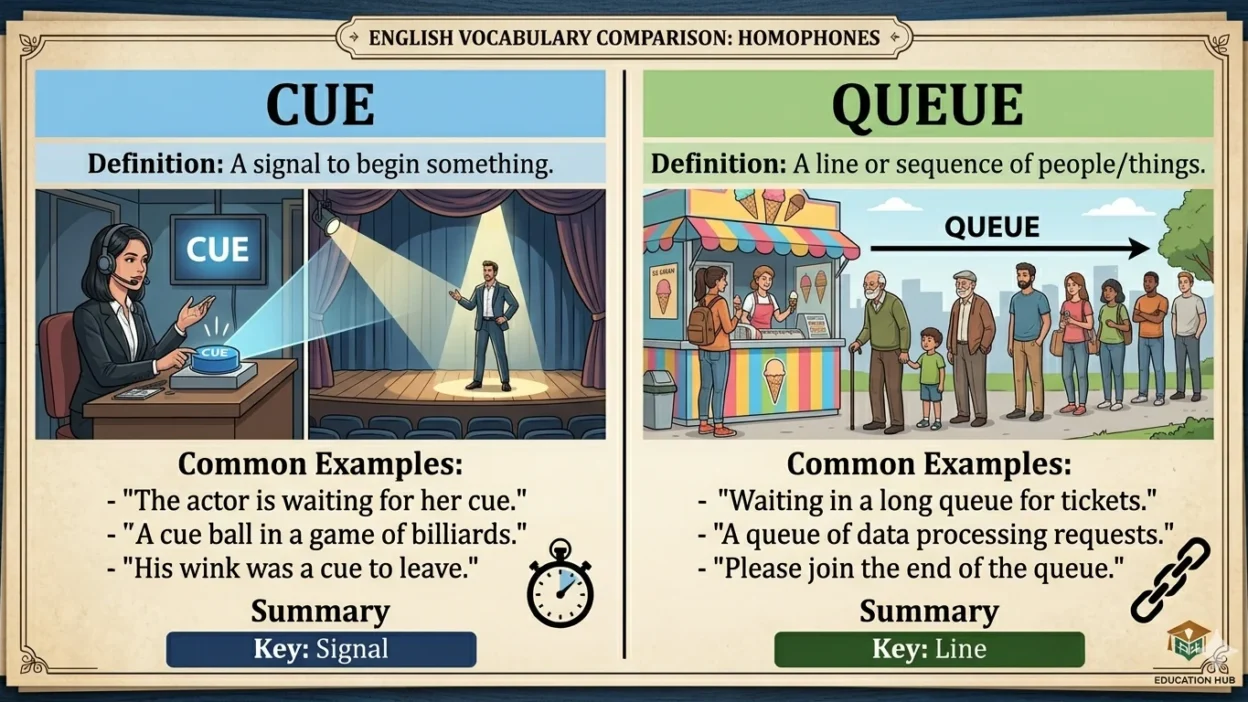
The difference between cue and queue is simple:
| Word | Meaning | Example |
|---|---|---|
| Cue | A signal, prompt, or hint to act | “That was my cue to leave.” |
| Queue | A line of people or things waiting | “We stood in a queue for tickets.” |
Easy Examples
- Cue the music = Start the music.
- Queue up for tickets = Wait in line for tickets.
Many people ask: “Queue up or cue up?”
- Cue up means prepare something to start.
- “Cue up the next song.”
- Queue up means form a line.
- “People queued up outside the store.”
So, queue or cue the music?
The correct phrase is cue the music.
The Origin of Cue vs Queue
The word cue came from theater language. Actors used cues as signals for when to speak or move on stage. Over time, the word became common in daily life.
The word queue comes from French. It originally meant “tail.” That makes sense because a queue looks like a long tail or line.
Why Do the Spellings Look So Different?
Even though they sound the same, the spelling changed because the words came from different languages.
- Cue = short English spelling
- Queue = French-based spelling
This is why people often search:
- Cue vs queue pronunciation
- Queue vs que
- Visual queue or cue
The pronunciation is the same, but the meanings are not.
British English vs American English Spelling
Both British English and American English use cue and queue in the same way. The meaning does not change between regions.
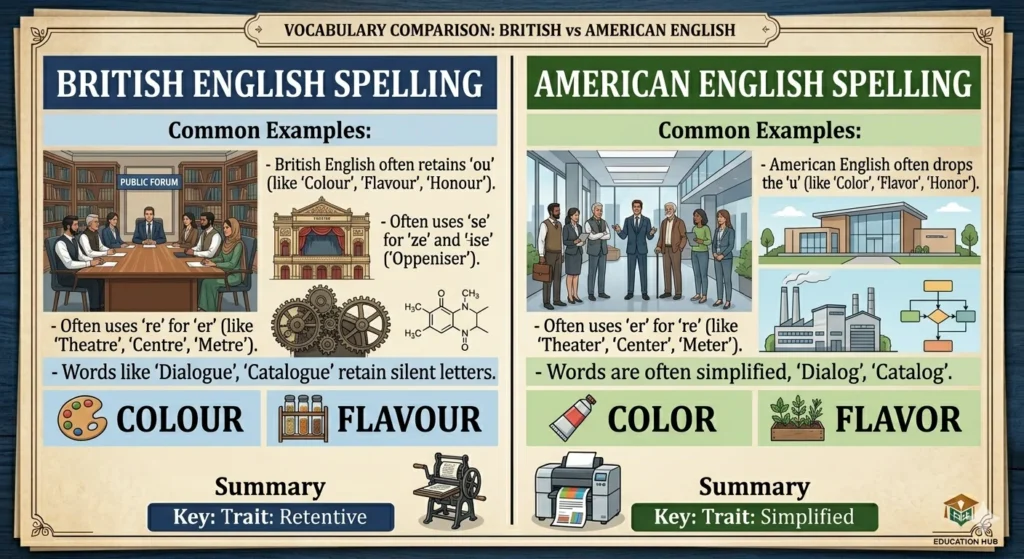
However, queue is more common in British English because British speakers often say “queue” instead of “line.”
Examples
| British English | American English |
|---|---|
| “Join the queue.” | “Stand in line.” |
| “People queued outside.” | “People waited in line.” |
Cue vs Queue Comparison Table
| Feature | Cue | Queue |
|---|---|---|
| Pronunciation | “kyoo” | “kyoo” |
| Main Meaning | Signal or prompt | Waiting line |
| Common Usage | Theater, media, music | Stores, banks, apps |
| Verb Form | Cue the video | Queue the files |
| Related Phrase | “This is my cue meaning” | “Queue up here” |
Which Spelling Should You Use?
Use cue when talking about signals, prompts, or starting something.
Use queue when talking about waiting lines or lists.
Audience-Based Advice
For US Audiences
American readers usually say “line” more than “queue.” But queue is still correct in technology and apps.
For UK and Commonwealth Audiences
British, Canadian, and Australian English use queue very often.
For Global Audiences
Use:
- Cue for prompts or signals
- Queue for waiting lists or ordered systems
Common Mistakes with Cue vs Queue
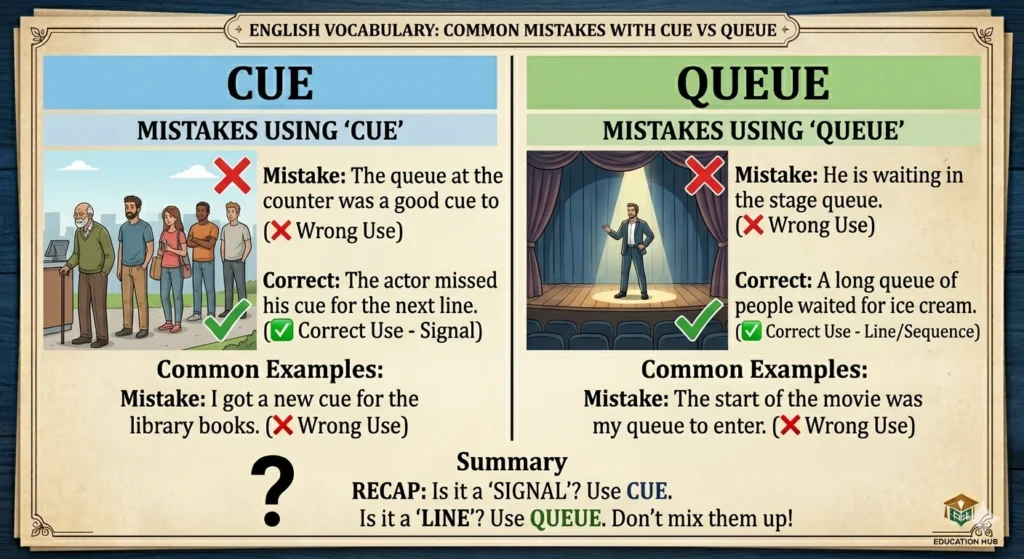
Here are the most common errors people make.
| Wrong | Correct |
|---|---|
| “Queue the music.” | “Cue the music.” |
| “I waited in a cue.” | “I waited in a queue.” |
| “Que up the song.” | “Cue up the song.” |
Common Search Confusions
Is it in the cue or queue?
- If you are waiting in line → queue
- If it is a signal → cue
Which is correct, que or queue?
- Queue is correct in English.
- Que is usually Spanish.
What does my cue mean?
It means “my signal” or “my time to act.”
Visual queue or cue
The correct phrase is usually visual cue because it means a visual signal.
Cue vs Queue in Everyday Examples
In Emails
- “Please cue up the presentation.”
- “Customers are in the support queue.”
In News Writing
- “Fans queued outside the stadium.”
- “The host cued the next speaker.”
On Social Media
- “That was my cue to leave the party.”
- “People are queueing for the new phone.”
In Formal Writing
- “The manager gave a cue to begin.”
- “Applications are processed in queue order.”
Cue vs Queue Example Sentences
- “The teacher gave me a cue to answer.”
- “We waited in a long queue.”
How do you use cue and queue in a sentence?
- Cue: “The lights were my cue to enter the stage.”
- Queue: “Passengers formed a queue at the airport.”
Cue vs Queue – Google Trends & Usage Data
Search data shows that many users confuse these words because they sound identical.

Popular Searches
- Cue vs queue meaning
- Cue vs queue pronunciation
- Queue up or cue up
- Queue or cue the music
Country-Based Usage
| Country | More Common Word |
|---|---|
| United States | Cue / Line |
| United Kingdom | Queue |
| Canada | Queue |
| Australia | Queue |
| Global Tech Industry | Queue |
Technology Usage
In tech, queue is very common:
- Print queue
- Email queue
- Task queue
In entertainment and media, cue appears more:
- Cue the lights
- Cue the music
- Cue card
Council vs Counsel: Another Common Word Confusion
Many people searching cue vs queue also search council vs counsel because both are confusing homophones.
Council vs Counsel Difference
| Word | Meaning |
|---|---|
| Council | A group or committee |
| Counsel | Advice or a lawyer |
Examples
- “The city council met today.”
- “She sought legal counsel.”
Common Searches
- Council vs counsel meaning
- Legal council vs counsel
- Council vs counsel lawyer
- Council vs counsel pronunciation
- Council vs counsel definition
- Council vs counsel difference usage
- When to use council vs counsel
Quick Tip
- Council = group
- Counsel = advice or attorney
More Examples
| Phrase | Correct Form |
|---|---|
| General council vs counsel | General counsel |
| Council vs counsel legal | Counsel |
| Consul vs council vs counsel | All different words |
| Council vs counsel spelling difference | Different endings, different meanings |
FAQs About Cue vs Queue
What is the main difference between cue and queue?
A cue is a signal. A queue is a waiting line.
Is it queue or cue the music?
The correct phrase is cue the music.
What does “this is my cue” mean?
It means “this is my signal to act.”
How do you pronounce cue and queue?
Both are pronounced the same: “kyoo.”
Which is correct: que or queue?
Queue is correct in English.
What does queue up mean?
It means to form a line or wait in order.
What does cue up mean?
It means prepare something to start, like a song or video.
Conclusion
Understanding cue vs queue is easier once you know the basic meanings. A cue is a signal, hint, or prompt. A queue is a line of people or things waiting in order. Even though both words sound the same, they are used in very different situations.
Use cue when talking about action, timing, music, theater, or signals. Use queue when talking about waiting lines, technology systems, or organized order. Remember that phrases like “cue the music” and “queue up for tickets” follow different meanings.
This confusion is common because English contains many homophones, just like council vs counsel. Learning the meaning, spelling, and usage of these words helps improve writing and communication.
If you write for a global audience, keeping these differences clear will make your content look more professional and easier to understand. With the examples and tips in this guide, you can now confidently use both words correctly in daily writing

“Sylvia Townsend, a witty humorist at PunsBlast, crafting clever puns and playful wordplay that bring smiles to readers everywhere.”