Many people get confused by complement vs compliment because the words sound almost the same.
Their spelling is close too. But their meanings are very different. One word is about praise. The other is about completing or matching something.
This confusion is common in emails, social media posts, school writing, business messages, and even news articles.
People often ask questions like: What is complement vs compliment?, when to use complement vs compliment, and Is free food complimentary or complementary? These words can change the meaning of a sentence completely.
For example:
- “You compliment me” means you praise me.
- “You complement me” means you complete or match me well.
That small spelling change matters a lot.
In this guide, you will learn the complement vs compliment meaning, spelling rules, pronunciation, grammar, examples, and correct usage in simple English. You will also see tables, quizzes, FAQs, and real-world examples to help you remember the difference forever.
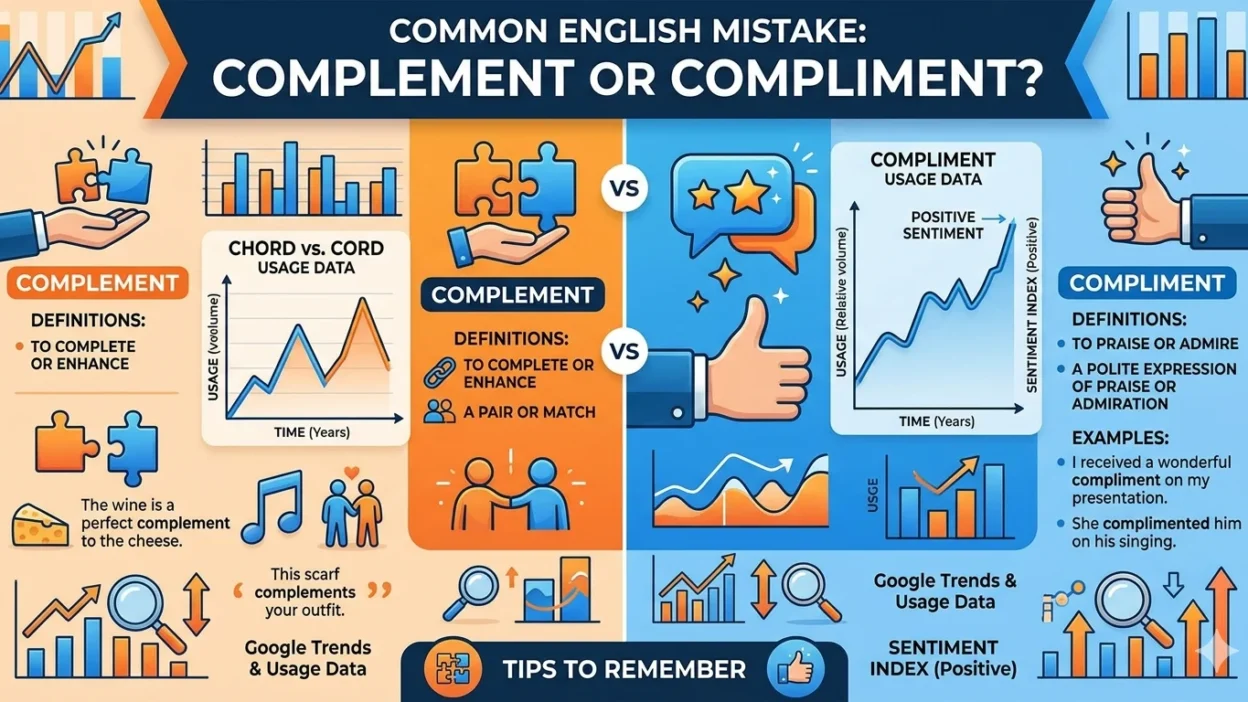
Complement vs Compliment means
The quick answer is simple:
| Word | Meaning | Example |
|---|---|---|
| Complement | Something that completes or matches well | “The sauce complements the pasta.” |
| Compliment | Praise or kind words | “She gave me a compliment.” |
Easy Trick to Remember
- ComplIment → “I” = admiration or praise
- ComplEment → “E” = enhance or complete
Complement vs Compliment Examples
- “Your shoes complement your outfit.”
- “Your friend complimented your shoes.”
Use Compliment and Complement in a Sentence
- “The colors complement each other perfectly.”
- “He complimented her cooking at dinner.”
This explains the basic complement vs compliment difference and helps solve the common spelling mistake.
The Origin of Complement vs Compliment
The words come from Latin roots but changed over time.
Origin of “Complement”
The word complement comes from the Latin word complementum, which means “something that fills up or completes.”
That is why complement means:
- to complete
- to improve
- to go well together
Example:
- “Wine complements cheese.”
Origin of “Compliment”
The word compliment came from Italian and Spanish words related to politeness and praise.
That is why compliment means:
- praise
- admiration
- kind words
Example:
- “She received a compliment on her dress.”
Why the Spelling Difference Exists
Both words sound similar because they developed from related European languages. Over time, English kept both spellings but gave them different meanings.
This causes confusion in:
- grammar
- writing
- emails
- advertising
- social media captions
That is why many people search for:
- complement vs compliment meaning difference
- define complement vs compliment
- complement vs compliment definition
British English vs American English Spelling
The good news is this:
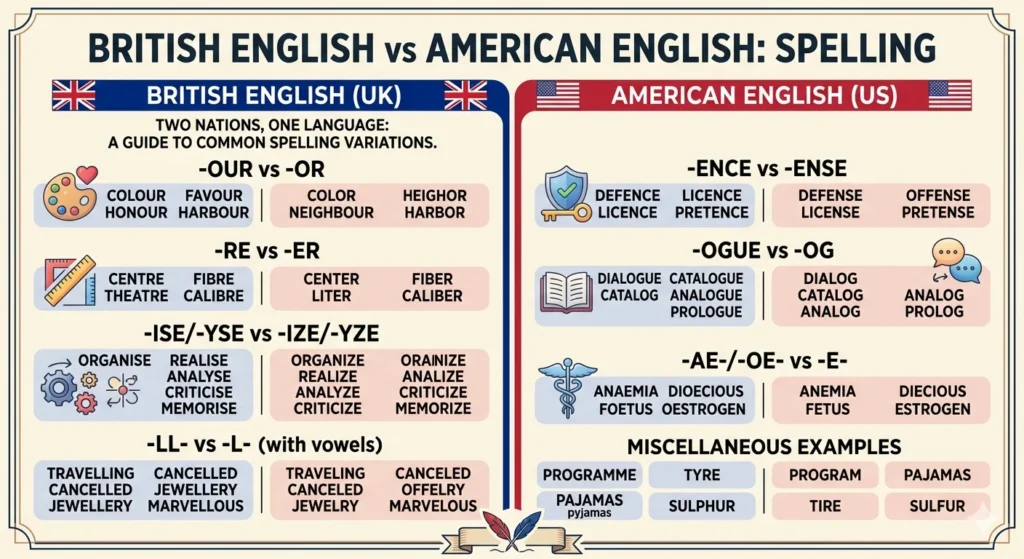
Both British English and American English use the same spellings:
- Complement
- Compliment
There is no major spelling change between US and UK English.
Still, usage style can differ slightly.
| English Style | Complement | Compliment |
|---|---|---|
| American English | Common in business and branding | Common in conversation |
| British English | Common in formal writing | Common in polite speech |
| Australian English | Same as UK usage | Same as UK usage |
| Canadian English | Uses both forms normally | Uses both forms normally |
Complement vs Compliment UK Usage
In the UK, restaurants may say:
- “Complimentary drinks”
This means the drinks are free.
People sometimes wrongly write:
- “Complementary drinks”
But that means the drinks go well with the meal.
Is Free Food Complimentary or Complementary?
This is one of the most searched questions.
- Complimentary food = free food
- Complementary food = food that matches another food
Example:
- “The hotel offers complimentary breakfast.”
- “The salad complements the steak.”
This is a key part of complement vs compliment usage.
Which Spelling Should You Use?
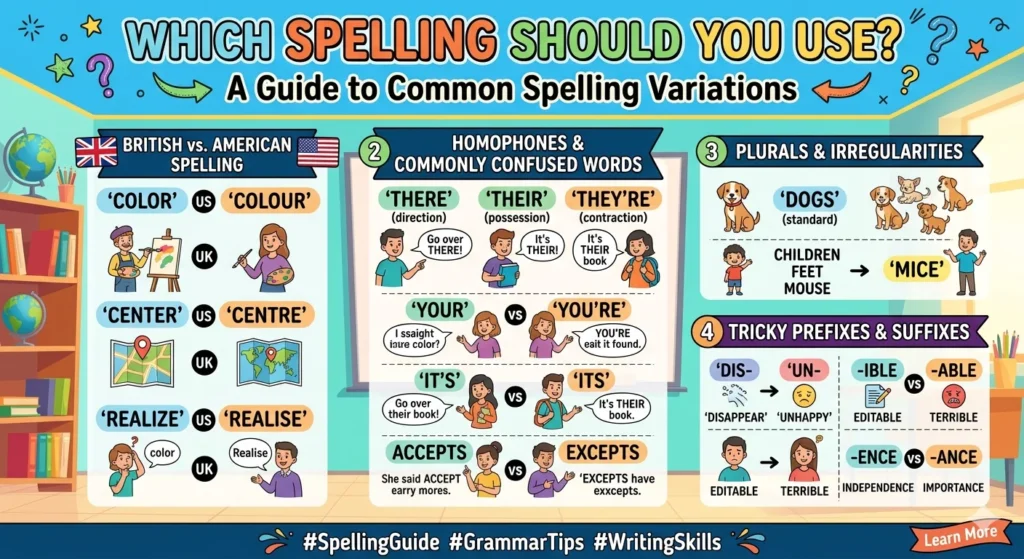
The correct spelling depends on the meaning, not the country.
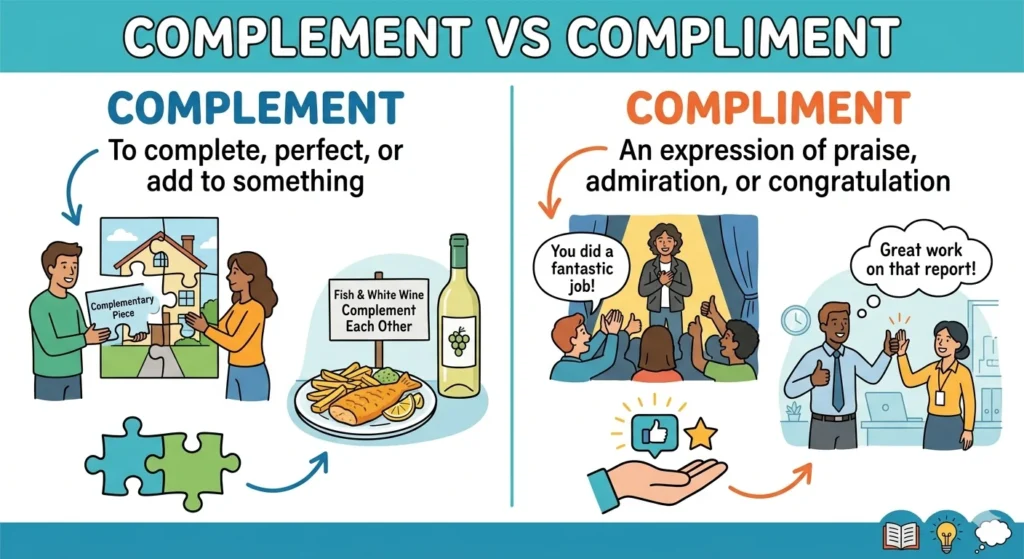
Use “Complement” When:
You mean:
- complete
- improve
- match
- enhance
Examples:
- “Blue curtains complement the room.”
- “Her skills complement the team.”
Use “Compliment” When:
You mean:
- praise
- admire
- say something nice
Examples:
- “He complimented her presentation.”
- “That was a lovely compliment.”
Audience-Based Advice
| Audience | Best Choice |
|---|---|
| US readers | Use standard meanings carefully |
| UK/Commonwealth readers | Same spelling rules apply |
| Global audience | Use simple examples for clarity |
Complement vs Supplement
People also compare complement vs supplement.
- Complement = completes something already there
- Supplement = adds extra support
Example:
- “Rice complements curry.”
- “Vitamins supplement your diet.”
Common Mistakes with Complement vs Compliment
Here are the most common grammar mistakes.
| Incorrect | Correct | Why |
|---|---|---|
| “Nice shoes complement.” | “Nice shoes compliment.” | Praise needs “compliment” |
| “The sauce complimented the pasta.” | “The sauce complemented the pasta.” | Matching needs “complement” |
| “Free complimentary colors.” | “Complementary colors.” | Colors match, not praise |
| “He gave me a complement.” | “He gave me a compliment.” | Praise uses “compliment” |
Complement vs Compliment Difference Grammar
Grammar rule:
- Compliment is often about speech or praise.
- Complement is often about matching or completing.
Is It Complement or Compliment of the Season?
Correct phrase:
- Compliments of the season
This means good wishes or greetings during holidays.
Wrong:
- “Complement of the season”
But people still confuse it because of pronunciation.
Complement vs Compliment in Everyday Examples
Here are real-life examples.
In Emails
- “Thank you for the compliment.”
- “Your experience complements our team.”
In News Writing
- “The actor received many compliments.”
- “The design complements the modern building.”
On Social Media
- “Thanks for all the compliments!”
- “This music complements the video perfectly.”
In Formal Writing
- “The research complements previous studies.”
- “The manager complimented the staff.”
What Does “You Complement Me” Mean?
It means:
- you complete me
- you balance me
- you make me better
What Does “You Compliment Me” Mean?
It means:
- you praise me
- you say nice things about me
These are important complement vs compliment examples because one letter changes the whole meaning.
Complement vs Compliment – Google Trends & Usage Data
Search interest for complement vs compliment stays high because many English learners and native speakers confuse the words.
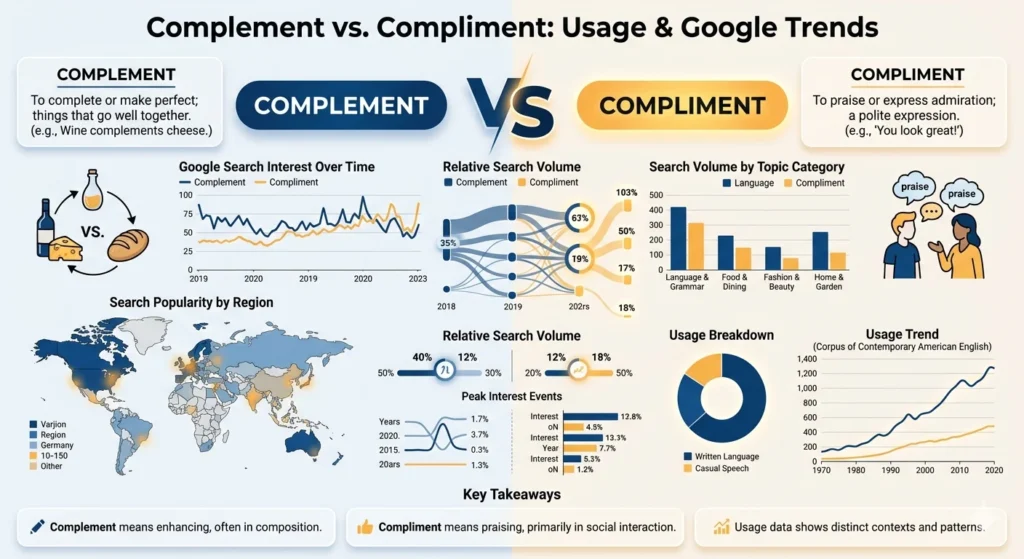
Countries With High Search Interest
Common searches come from:
- United States
- United Kingdom
- Canada
- India
- Pakistan
- Australia
Most Popular Search Intent
People usually want:
- Quick meaning difference
- Correct spelling
- Grammar help
- Real examples
- Business writing guidance
Common Search Phrases
- complement vs compliment meaning
- complement vs compliment difference
- complement vs compliment pronunciation
- complement vs compliment quiz
- complement vs compliment in a sentence
Compliment vs Complement Pronunciation
Both words sound almost the same:
- /KOM-pluh-ment/
That is why spelling mistakes happen often.
Complement vs Compliment Comparison Table
| Feature | Complement | Compliment |
|---|---|---|
| Main Meaning | Complete or match | Praise or admire |
| Part of Speech | Noun/Verb | Noun/Verb |
| Related Idea | Harmony | Kind words |
| Example | “The wine complements dinner.” | “She gave a compliment.” |
| Used in Design? | Yes | Rarely |
| Used in Praise? | No | Yes |
| Complement vs Compliment Which Means Free | No | Yes, in “complimentary” |
| Common Confusion | Matching vs praise | Praise vs matching |
Complement vs Compliment Synonyms
Complement Synonyms
- complete
- enhance
- match
- balance
- improve
Compliment Synonyms
- praise
- admiration
- flattery
- approval
- tribute
FAQs About Complement vs Compliment
What is complement vs compliment?
Complement means to complete or match. Compliment means praise or admiration.
What is an example of complement?
“The red tie complements his suit.”
What does you complement me mean?
It means someone completes or balances you well.
What does you compliment me mean?
It means someone praises or admires you.
Complement vs compliment which means free?
“Complimentary” means free, such as complimentary drinks at a hotel.
When to use complement vs compliment?
Use complement for matching or completing. Use compliment for praise or kind words.
What is the complement vs compliment pronunciation?
They are pronounced almost the same, which causes spelling confusion.
Complement vs compliment quiz trick?
Ask yourself:
- Is it praise? → compliment
- Is it matching or completing? → complement
Conclusion
Understanding complement vs compliment is easier once you know the core difference. A compliment is about praise, kind words, or admiration. A complement is about matching, completing, or improving something. Even though the words sound alike, they are not interchangeable.
This confusion happens because the pronunciation is nearly identical. That is why many writers, students, and professionals search for the complement vs compliment meaning, grammar rules, examples, and correct usage. The easiest way to remember the difference is this:
- Compliment = praise
- Complement = complete
You should also remember that “complimentary” often means free, while “complementary” means things that go well together. These words appear often in business writing, emails, design, fashion, food, and everyday conversations.
If you practice using both words in sentences, the difference will quickly become natural. With the examples, tables, and tips in this guide, you can now use complement and compliment correctly with confidence.

“Witty McGiggles, PunsBlast’s resident pun master, spins clever wordplay and playful humor to turn every moment into a laugh.”