Many people search for “breath vs breathe” because these two words look almost the same—but they are used very differently.
This small spelling change can confuse even fluent English users. You might wonder: What is the difference between breath and breathe? or Is it holding my breath or breathe?
The confusion usually comes from pronunciation and grammar. Both words relate to air and breathing, but one is a noun and the other is a verb.
If you mix them up, your sentence can sound strange or incorrect—like saying “I can’t breath” instead of “I can’t breathe.”
This guide will make everything clear. You’ll learn the breath vs breathe meaning, pronunciation, grammar rules, and real-life examples.
By the end, you’ll confidently know when should I use breath vs breathe and avoid common mistakes in writing and speaking.
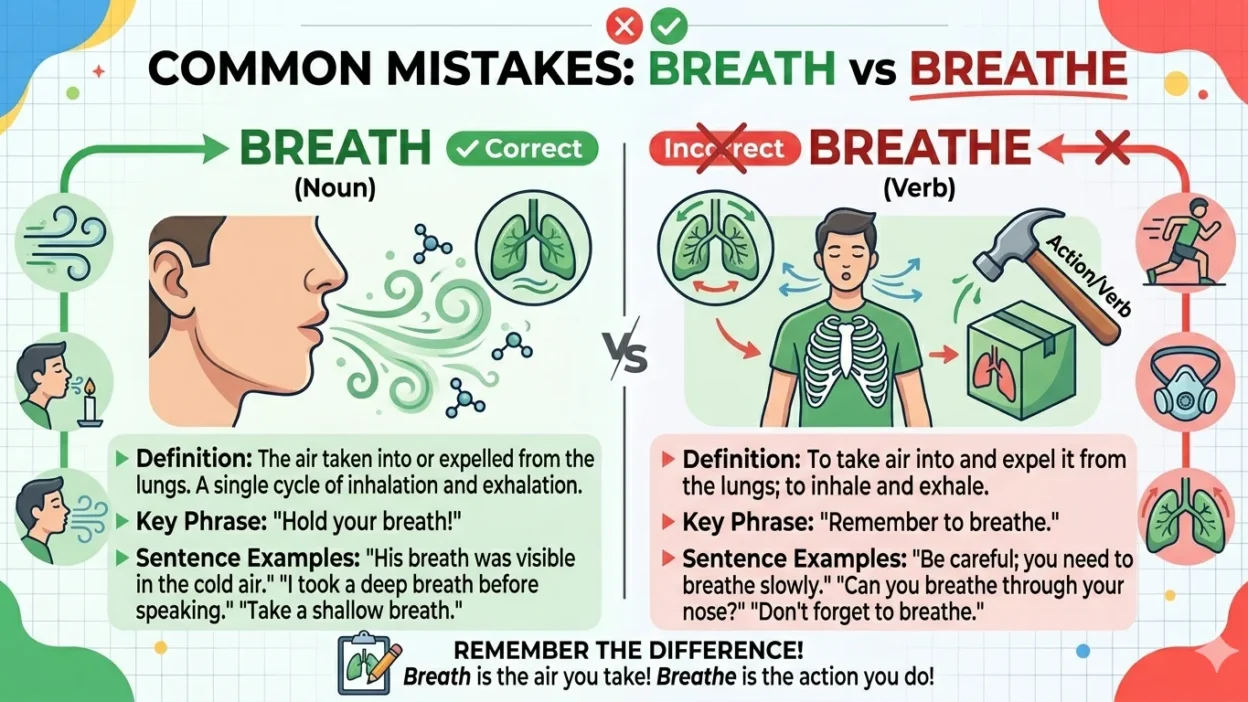
Breath vs Breathe means
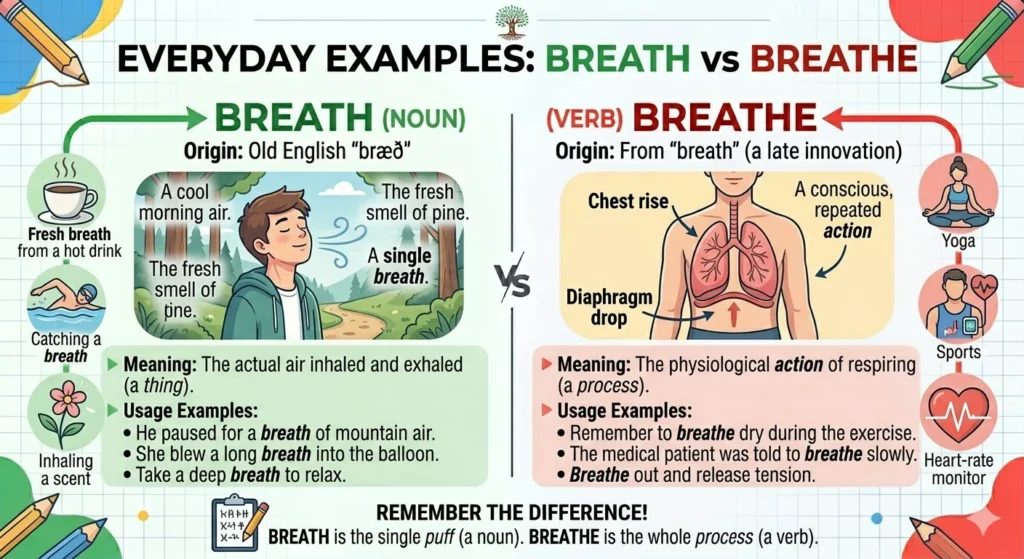
Breath (noun) = the air you take in or out
Breathe (verb) = the action of taking air in or out
Examples:
- Take a deep breath ✅
- Please breathe slowly ✅
- I can’t breathe (not breath) ❌
👉 Easy rule:
If it’s an action, use breathe.
If it’s a thing, use breath.
The Origin of Breath vs Breathe
The words come from Old English:
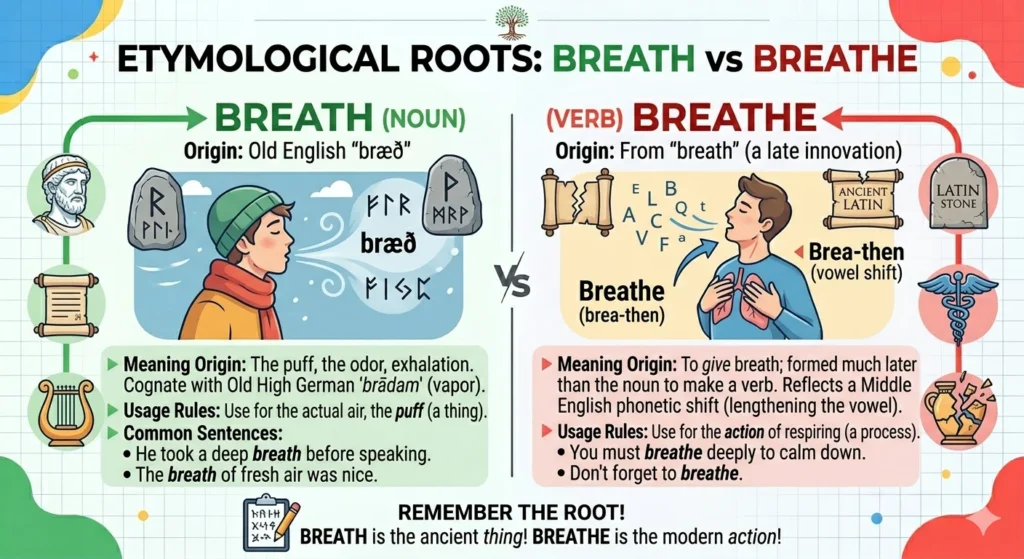
- Breath → from “brǣth” (air, vapor)
- Breathe → from “brǣthian” (to exhale air)
That extra “e” at the end turns the noun into a verb. This pattern exists in English:
- Bath → Bathe
- Cloth → Clothe
This is why breath vs breathe spelling looks similar but works differently.
British English vs American English Spelling
Good news:
There is no difference between British and American English for these words.
Both use:
- Breath (noun)
- Breathe (verb)
Comparison Table
| Usage Type | Word | Example |
|---|---|---|
| Noun | Breath | Take a deep breath |
| Verb | Breathe | Try to breathe slowly |
| UK English | Same | No change |
| US English | Same | No change |
So if you ask “how do you spell breath vs breathe”—the answer is the same everywhere.
Which Spelling Should You Use?
Use depends on grammar, not location:
- 🇺🇸 US audience → same rule
- 🇬🇧 UK audience → same rule
- 🌍 Global audience → same rule
👉 Focus on sentence structure:
- “Take a breath” ✔
- “Try to breathe” ✔
Common Mistakes with Breath vs Breathe
Here are frequent errors:
❌ I can’t breath
✔ I can’t breathe
❌ Take a deep breathe
✔ Take a deep breath
❌ Holding my breathe
✔ Holding my breath
❌ Last breathe
✔ Last breath
Quick Fix Tip:
- If you can replace it with “inhale/exhale” → use breathe
- If you can add “a” or “the” before it → use breath
Breath vs Breathe in Everyday Examples
Emails
- Please take a moment to breathe before replying.
- Take a deep breath and relax.
News
- The patient struggled to breathe.
- He took his last breath.
Social Media
- I can’t breathe after that workout 😅
- Fresh air feels like a new breath of life
Formal Writing
- Controlled breathing helps you breathe better.
- The runner paused to catch his breath.
Breath vs Breathe – Google Trends & Usage Data
Search data shows:
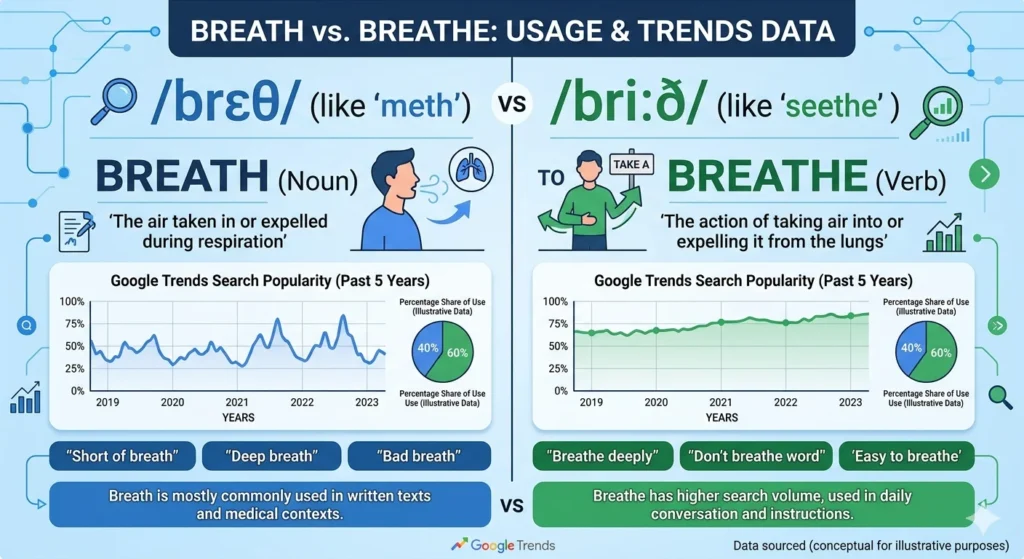
- “breath vs breathe difference” is highly searched by students
- “I can’t breathe or breath” is common due to grammar confusion
- English learners often search:
- breath vs breathe pronunciation
- breath vs breathe meaning in English
Popular Regions:
- India
- Pakistan
- USA
- UK
This shows global confusion, especially among learners.
Comparison Table (All Variations)
| Word | Type | Meaning | Example |
|---|---|---|---|
| Breath | Noun | Air taken in/out | Take a breath |
| Breathe | Verb | To inhale/exhale | Try to breathe |
| Breadth | Noun | Width/size | Breadth of river |
👉 Many confuse breadth vs breath vs breathe—but breadth means size, not air.
FAQs
1. What is the difference between breath and breathe?
Breath is a noun. Breathe is a verb.
2. How do you use breath and breathe?
Use breath for things, breathe for actions.
3. Is it holding my breath or breathe?
Correct: holding my breath ✅
4. I can’t breathe or breath—which is correct?
Correct: I can’t breathe ✅
5. Take a deep breath or breathe?
Correct: Take a deep breath ✅
6. What about “breath vs breathe of fresh air”?
Correct phrase: a breath of fresh air
7. How to remember breath vs breathe?
👉 Breathe has an “e” = action (verb)
Conclusion
Understanding breath vs breathe is easier than it first looks. The key difference is simple: one is a noun and the other is a verb. If you remember that breath is something you take, and breathe is something you do, you will avoid most mistakes.
This confusion happens because the words look alike and sound similar. But with practice, you can quickly spot the correct choice. Pay attention when writing common phrases like “take a deep breath,” “I can’t breathe,” or “holding my breath.” These are everyday examples where people often make errors.
If you’re still unsure, use the quick trick: add “a” before the word. If it sounds right, use breath. If not, use breathe. Over time, this will become natural.
Mastering small grammar rules like this improves your writing, makes your communication clearer, and helps you sound more confident in English.

“George Gissing, a humor-loving writer at PunsBlast, crafting witty puns and playful word magic to make readers laugh every single day.”