
Have you ever paused mid-sentence, unsure if you meant a vile person or a vial of medicine? You’re not alone. The mix-up between “vile” and “vial” is one of the most common spelling confusions in English.
People search for this phrase not to find a single definition, but to solve a real problem: they’ve heard a word and don’t know which meaning—or spelling—applies.
This confusion stems from them being homophones; they sound identical when spoken but have utterly different meanings. One refers to something morally repulsive, the other to a small glass container.
This article cuts through the noise. We’ll provide a quick answer, explore the words’ origins, and offer clear, practical advice.
Whether you’re writing a medical report, a novel, or a simple email, knowing the difference between vile and vial is crucial for clear and professional communication. Let’s solve this common language puzzle once and for all.
Vile or Vial
“Vile” and “vial” are two different words with completely different meanings.

- Vile (adjective): This means extremely unpleasant, morally bad, or disgusting.
- Examples: The vile odor filled the room. He was known for his vile temper. It was a vile act of betrayal.
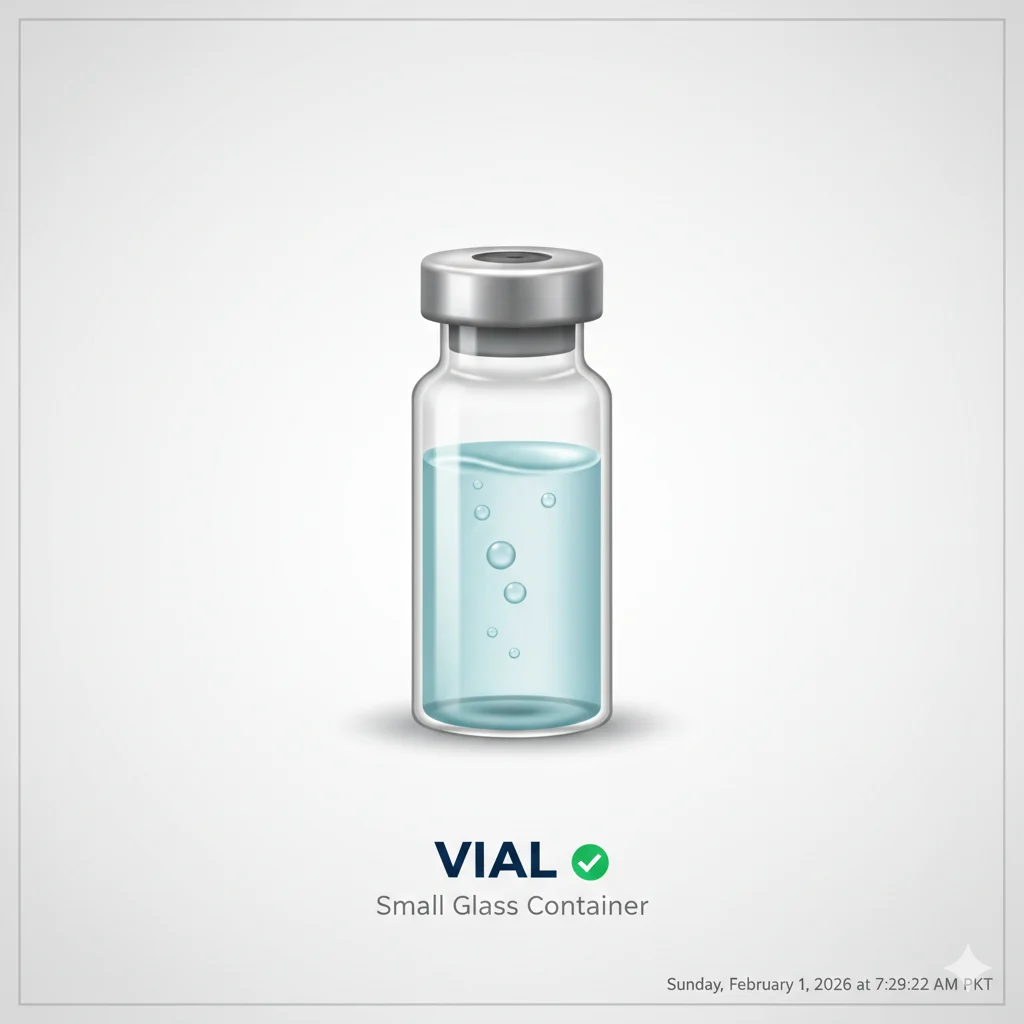
- Vial (noun): This is a small container, typically a glass tube or bottle, used to hold liquids like medicines or perfumes.
- Examples: The nurse carefully filled the vial with vaccine. The scientist broke a vial of rare chemicals. Is it a vial or vile of blood? The correct phrase is “a vial of blood.”
Simple Trick: Remember that a vial is a vessel (both start with ‘v’). Vile is a value judgment about behavior or things.
The Origin of Vile and Vial
Understanding where these words come from explains why they sound the same but mean such different things.
Origin of “Vile”:
The word “vile” comes from the Latin word vilis, meaning “cheap, base, worthless.” It entered English through Old French in the 14th century. Its meaning evolved from “of low cost or status” to “morally low, despicable, or unpleasant.” This history connects to its modern use, where it describes something profoundly bad or repulsive in nature. The “vile meaning” is always tied to a lack of worth or quality in character or substance.
Origin of “Vial”:
The word “vial” has a more physical origin. It comes from the Greek word phialē, meaning a broad, flat container. This passed into Latin as phiala and then into Old French as fiole. The ‘f’ eventually changed to a ‘v’ in English. It has always referred to a small vessel for holding liquids. This is why you’ll see it in scientific and medical contexts—a “vile container” is incorrect; the right term is a “vial.”
Their spelling difference exists because they entered English from different French/Latin roots, converging on a similar sound by chance.
British English vs American English Spelling
For these particular words, there is no difference between British and American spelling. “Vile” and “vial” are spelled identically in both major English variants. The confusion is purely about meaning, not regional spelling rules.
However, it’s useful to see how other “container” words can vary. The word “vial” is sometimes linked to “phial,” which is a less common variant but means the same thing.
| Word | American English Preference | British English Preference | Meaning |
|---|---|---|---|
| Vile | vile | vile | Extremely unpleasant |
| Vial | vial | vial (or sometimes phial) | Small glass container |
| Phial | phial (less common) | phial (slightly more common) | Small glass container (same as vial) |
The key takeaway: you don’t need to change the spelling of vile or vial based on your audience’s location, only their correct usage.
Which Spelling Should You Use?
Your choice depends entirely on what you want to say, not where your audience is from.
- For US Audiences: Use “vial” for the container and “vile” for describing something disgusting. The spelling is standard.
- For UK/Commonwealth Audiences: The same rule applies. Use “vial” (or occasionally “phial” in literary contexts) for the container. “Vile” remains the spelling for the adjective.
- For Global/Formal Writing (Medical, Scientific, Business): Precision is critical.
- In a lab report, you will always use “vial.” (“Store the sample in a sealed vial.“)
- In a legal or ethical document, you might use “vile” to describe an action. (“The defendant’s conduct was vile.“)
- Incorrect usage can damage credibility. Writing about a “vile of blood” in a medical paper is a serious error.
Common Mistakes with Vile and Vial
Here are the most frequent errors and how to correct them.
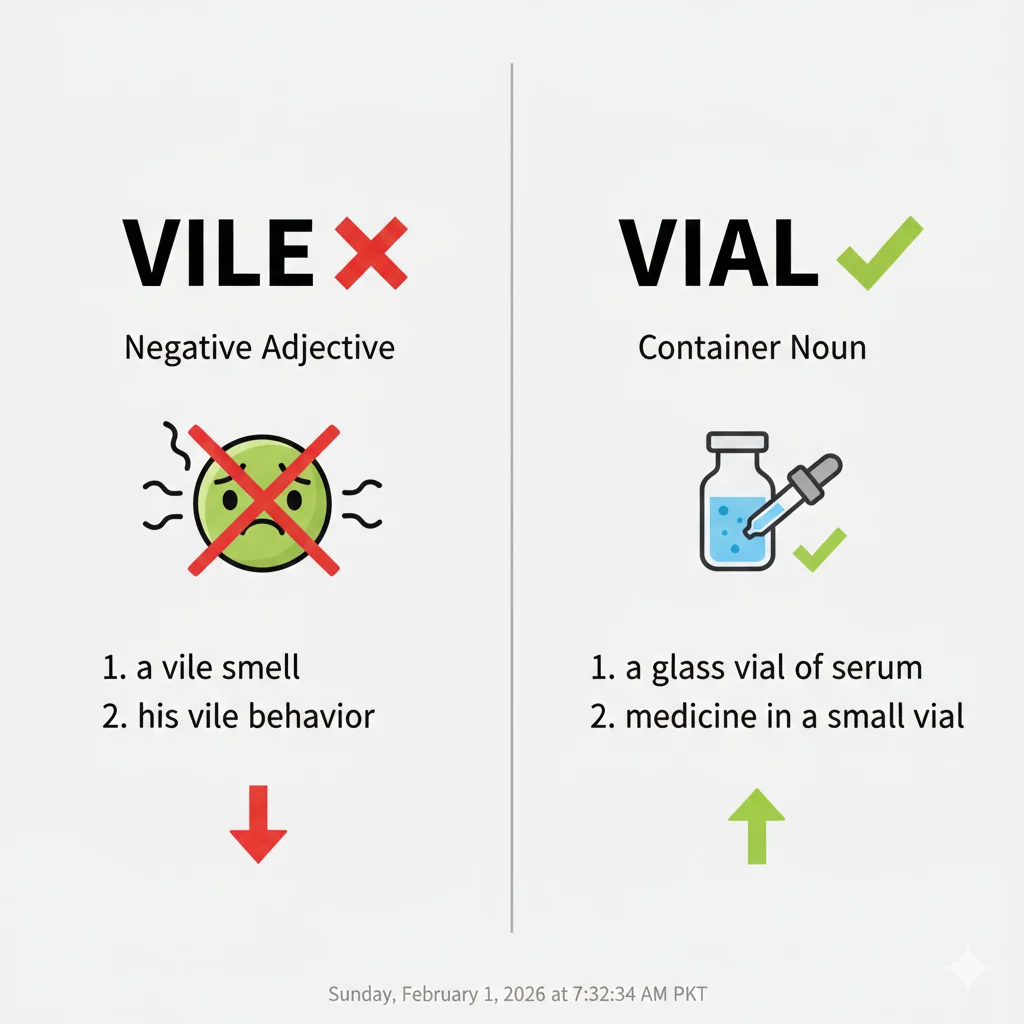
- Incorrect: “The doctor took a vile of blood.”
- Correction: “The doctor took a vial of blood.” (You cannot take a “disgusting” of blood.)
- Incorrect: “His vial comments offended everyone.”
- Correction: “His vile comments offended everyone.” (Comments are not containers.)
- Mixing Up Meanings: Using “vial” as an adjective (e.g., “a vial substance”) is always wrong. “Vial” is only a noun.
- Confusing with “Phial”: While “phial” is a synonym for “vial,” it is less common in everyday modern English, especially in American usage. Sticking with “vial” is generally the safest choice.
Vile or Vial in Everyday Examples
Seeing them in context makes the distinction clear.
- Email (Work): “Please ensure the vial samples are sent to Lab B by 3 PM. The delay in the process was due to a vile misunderstanding that has now been resolved.”
- News Headline: “Breaking: Contaminated Vials of Vaccine Destroyed; Politician Denounces ‘Vile‘ Act of Sabotage.”
- Social Media Post: “Just got my flu shot! One tiny vial protects so many. Spreading misinformation about vaccines, however, is vile.”
- Formal Writing (Medical): “The serum was aliquoted into 5ml sterile vials and stored at -20°C.” (Note: “vile” would almost never appear in a standard medical report unless describing a disease’s symptoms metaphorically.)
- Casual Conversation: “What a vile smell! Did something spill?” vs. “Can you hand me that small vial of perfume?”
Vile or Vial – Google Trends & Usage Data
Analyzing search data reveals the nature of the confusion. Searches for “vile or vial” and “is it vial or vile?” spike consistently, showing it’s a perennial question. Geographically, these searches are common in English-speaking countries like the US, UK, Canada, and Australia.
The term “vial” sees higher sustained search volume due to its practical, non-emotional use—people look up what it is, where to buy one, or its role in medical contexts (e.g., “covid vaccine vial”). Searches for “vile meaning” also occur frequently, often tied to news stories about offensive speech or actions.
This data confirms that the primary user intent is clarification. People aren’t just looking for a definition; they are actively trying to decide which word to use in their own writing or to understand which meaning was intended in something they’ve read or heard.
Keyword Variations Comparison Table
| Keyword | Part of Speech | Meaning | Common Context | Example |
|---|---|---|---|---|
| Vile | Adjective | Extremely unpleasant, morally despicable. | Describing behavior, smells, actions, or people. | “It was a vile insult.” |
| Vial | Noun | A small glass or plastic container for liquids. | Medical, scientific, perfume, and sample storage. | “A vial of insulin.” |
| Vile person | Noun Phrase | A morally wicked or disgusting individual. | Character description, criticism. | “He was revealed to be a vile person.” |
| Vial of blood | Noun Phrase | A small container holding a blood sample. | Healthcare, laboratories, testing. | “They drew a vial of blood for testing.” |
| Phial | Noun | A variant of “vial,” means the same. | More common in literary or older texts. | “The ancient phial contained a potion.” |
FAQs: Vile vs. Vial
1. Is it vial or vile?
It depends on the meaning. Use vile to describe something disgusting or evil. Use vial for a small container for liquids.
2. Is it vile or vial of blood?
The correct phrase is “a vial of blood.” A “vile of blood” is incorrect, as “vile” cannot hold anything.
3. Why does vile mean what it does?
The word “vile” comes from Latin vilis (cheap, worthless), which evolved to mean morally base or repulsive.
4. What is the meaning of vial?
A vial is a noun meaning a small bottle, usually made of glass or plastic, used to store medicines, chemicals, or perfumes.
5. Can ‘vile’ be a noun?
Rarely. While primarily an adjective, “vile” can be used informally as a noun (e.g., “the vicissitudes of life, the vile and the sublime”), but this is not common. “Vial” is always a noun.
6. Does ‘vial’ ever mean ‘bad’?
No. “Vial” never means bad. The word for “bad” or “disgusting” is vile. “Vial meaning bad” is a common search resulting from this confusion.
7. What is a ‘vile person’?
A “vile person” is someone whose character or actions are considered profoundly wicked, offensive, or morally repugnant.
Conclusion
In summary, the confusion between vile and vial is a classic example of a homophone trap in English. The key to never making this mistake is to anchor their distinct meanings: vile is an adjective describing the disgusting or morally repulsive, while vial is a noun naming a physical container. Remember the simple trick: a vial is a vessel. Whether you’re in the US, UK, or anywhere else, this rule holds true. In professional settings, especially medical or scientific fields, using the correct term is non-negotiable for maintaining clarity and credibility. By understanding their origins, contexts, and common pitfalls, you can now confidently choose the right word. Let this guide be your reference to ensure your writing is always precise, whether you’re condemning a vile act or handling a crucial vial of medicine.

“Margaret Oliphant, a witty wordsmith at PunsBlast, blending charm and clever humor to turn everyday moments into laugh-worthy puns.”