Have you ever paused before typing “teams” or “team’s,” your finger hovering over the keyboard? You’re not alone.
This tiny apostrophe is a giant source of confusion for millions. People search for this phrase because they want to sound professional, avoid grammar mistakes, and clearly express ownership or plurality in their writing.
This confusion appears everywhere – in emails about a team’s project goals, on social media cheering for favorite football teams, or in business reports discussing team efforts.
This article will cut through the noise. We’ll solve the simple but crucial spelling problem of teams or team’s. You’ll learn the core rules, see clear examples, and get practical advice so you can write with complete confidence. The difference is easy to master, and getting it right makes your communication instantly clearer.
Teams or Team’s
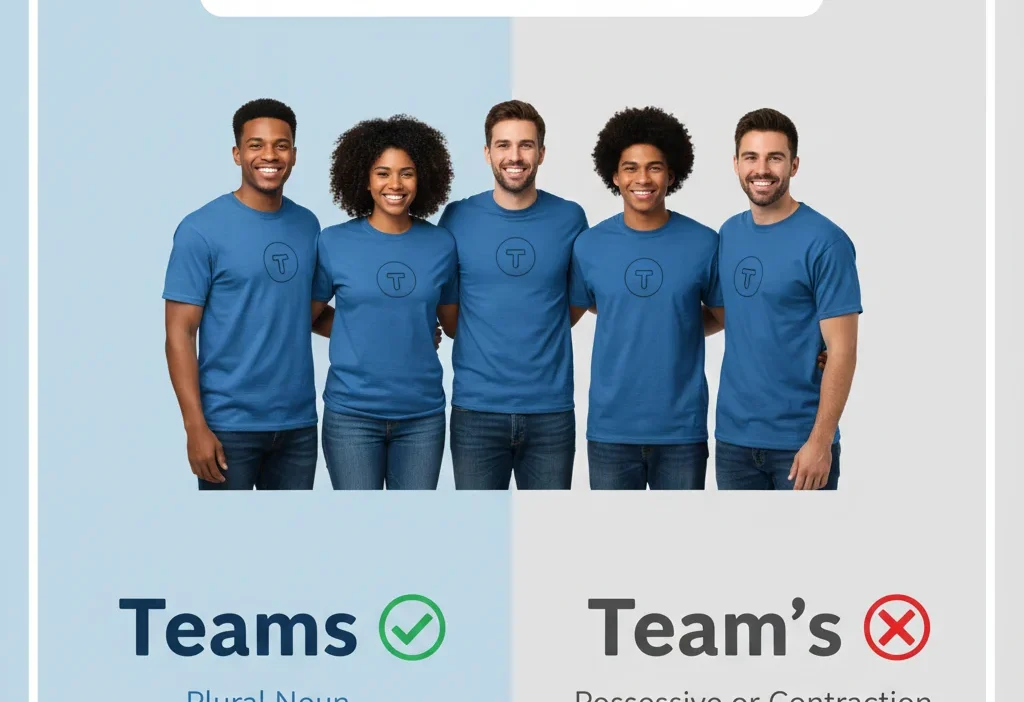
Here is the short, direct answer. The difference is about plural vs. possessive.
Teams (no apostrophe) is the simple plural of “team.” It means more than one team.

- Example: “There are 32 teams in the National Football League.”
- Example: “The project required multiple teams to collaborate.”
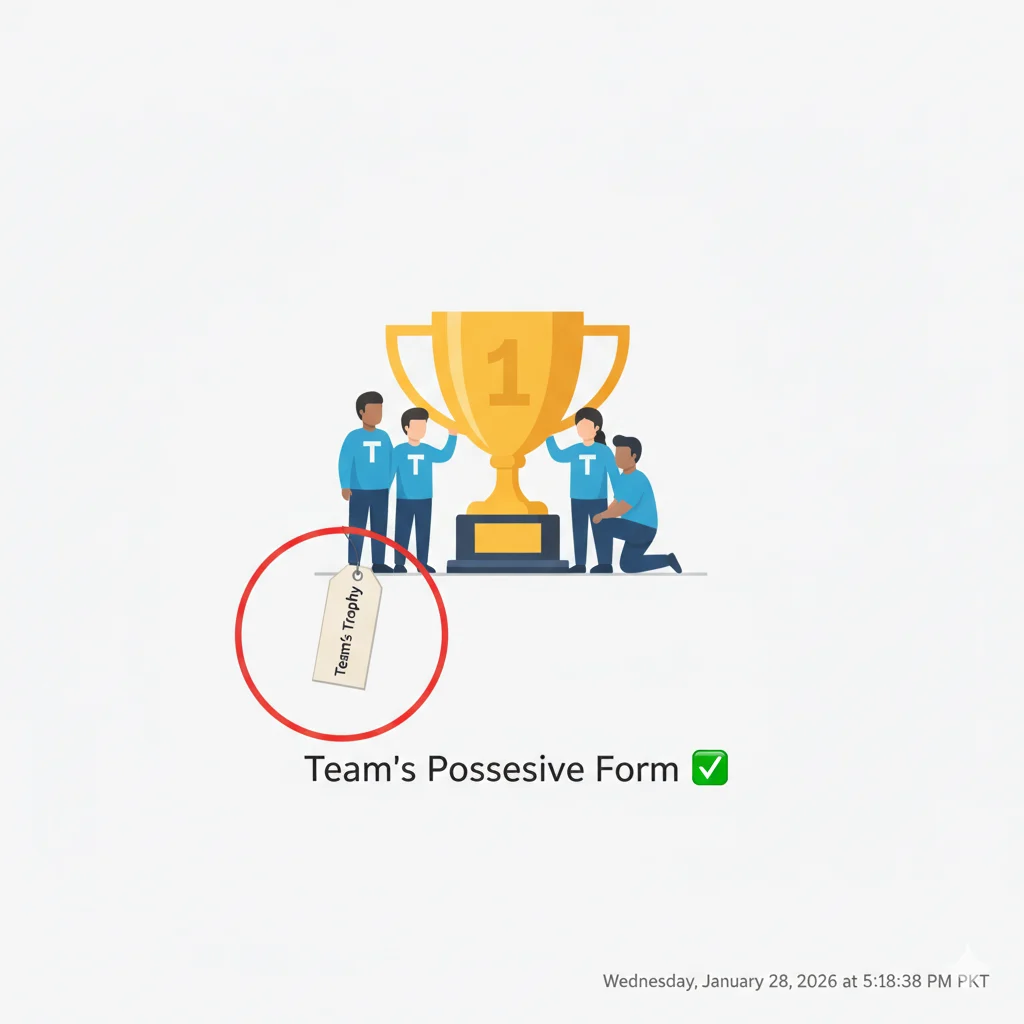
Team’s (with an apostrophe + s) is the possessive form. It shows something belongs to one team.
- Example: “Our team’s strategy won the game.” (The strategy belongs to the team).
- Example: “The team’s morale is high.” (The morale of the team).
There is also teams’ (apostrophe after the s). This is the plural possessive, used when something belongs to more than one team.
- Example: “All teams’ scores were posted.” (The scores of all the teams).
If you’re asking “Is it team’s time or teams time?” for a shared moment, the correct possessive is team’s time (e.g., “It is the team’s time to shine”).
The Origin of Teams and Team’s
The word “team” comes from Old English tēam, meaning “family, lineage, or offspring.” It later evolved to mean a group of animals working together, like a team of horses, before shifting to its modern sense of a group of people working toward a common goal.
The spelling confusion doesn’t come from “team” itself, but from English possessive rules. Centuries ago, English used a complex case system. Over time, this simplified, and the apostrophe was adopted in the 18th century to show possession, replacing the older genitive “es” ending. This is why we add ‘s to show that a noun owns something.
The difference between teams and team’s exists because written English uses the same sound (/tēmz/) for three different grammatical ideas: plural, singular possessive, and plural possessive. Our ears can’t tell the difference, so we rely on the written apostrophe to show ownership. This is why understanding the rule is so important for clear writing.
British English vs. American English Spelling
The good news is that for “teams” and “team’s,” the core rules are identical in both British and American English. The plural is “teams,” and the possessive uses an apostrophe.
However, subtle differences in possessive style can sometimes appear with singular nouns ending in “s.” While this is more relevant for names like “James” or “bus,” it’s worth noting for thoroughness. Both dialects sometimes use just an apostrophe for classical or proper names ending in s (e.g., “Jesus’ teachings”), but American English more consistently prefers ‘s (e.g., “James’s car”).
For the word “team,” there is no difference. You will always write “the team’s coach” in both dialects.
| Feature | American English Preference | British English Preference | Example with “Team” |
|---|---|---|---|
| Plural | teams | teams | Both: Many teams competed. |
| Singular Possessive | team’s | team’s | Both: The team’s victory was celebrated. |
| Plural Possessive | teams’ | teams’ | Both: The teams’ buses arrived. |
Which Spelling Should You Use?
Your choice depends entirely on what you want to say and who your audience is.
- For a US Audience: Use team’s for singular possession and teams’ for plural possession. The rules are applied strictly. Clarity is king.
- For a UK/Commonwealth Audience: The rules are the same. Use team’s and teams’ as described. You can be confident these forms are universally correct.
- For Global or Business Communication: Always default to the standard rules. Using the correct possessive (team’s) shows professionalism and attention to detail. If you are ever unsure, ask: “Am I talking about more than one team (teams), or am I showing something belongs to a team (team’s)?”
Simple Tip: Use the “of the” test.
- If you can say “the strategy of the team,” use team’s (team’s strategy).
- If you are simply counting (“many teams”), use teams.
Common Mistakes with Teams or Team’s
Here are the most frequent errors and how to fix them.

- Using “teams” when you mean “team’s” (the possessive).
- Incorrect: “The teams morale is low.” (You are talking about the morale belonging to one team).
- Correct: “The team’s morale is low.”
- Using “team’s” as a simple plural.
- Incorrect: “All five team’s advanced to the playoffs.”
- Correct: “All five teams advanced to the playoffs.”
- Confusing “teams” with “team’s” in phrases like “teams efforts.”
- Incorrect: “We succeeded through our teams efforts.” (This is a very common error).
- Correct: “We succeeded through our team’s efforts.” (The efforts of one team) OR “We succeeded through our teams’ efforts.” (The efforts of multiple teams).
- Misplacing the apostrophe in the plural possessive.
- Incorrect: “The team’s locker rooms were cleaned.” (This implies one team has multiple locker rooms).
- Correct, if talking about multiple teams: “The teams’ locker rooms were cleaned.” (The locker rooms belonging to the various teams).
Teams or Team’s in Everyday Examples
Seeing these words in context helps lock in the rules.
- Email (Business): “Please submit your team’s quarterly report by Friday. We will then compare all teams’ results in the meeting.”
- News Headline: “City Teams’ Rivalry Reaches Fever Pitch Ahead of Championship.” (Plural possessive).
- Social Media Post: “So proud of both our #sales teams! Our team’s hard work in Q4 really paid off. #Teamwork”
- Formal Report: “The merger will integrate the two teams’ client databases. Each team’s manager will oversee the transition.”
- Sports Commentary: “The team’s defense was impenetrable tonight. They are one of the best teams in the league.”
Teams or Team’s – Google Trends & Usage Data
While Google Trends doesn’t track grammar rules directly, we can see the massive search volume for related terms. Searches for “teams login” (referring to Microsoft Teams) dominate globally, showing the brand’s huge impact. However, consistent long-tail keyword searches like “teams or team’s” and “teams efforts or team’s efforts” reveal widespread and ongoing confusion.
Data shows these grammar searches are common in English-speaking countries like the US, UK, Canada, and Australia. They spike during academic seasons and in professional contexts, indicating students and working adults actively seek clarity to improve their written work. The simple fact that “What is the difference between team’s and teams?” is a frequent query proves that mastering this distinction meets a real and common need.
Comparison Table: Keyword Variations Side by Side
| Form | Example Sentence | Explanation | Correct? |
|---|---|---|---|
| teams | Three teams qualified. | Simple plural (more than one team). | ✅ |
| team’s | Our team’s project is done. | Singular possessive (thing belongs to one team). | ✅ |
| teams’ | The teams’ jerseys were colorful. | Plural possessive (thing belongs to many teams). | ✅ |
| teams efforts | I admire their teams efforts. | Missing apostrophe for possessive. | ❌ |
| team’s efforts | I admire their team’s efforts. | Correct singular possessive. | ✅ |
| teams’ efforts | I admire all teams’ efforts. | Correct plural possessive. | ✅ |
FAQs
1. What is the difference between team’s and teams?
“Teams” is the plural (more than one). “Team’s” is the possessive, showing something belongs to one team.
2. What is the meaning of team’s?
“Team’s” means that something belongs to or is associated with one specific team (e.g., the team’s captain, the team’s spirit).
3. Is the word “teams” correct?
Yes, “teams” is perfectly correct when you are referring to more than one team. It is the standard plural form.
4. Is it “team’s time” or “teams time”?
The correct phrase is “team’s time.” The apostrophe shows it is the time belonging to the team (e.g., “It’s our team’s time to present”).
5. How do I write about the efforts of my team?
You write “my team’s efforts.” If you have multiple teams, it would be “my teams’ efforts.”
6. What is “teams plural possessive”?
The plural possessive is teams’ (apostrophe after the s). It shows something belongs to multiple teams (e.g., “The teams’ schedules aligned”).
7. Is “Teams login” related to this grammar rule?
No. “Teams login” almost always refers to logging into the Microsoft Teams software application. It is a proper noun, not a grammar example.
Conclusion
In summary, the battle of teams or team’s is easily won by remembering one core rule: the apostrophe shows possession. Use teams for more than one team. Use team’s when something belongs to that team. For ownership by multiple teams, use teams’. This simple distinction prevents common errors like “teams efforts” and makes your writing precise and professional. Whether you’re discussing football teams, your team’s objectives at work, or coordinating multiple teams’ schedules, applying this rule ensures your meaning is clear. Bookmark this guide, use the “of the” test when in doubt, and never second-guess your apostrophe again.

“Witty McGiggles, PunsBlast’s resident pun master, spins clever wordplay and playful humor to turn every moment into a laugh.”