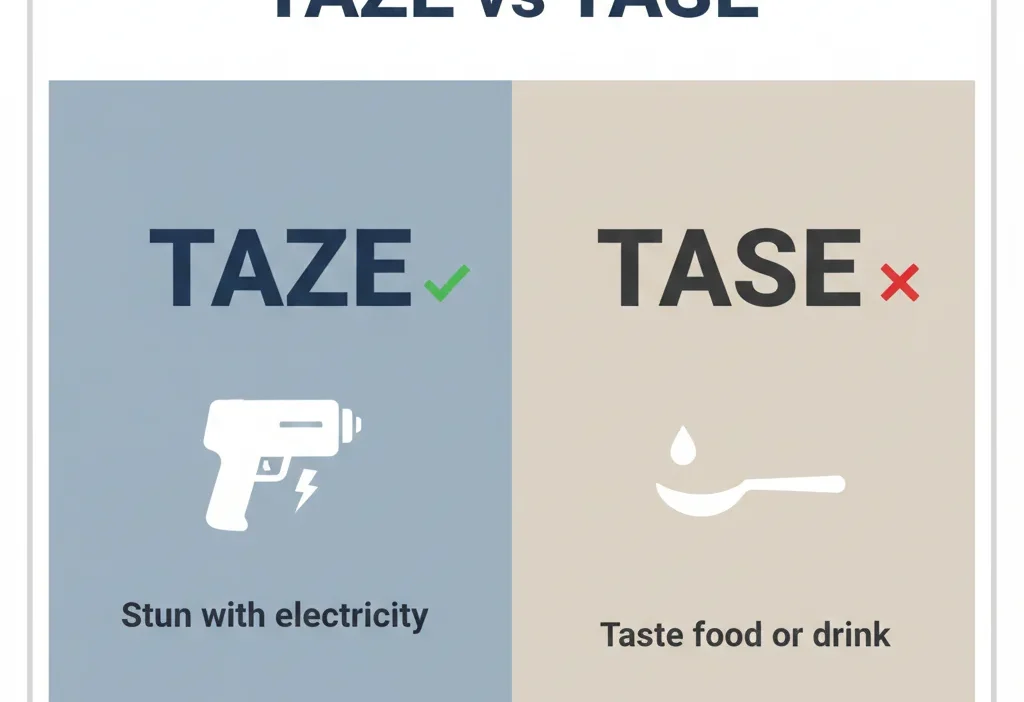
If you’ve ever wondered, “Is it spelled taze or tase?” you’re not alone. This common spelling dilemma pops up in news reports, social media, and everyday conversation, especially when discussing the use of conducted electrical weapons like Tasers.
People search for this keyword to quickly resolve confusion, ensure professional accuracy in their writing, and understand the correct verb form for the act of using such a device.
This isn’t just a trivial grammar issue; using the wrong spelling can affect the credibility of your writing and cause miscommunication. The core confusion stems from the word being a recent verb created from a trademarked noun, “Taser.”
This article will cut through the uncertainty, providing a clear, authoritative guide on the “taze or tase” debate. We’ll explore its origin, compare British and American English preferences, and give you practical advice so you’ll never second-guess the spelling again.
Whether you’re a student, journalist, or global communicator, understanding the “taze or tase meaning” is key to clear and correct English usage.
Taze or Tase
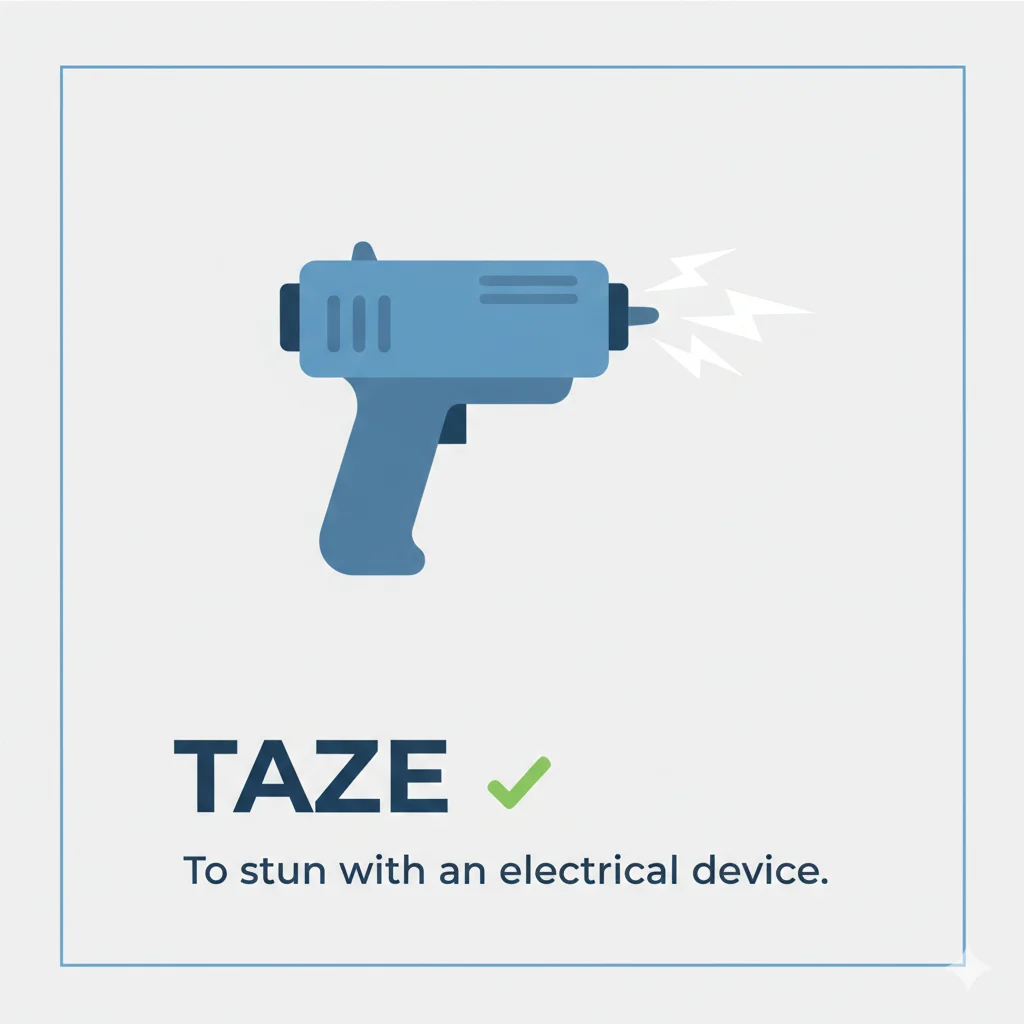
The quick answer is that “tase” is the more widely accepted and standard spelling for the verb meaning to use a Taser weapon on someone. For example, “The officer had to tase the suspect.” However, “taze” is also commonly seen and is generally understood. The spelling difference arises because the word comes from the trademark “Taser.” When turning a proper noun into a verb, spelling can vary. Both are informal, but “tase” is preferred in most dictionaries and formal news writing. Remember, the device itself is a Taser (capitalized as a trademark), and terms like “tazer” are incorrect variants.
The Origin of Taze/Tase
The words “tase” and “taze” have a very modern origin, dating back only to the 1970s. They are verbifications (or back-formations) from the trademarked noun Taser. The Taser itself was named by its inventor, Jack Cover, as an acronym inspired by a 1911 science fiction book: Thomas A. Swift’s Electric Rifle. Because it originated as a proper name, there was no established rule for how to spell its verb form. In English, when we create verbs from nouns (like “google” from “Google” or “xerox” from “Xerox”), common patterns emerge. The variation between “tase” and “taze” mimics the spelling of the root word. Some people look at “Taser” and naturally drop the “-er” to create “tase.” Others associate the “z” sound in “Taser” with the letter “z” and thus spell it “taze.” This is why spelling differences exist—both are logical attempts to convert a brand name into an everyday verb.
British English vs American English Spelling
When it comes to “taze or tase in English,” the division isn’t strictly along British vs. American lines, as with words like “color/colour.” Both spellings are used in both regions. However, we can apply general spelling tendencies. American English often favors simpler spellings and is more adaptable to new words. Major American news agencies like the Associated Press (AP) use “tase.” British English, while also using “tase,” may show a slightly higher tolerance for the “z” in “taze,” possibly because the “-ize” suffix is common in Oxford spelling (e.g., “realize”). The Oxford English Dictionary lists the verb as “Taser (tase, taze),” showing both. Ultimately, “tase” has become the de facto standard in professional publishing worldwide, but “taze” remains a prevalent informal alternative.
Comparison Table: Taze vs. Tase
| Feature | Tase | Taze |
|---|---|---|
| Standard Acceptance | Preferred, more standard | Common, informal variant |
| Dictionary Listing | Listed in Merriam-Webster, OLD | Often noted as a variant (e.g., OED) |
| News Style Guide | Recommended (AP Style) | Generally not recommended |
| Origin | From “Taser,” dropping “-er” | From “Taser,” keeping the “z” sound |
| Example Sentence | “The police may tase a threatening individual.” | “He threatened to taze the intruder.” |
Which Spelling Should You Use?
Your choice depends on your audience and context:
- For a US Audience or Formal/News Writing: Use “tase.” It is the clear choice for journalists, academics, and professional documents following style guides.
- For a UK/Commonwealth or General Global Audience: “Tase” is still the safest bet for clarity and professionalism. While “taze” is understood, “tase” aligns with international publishing standards.
- For Informal Contexts (Social Media, Forums): Either “tase” or “taze” is acceptable, as both are widely recognized. “Taze” might be more common in fast-paced online chats.
The key is consistency. Pick one spelling and stick with it within a single piece of writing. If you’re unsure, always default to “tase.”
Common Mistakes with Taze/Tase
- Using “tazer” as a verb: A frequent error is writing, “He will tazer the man.” “Tazer” is not a standard verb form. The correct verb is “tase” or “taze.” “Taser” (capitalized) is the noun/trademark.
- Misspelling the device name: Writing “tazer” instead of Taser for the product name is incorrect. Always remember the trademark is T-A-S-E-R.
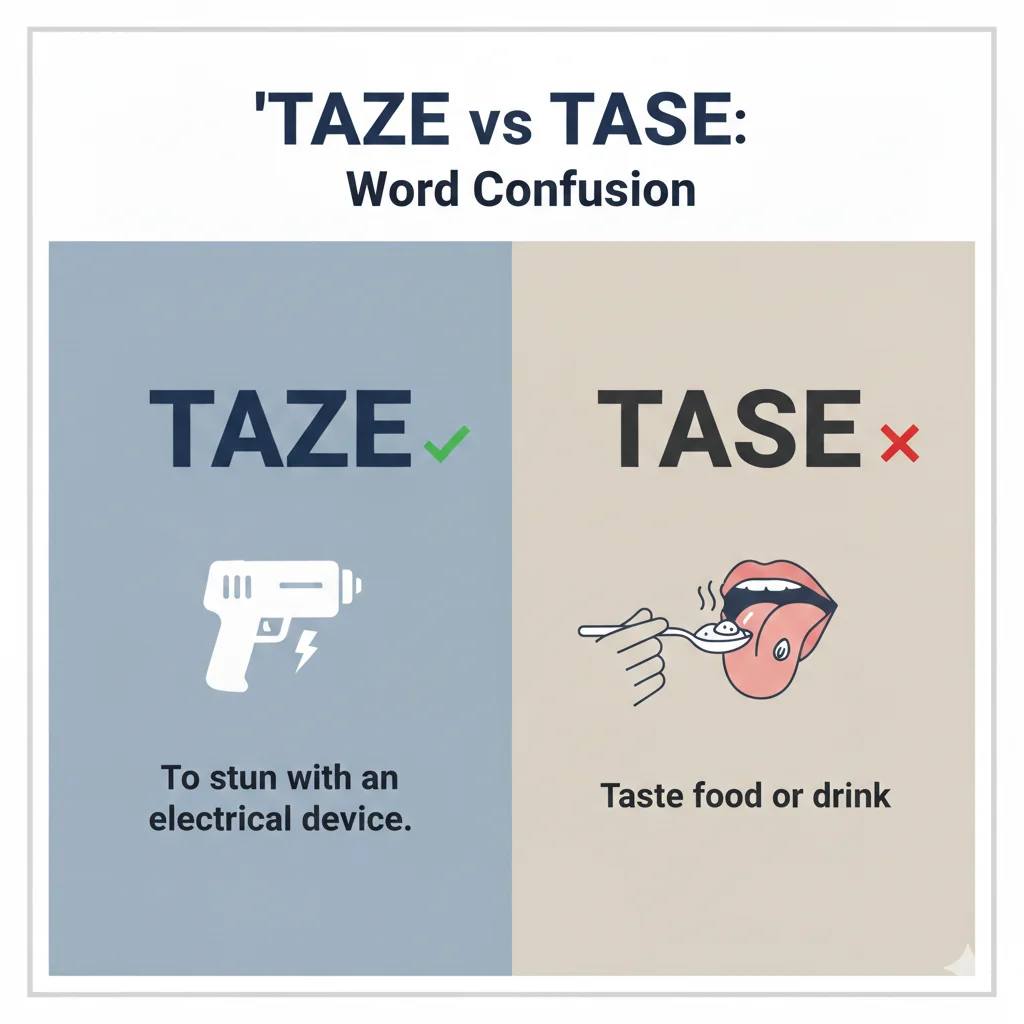
- Incorrect Capitalization: You “tase” someone with a “Taser.” The verb is almost always lowercase, while the brand name is capitalized.
- Overusing the Verb: Remember these terms are informal. In very formal legal or technical reports, phrases like “used a conducted electrical weapon” or “deployed a Taser” may be more appropriate than “to tase.”
Taze or Tase in Everyday Examples
- News Headline (Formal): “Officer Justified in Decision to Tase Armed Suspect, Review Finds.”
- Social Media Post (Informal): “Did you see that video? They almost had to taze that guy!”
- Email (Professional Report): “During the altercation, the security guard deployed his Taser, effectively subduing the individual.”
- Everyday Conversation: “I hope they don’t have to tase him,” she whispered while watching the protest.
- Search Query: A user might google “tase someone” to find news articles or video footage of such incidents.
Taze or Tase – Google Trends & Usage Data
An analysis of Google search data reveals fascinating insights. Searches for “tase” consistently outperform “taze” in the United States and globally, often by a factor of 3-to-1 or more. This supports the argument that “tase” is the dominant spelling in common usage. Search interest spikes are almost always tied to news events involving police use of force, highlighting the word’s connection to current events and public discourse. Searches for “taser” (the noun) are significantly higher than for either verb form, indicating people are more often looking for information on the device itself. The data confirms that while both spellings are searched, “tase” is the more common and established term in the digital landscape.
FAQs: Answering Your Questions
Is it spelled taze or tase?
“Tase” is the more standard and widely accepted spelling for the verb. “Taze” is a common informal variant.
What is the meaning of taze/tase?
It means to stun or incapacitate someone temporarily by using a Taser or similar conducted electrical weapon.
Is it tazer or Taser?
The correct spelling for the device is Taser (always capitalized as it’s a trademark). “Tazer” is a common misspelling.
Is tazer a word in English?
“Tazer” is not a standard word. It is a frequent misspelling of either the verb “tase/taze” or the noun “Taser.”
Is “tase” a word?
Yes, “tase” is a recognized, though informal, verb in modern English dictionaries.
Why is there so much confusion?
The word is a recent verb created from the trademark “Taser.” English has no fixed rule for such conversions, leading to natural variation (like “tase” vs. “taze”).
Should I write “tase her” or “taze her” in a report?
In any formal context, including a report, you should use “tase her.” It is the professionally preferred spelling.
Conclusion
In the “taze or tase” debate, the clearest takeaway is that “tase” is the preferred and more standard spelling for the verb, while “taze” remains a widely understood informal alternative. This confusion is a perfect example of how living English evolves, especially around new technologies and brand names. For formal writing, journalism, or any context where credibility matters, default to “tase.” Always remember the device itself is a Taser, and “tazer” is not correct. By understanding the origin and usage patterns, you can confidently navigate this modern spelling dilemma. Whether you’re reading a headline about police needing to tase someone or writing a post yourself, you now have the knowledge to use the term accurately and effectively.

“George Gissing, a humor-loving writer at PunsBlast, crafting witty puns and playful word magic to make readers laugh every single day.”