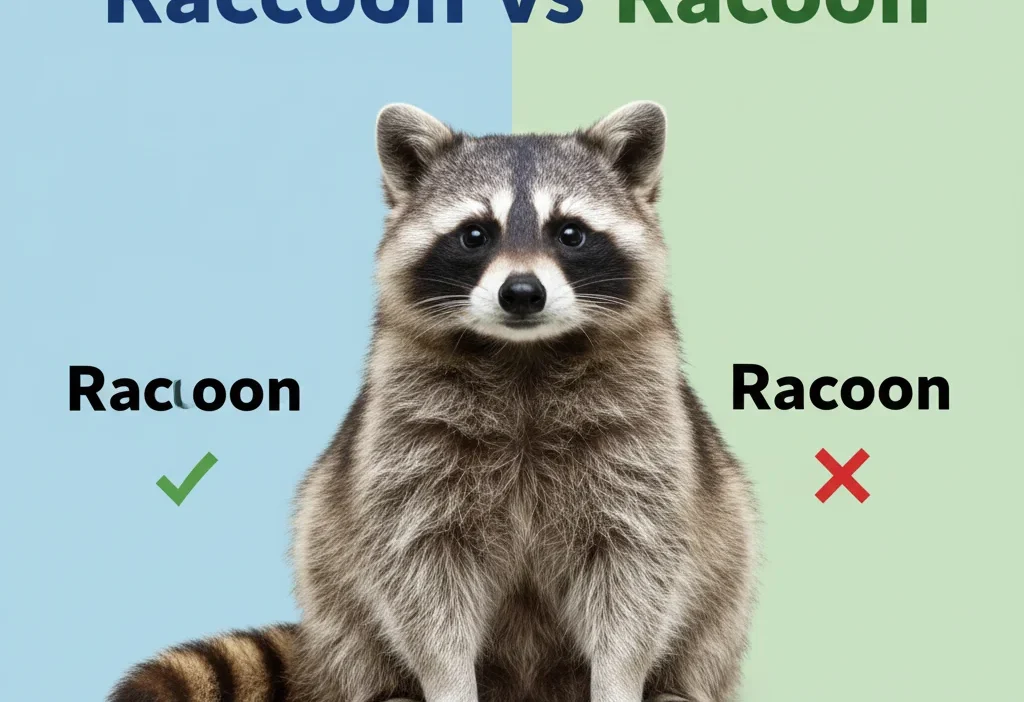
Have you ever typed “raccoon” and paused, wondering if it’s raccoon with one C or two? You are not alone. This furry backyard visitor causes a surprising amount of spelling confusion.
People search for “raccoon or racoon” to find a quick, definitive answer. They want to know the correct spelling for schoolwork, professional writing, or just to settle a friendly debate. This search often stems from seeing both versions online, in books, or even in news articles.
The confusion is real, and it’s tied to the fascinating differences between English dialects. Is one spelling American and the other British? Does the spelling change if you’re talking about one animal or a group?
This article cuts through the clutter. We will solve the “raccoon or racoon in english” puzzle, explain why two spellings exist, and give you clear advice based on where you are writing.
By the end, you’ll never second-guess this word again. Let’s unravel the mystery of this clever mammal’s name.
Raccoon
The standard and correct spelling in modern English is “raccoon” with two C’s. This is true for both American and British English in formal writing and scientific contexts. For example: “We saw a raccoon raid the trash can.” The plural is “raccoons.”
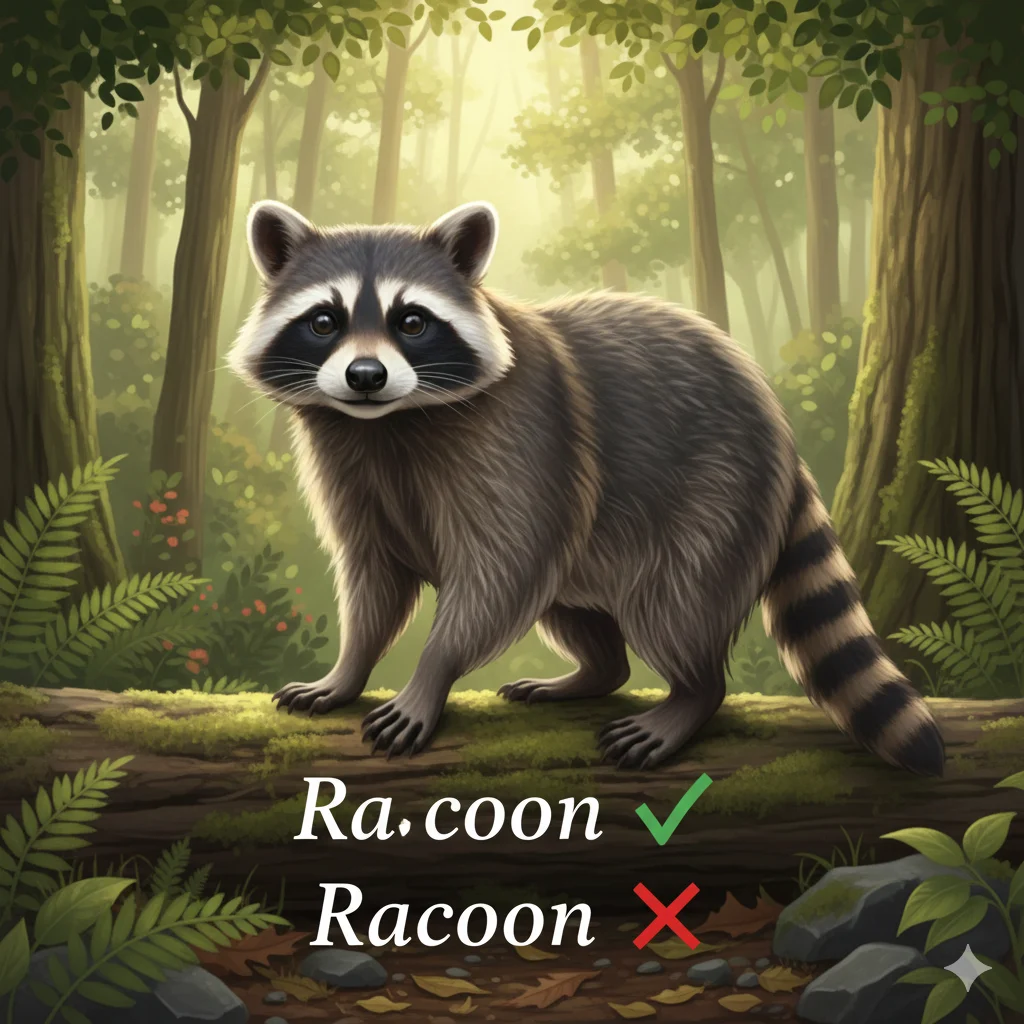
The spelling “racoon” with one C is an accepted variant, but it is less common. You might see it in older texts, in some UK publications, or used as a stylistic choice (like in a brand name). However, for clarity and to follow the most widely accepted rule, using “raccoon” is always the safe choice. This quick answer solves the core question: Is raccoon with one C or two? The answer is two.
The Origin of Raccoon
The word “raccoon” didn’t start in English. It comes from the Powhatan word aroughcun, a Native American language spoken in the coastal regions of what is now Virginia. Early English settlers adopted it in the 1600s, spelling it in various ways like “raugroughcum” or “rarowcun” to mimic the sound.

The spelling eventually settled into two main forms: “raccoon” and “racoon.” Why the difference? It largely came down to how people heard the word and how they chose to represent that “kuh” sound in the middle. Some used a double ‘c’ to show the hard ‘k’ sound, while others felt a single ‘c’ was enough. For centuries, both were used interchangeably in both America and Britain. Over time, “raccoon” became the dominant form in dictionaries and formal use, especially after it was fixed as the standard zoological name for the animal.
British English vs American English Spelling
When it comes to “raccoon or racoon in english,” the line between British and American spelling is blurrier than for words like “color/colour.” Both dialects have used both spellings. However, a pattern exists.
- American English: Strongly prefers “raccoon” with two C’s. Major dictionaries, style guides, and media outlets in the US almost exclusively use this spelling. It is the definitive standard.
- British English: Has traditionally been more accepting of the “racoon” variant. You are more likely to encounter the one-C spelling in older UK texts or some modern UK publications. However, the two-C spelling “raccoon” is also very common and is considered perfectly correct. In fact, for scientific classification, “raccoon” is used globally.
Comparison Table: Raccoon vs. Racoon
| Feature | Raccoon (Two C’s) | Racoon (One C) |
|---|---|---|
| Prevalence | Dominant, standard spelling | Less common variant |
| US Preference | Strongly preferred | Rarely used |
| UK Preference | Common and correct | More accepted than in the US |
| Formality | Preferred in formal, scientific, and academic writing | Often considered informal or stylistic |
| Example Usage | “The raccoon is a nocturnal omnivore.” | “The old book described a racoon.” |
Which Spelling Should You Use?
Your audience should guide your choice.
- For a US Audience: Always use “raccoon.” Using “racoon” might be viewed as a spelling error in schools, businesses, or official publications.
- For a UK/Commonwealth Audience: “Raccoon” is still the safest and most widely understood choice. While “racoon” may not be wrong, using the global standard prevents any perception of error.
- For Global or Scientific Audiences: Always use “raccoon.” This is the universal spelling in zoology and international contexts. It is the name used for their classification: what are raccoons classified as? They are in the genus Procyon, and the common species is Procyon lotor—the common raccoon.
When in doubt, choose “raccoon” with two C’s. It is never incorrect.
Common Mistakes with Raccoon
- Mixing up the plural: A common question is, “Is racoon singular or plural?” The answer is singular for both spellings. The mistake is forming the plural.
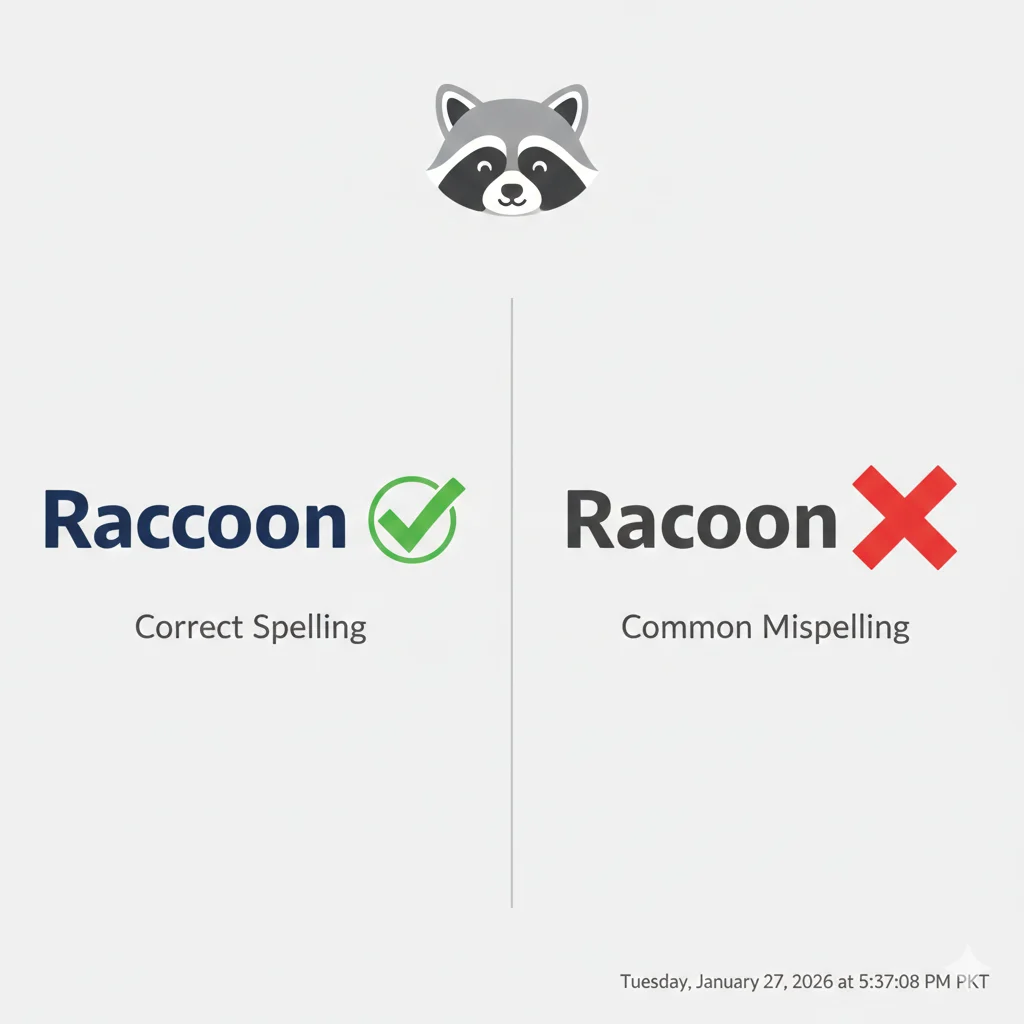
- Incorrect: “I saw three racoon last night.”
- Correct: “I saw three raccoons (or racoons)”.
- Inconsistent spelling in one document: Switching between “raccoon” and “racoon” looks sloppy. Pick one spelling and stick with it.
- Misspelling based on pronunciation: Some might write “rackoon” or “raccon,” trying to match the sound. Remember the root: two C’s or one C, always followed by a double O.
Raccoon in Everyday Examples
- Email (Formal): “Please ensure the trash bins are secured, as we have noticed raccoon activity in the neighborhood.”
- News Headline: “Urban Raccoons Are Getting Smarter, Study Finds”
- Social Media (Casual): “OMG, a mama racoon (or raccoon) and her babies just walked across my deck! 🦝 #wildlife”
- Formal Report: “The population density of the common raccoon (Procyon lotor) has increased by 15% in the urban corridor.”
Raccoon – Google Trends & Usage Data
Google Trends data shows that the search for “raccoon” (two C’s) is significantly more common worldwide than for “racoon.” In the United States, searches for “raccoon” dwarf those for “racoon,” confirming its dominance. In the United Kingdom, the gap is smaller, but “raccoon” still leads.
Searches often spike in spring and summer, corresponding with raccoon breeding season and increased human-animal encounters. People also search in relation to questions like “are raccoons dangerous” or for help with identification. The data clearly supports that “raccoon” is the primary spelling used by people seeking information online, further solidifying it as the standard.
FAQs: Raccoon or Racoon?
Q1: Is raccoon with one C or two?
A: The standard spelling uses two C’s: raccoon. “Racoon” with one C is a less common variant.
Q2: How do British people say raccoons?
A: British people pronounce it similarly to Americans: /ræˈkuːn/. The spelling difference does not usually affect the pronunciation.
Q3: Is racoon singular or plural?
A: “Racoon” is singular. The plural form is “racoons.” The same rule applies to “raccoon” (singular) and “raccoons” (plural).
Q4: What does raccoon mean?
A: The name comes from a Powhatan word meaning “animal that scratches with its hands.” It refers to the mammal’s distinctive, dexterous front paws.
Q5: What are raccoons classified as?
A: Raccoons are mammals in the family Procyonidae. Their scientific name is Procyon lotor.
Q6: What are raccoons related to?
A: They are related to other procyonids like coatis, kinkajous, olingos, and ringtails.
Q7: What are the 7 species of raccoons?
A: The genus Procyon includes several species. The most well-known is the common raccoon (P. lotor). Others include the Crab-eating raccoon (P. cancrivorus) and the Cozumel raccoon (P. pygmaeus). The exact number of species can vary based on taxonomic classification, but the common raccoon is the one most people know.
Conclusion
The journey from the Powhatan word aroughcun to our modern spelling debate highlights the living nature of language. While “racoon” with one C persists as a historical variant, the clear winner for clarity, modernity, and global acceptance is “raccoon” with two C’s. Whether you’re in the US, the UK, or anywhere else, using “raccoon” ensures your writing is accurate and professional. It solves the “raccoon or racoon” confusion by providing a single, reliable standard. Remember the simple rule: for formal writing, science, and clear communication, the double-C spelling is always correct. Let this guide help you write with confidence, whether you’re discussing if raccoons are dangerous or simply admiring their clever, masked faces.

“Witty McGiggles, PunsBlast’s resident pun master, spins clever wordplay and playful humor to turn every moment into a laugh.”