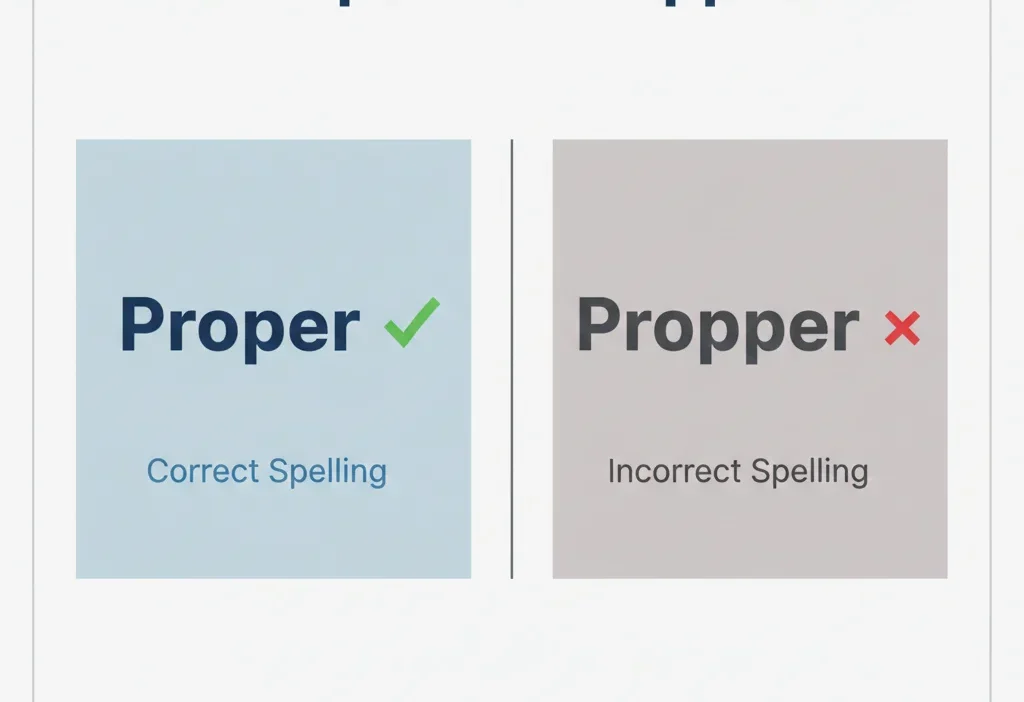
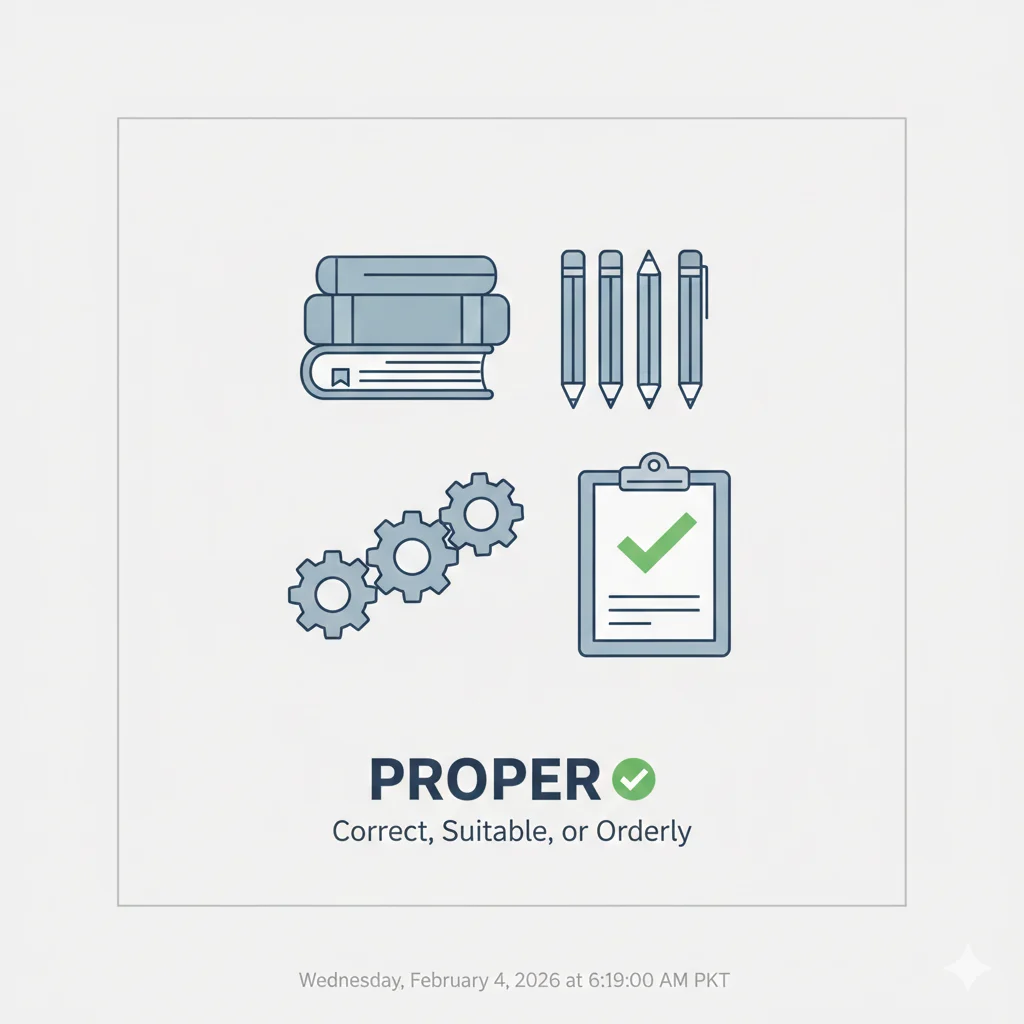
Confused between proper and propper? 🤔 You’re not alone! The correct spelling is proper, which means correct, suitable, or appropriate.
Many people mistakenly write it as propper, but that’s incorrect and should be avoided.
Understanding the right usage of proper is important in both writing and speaking.
In this guide, we’ll explain the correct spelling, meaning, and examples to help you always use it confidently.
Scroll down to learn how to use “proper” correctly and never make this common mistake again! ✨
Proper or Propper
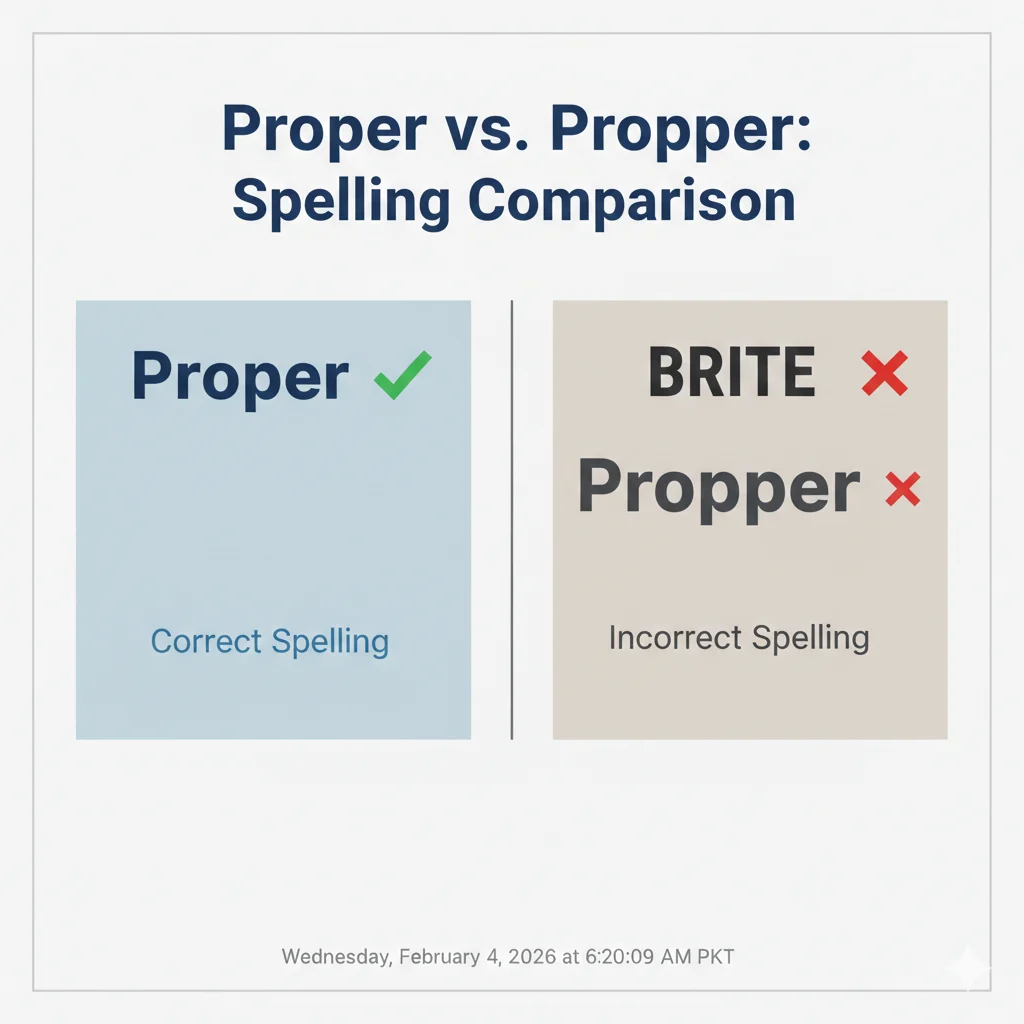
The correct spelling is “proper.” “Propper” is always a spelling error in standard English.
Proper is primarily an adjective meaning correct, suitable, or acceptable. It describes something that follows the rules or is appropriate.
- Example: “Please follow the proper channels for approval.”
- Example: “He couldn’t find the proper tools for the job.”
Propper is not a standard English word. However, it occasionally appears as:
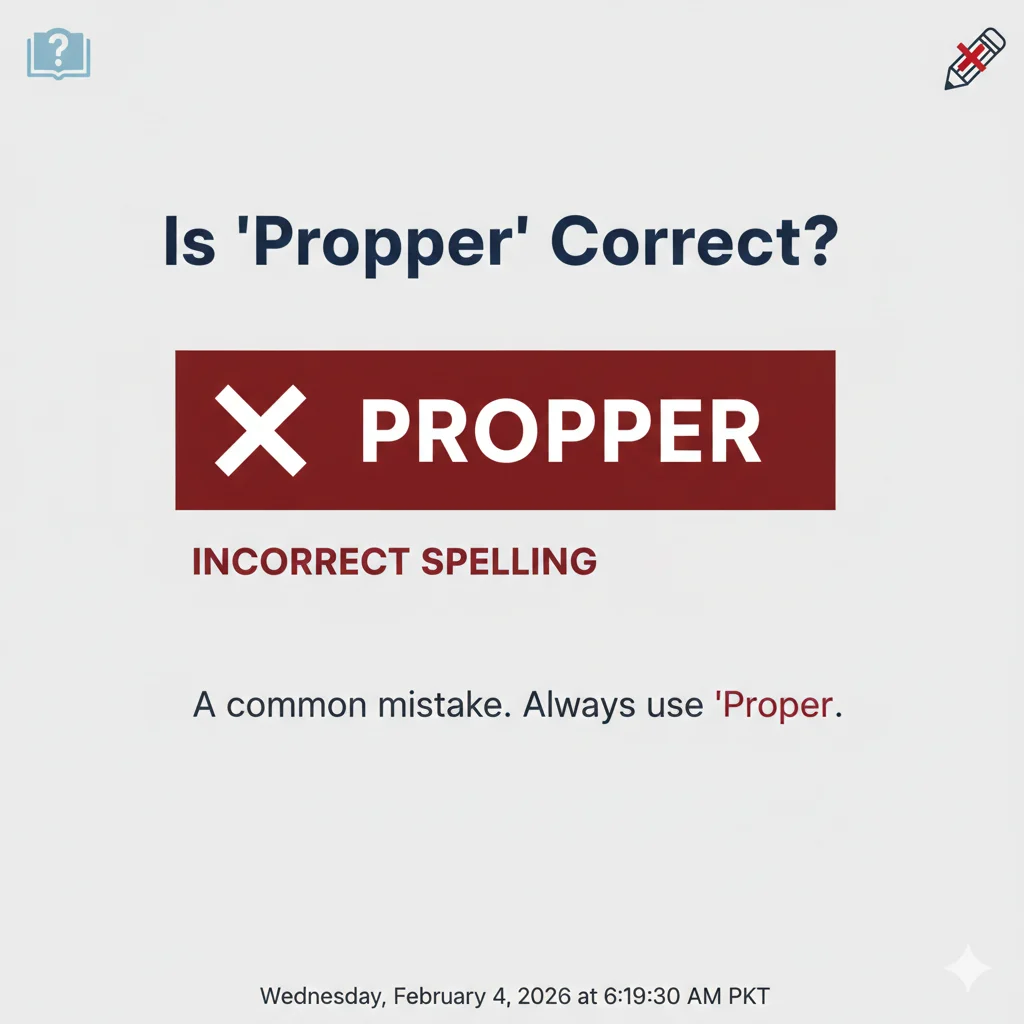
- A common misspelling of “proper.”
- A slang or informal spelling, sometimes used in gaming or online usernames to mean “one who props” or “excellent.”
- A rare surname.
For all formal writing, academic work, and business communication, you must use “proper.”
✅ Propper or Proper — The Correct Spelling Guide
The correct spelling is “proper” — with only one ‘p’ in the middle.
“Propper” is always a spelling error in standard English.
Proper is an adjective meaning correct, suitable, or appropriate.
Example: “Please follow the proper channels for approval.”
Example: “He couldn’t find the proper tools for the job.”
Propper is not a standard English word. It appears only as:
- A common misspelling of “proper”
- Slang in gaming or online usernames
- A rare surname
Why do people misspell it as “propper”? Because the pronunciation makes the ‘p’ sound slightly emphasized, leading some to think it should be doubled.
Remember: In all formal writing, academic work, and business communication, always use “proper.”
The word comes from Latin proprius meaning “one’s own” — and it has never had a double ‘p’ in its history.
✅ How to Spell Properly — A Simple Guide
The correct spelling is “properly” — P-R-O-P-E-R-L-Y.
“Properly” has 8 letters and 3 syllables: prop-er-ly.
It comes from the word “proper” (meaning correct) + the suffix “-ly” (which turns adjectives into adverbs).
Common misspellings to avoid:
- ❌ Propperly (double ‘p’ is wrong)
- ❌ Proprly (missing ‘e’)
- ❌ Properlly (double ‘l’ is wrong)
Remember: Proper → Add -ly = Properly. No extra letters needed!
Example: “Please fill out the form properly.”
Example: “He didn’t properly lock the door.”
Pro Tip: If you can spell “proper” correctly, just add “ly” at the end. That’s it!
The word means: in a correct, suitable, or appropriate manner.
So next time you write, spell it P-R-O-P-E-R-L-Y — and you’ve done it properly! ✅📝
The Origin of Proper
The word proper has a long history that explains its current spelling. It entered English in the 13th century from the Old French propre, which meant “own, particular, or fitting.” This, in turn, came from the Latin proprius, meaning “one’s own, particular, or special.”
The core idea from its origin is belonging uniquely to something or being suitable for a specific purpose. This evolved into our modern meanings of “correct” and “appropriate.”
So, why does the misspelling “propper” exist? It’s a classic case of phonetic spelling error. When we say “proper,” the single ‘p’ in the middle sounds slightly emphasized, leading some to think it should be doubled. English also has many words with double consonants after short vowels (like robber, slipper), which can mislead writers. The slang adoption of “propper” (meaning very good) further entrenches this incorrect spelling in casual use.
British English vs American English Spelling
Unlike words like colour/color or organise/organize, “proper” is spelled identically in both British and American English. There is no variation. Both dialects agree: it’s P-R-O-P-E-R.
The confusion with “propper” is not a dialect difference but a universal error. However, understanding general spelling rules can help clarify why “proper” is correct:
- The Doubling Rule: Typically, in both dialects, you double a final consonant (like ‘p’) when adding a vowel suffix (-ing, -ed, -er) ONLY if the word ends in a single consonant preceded by a single stressed vowel (e.g., run -> running, prop -> propped).
- In “Proper”: The word ends in ‘-er,’ and the stress is on the first syllable (PROP-er). We are not adding a suffix to a base word “prop.” Therefore, there is no reason to double the ‘p.’
Comparison Table: Correct vs. Incorrect
| Correct Spelling (All Dialects) | Incorrect Spelling | Explanation / Note |
|---|---|---|
| Proper (adjective) | Propper | The only correct standard spelling. |
| Properly (adverb) | Propperly | Adverb form. |
| Improper (opposite) | Impropper | Note the single ‘p’ here as well. |
| Property (related noun) | Propperty | From the same Latin root proprius. |
Which Spelling Should You Use?
Your audience dictates the only correct choice.
- For American & British Audiences (Formal/Standard): Always use “proper.” Whether you’re in the US, UK, Canada, Australia, or any other English-speaking country, “proper” is the universally accepted spelling in education, law, business, and publishing. “Propper” will be marked as a mistake.
- For Global / ESL Contexts: Use “proper.” Learning and using the standard spelling ensures clarity and professionalism worldwide. It is the form found in all dictionaries and teaching materials.
- Understanding Informal/Slang Contexts: You might see “propper” in very specific, informal settings:
- Online Gaming/Slang: In some UK slang or gaming communities, “a propper” might loosely mean “a proper one” or something excellent, often mimicking an accent. (e.g., “That was a propper goal!”).
- As a Verb Form (Non-Standard): Someone might incorrectly write “He propped it up” as “He proppered it up.”
Advice: Recognize it in casual chat, but do not adopt it in your own writing if you aim for correctness.
Common Mistakes with Proper
- Misspelling as “Propper”: The most frequent error.
- Incorrect: “It’s not the propper way.”
- Correct: “It’s not the proper way.”
- Confusing “Proper” with “Probe” or “Prop”: A typographical error.
- Incorrect: “We need to propper into this issue.” (Mixing with ‘probe’).
- Correct: “We need to look into this issue properly.”
- Misusing “Proper” as a Noun in Standard English: While “proper” can be a noun (e.g., in heraldry or “the Massachusetts Proper”), this is rare. Don’t force it.
- Awkward: “He has a sense of the proper.” (Better: “He has a sense of propriety.”)
- Overusing in Formal Writing: Repeating “proper” can sound simplistic. Use synonyms like appropriate, correct, suitable, conventional.
Proper in Everyday Examples
- Email (Business): “Before we proceed, we require the proper documentation signed by all stakeholders.”
- News Headline: “Authorities Stress Importance of Proper Safety Protocols Following Incident.”
- Social Media (Slang Alert): “Just had a proper Sunday roast! 🍖” OR (very informal) “That was a propper good film, mate!” #slang
- Formal Writing/Report: “The experiment was conducted under the proper laboratory conditions to ensure validity.”
- As a Noun (Specialized): “The study focuses on the dialect of Boston Proper.” (Meaning the city itself, not the suburbs).
- Meaning “Thorough”: “He gave it a proper cleaning.”
Proper – Google Trends & Usage Data
Data from tools like Google Trends and language corpora clearly shows the dominance of the correct spelling. Searches for “proper meaning” vastly outnumber those for “propper meaning.” The incorrect spelling sees occasional, minor spikes, often linked to specific gaming slang or as a brand/username.
Interest in the word “proper” is consistently high in English-speaking countries, with the United Kingdom often leading the search volume. This aligns with the word’s frequent use in British English, both in standard form (“the proper way”) and in colloquial emphatic use (“That’s proper good!”).
The sustained search volume for “proper or propper” indicates ongoing and widespread uncertainty, confirming the need for clear guidance on this common spelling issue.
FAQs: Proper or Propper
Q1: What is the meaning of proper or propper?
A: The meaning is tied to the correct spelling: proper. It means correct, suitable, or appropriate. “Propper” has no standard meaning.
Q2: Is “propper” a word in the dictionary?
A: No, “propper” does not appear as a standard English word in major dictionaries like Oxford or Merriam-Webster. It is listed only as a common misspelling of “proper.”
Q3: What does “proper person” or “proper place” mean?
A: A proper person is someone deemed suitable or morally correct for a role. A proper place is the correct or most suitable location for something.
Q4: Can “proper” be used as slang?
A: Yes, especially in British slang, “proper” can be used as an intensifier meaning “thoroughly” or “very” (e.g., “I’m proper tired”). The misspelling “propper” is sometimes used to represent this slangy, emphatic pronunciation.
Q5: What is “un proper”? Is it a word?
A: The correct opposite is “improper” (with a single ‘p’). “Un proper” is not a standard construction.
Q6: Can “proper” be a noun or a verb?
A: As a noun, it’s rare (e.g., referring to a specific region, “the city proper”). As a verb, “to proper” is archaic and not used in modern English. The related verb is “to appropriate.”
Q7: What is the use of proper in a sentence?
A: Its primary use is as an adjective to describe something that follows accepted rules or is appropriate: “Use the proper form of address when writing to the judge.”
Conclusion
The journey from confusion to clarity on proper vs. propper is straightforward. Remember, “proper” is the only correct spelling in standard English across all global dialects. The misspelling “propper” arises from pronunciation tricks and informal slang, but it has no place in professional, academic, or formal writing. Understanding the word’s meaning—signifying correctness, suitability, and appropriateness—empowers you to use it confidently. Whether you’re defining a proper place, describing a proper person, or simply ensuring your grammar is proper, sticking to the single ‘p’ is essential. Let this be your final guide: for clear and correct communication, always choose proper.

“Mary Elizabeth Braddon, a witty storyteller at PunsBlast, crafting clever puns and playful humor that turn everyday words into smiles.”