
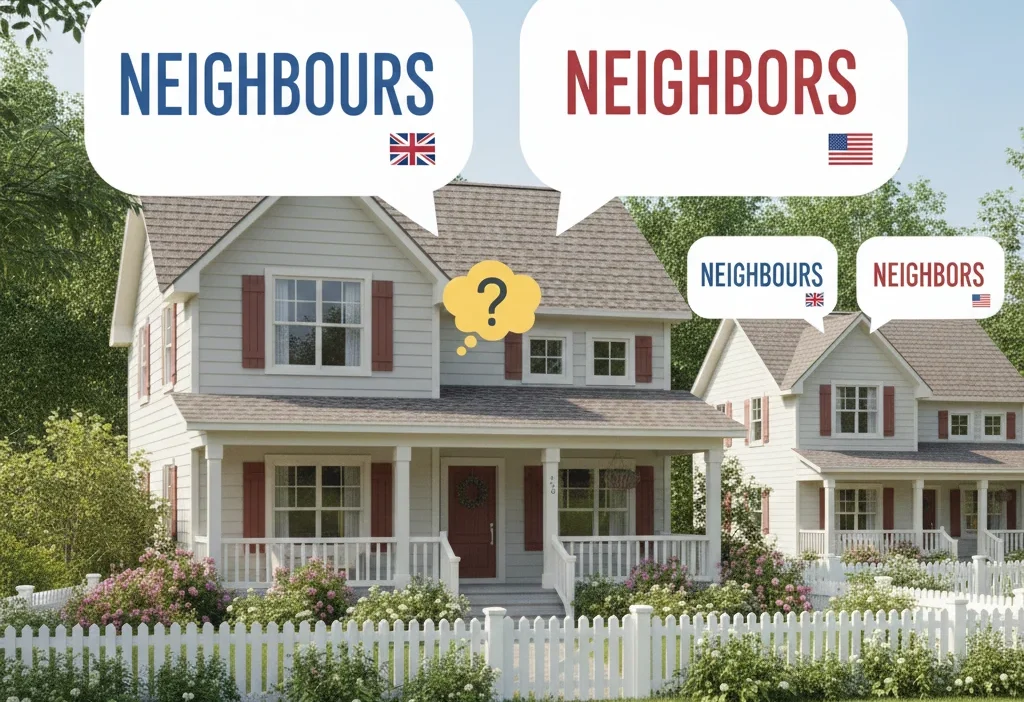
Have you ever been writing an email or a message and suddenly stopped, staring at the word “neighbor”? A little voice in your head asks, “Is it spelled with a ‘u’ or without?” You are not alone.
This is one of the most common spelling dilemmas in the English language. Millions of people search for “neighbours or neighbors” every month because they are confused by these two different versions of the same word.
This confusion is natural because English is a global language with two major spelling systems.
The good news is that both spellings are correct, but they are used in different parts of the world.
This article will solve your confusion once and for all. We will explore the quick answer, dive into the history of the word, explain the difference between American and British English, and give you clear advice on which spelling you should use.
By the end, you’ll never have to second-guess yourself when writing about the people who live next door.
Neighbours or Neighbors means
The quick answer is simple: “Neighbors” is the correct spelling in American English, while “neighbours” is the correct spelling in British English and most other English-speaking countries, including Canada, Australia, and New Zealand.
Both words mean exactly the same thing: a person who lives near another person, usually next door or in the same neighborhood.
- Example (American English): My neighbors are having a block party this Saturday.
- Example (British English): My neighbours are having a garden party this Saturday.
The difference is purely a matter of geography and spelling conventions, not meaning or grammar.
The Origin of Neighbour/Neighbor
To understand why we have two spellings, we have to look at the history of the word. The word comes from Old English. It is a combination of two words: neah, which meant “nigh” or “near,” and gebūr, which meant “dweller” or “farmer.” So, an early English “neighbor” was literally a “near-dweller” .
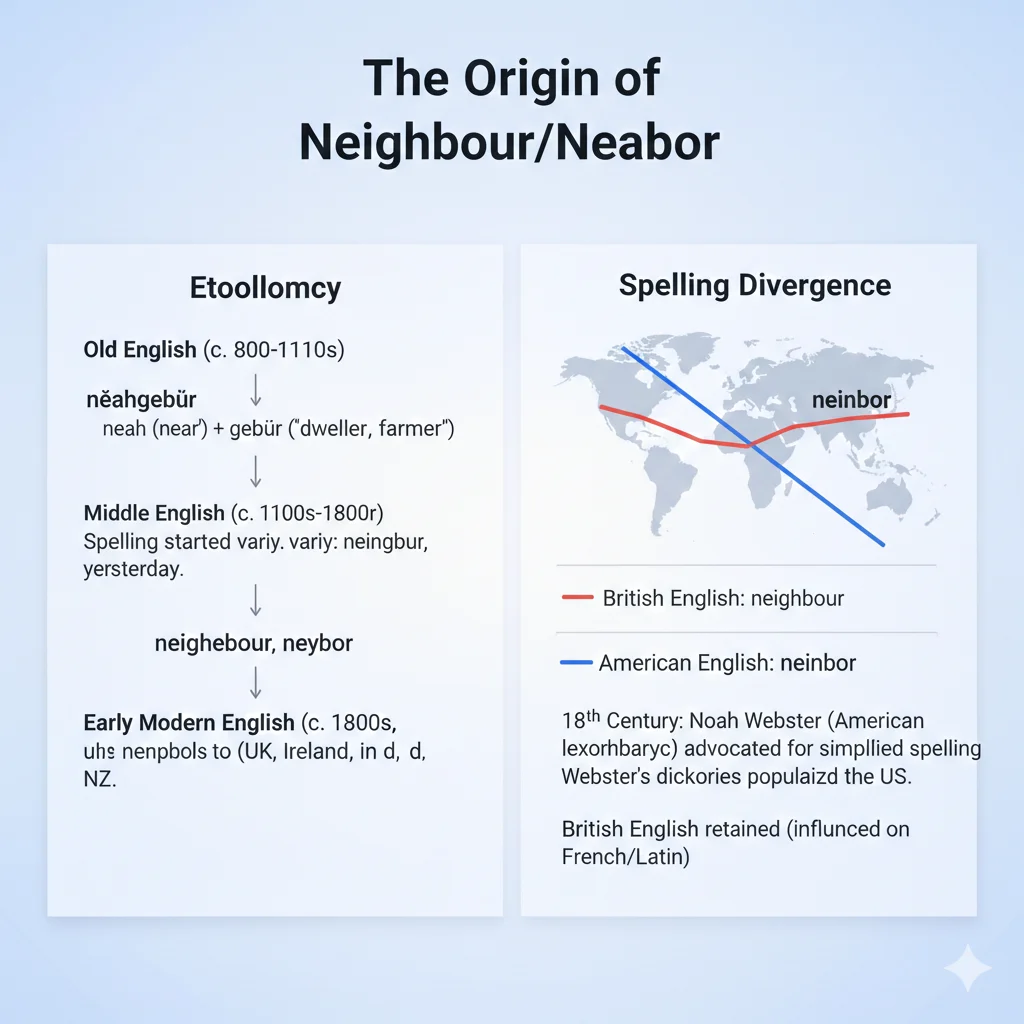
Over centuries, the word evolved into “neighbour” in Middle English. When Modern English began to develop, the standard spelling in Britain was with a “u”—neighbour. This is the version that matches words like “colour,” “honour,” and “flavour,” all of which were adopted from French after the Norman Conquest. The French influence is why British English kept that extra “u.”
The spelling change happened because of one man: Noah Webster. After the American Revolution, Webster wanted to create a distinct American identity. He believed American English should be simpler and more phonetic. In his famous dictionary, published in the early 19th century, he changed many spellings. He dropped the “u” from words like “neighbour” and “colour” to create “neighbor” and “color” . This was a deliberate act to make American English simpler and separate from British traditions.
British English vs American English Spelling
This is the core of the “neighbours or neighbors” debate. The difference is a textbook example of how British and American spelling rules diverge.
In British English, many words that end in “-our” in the UK end in “-or” in the US. “Neighbour” is a prime example, along with:
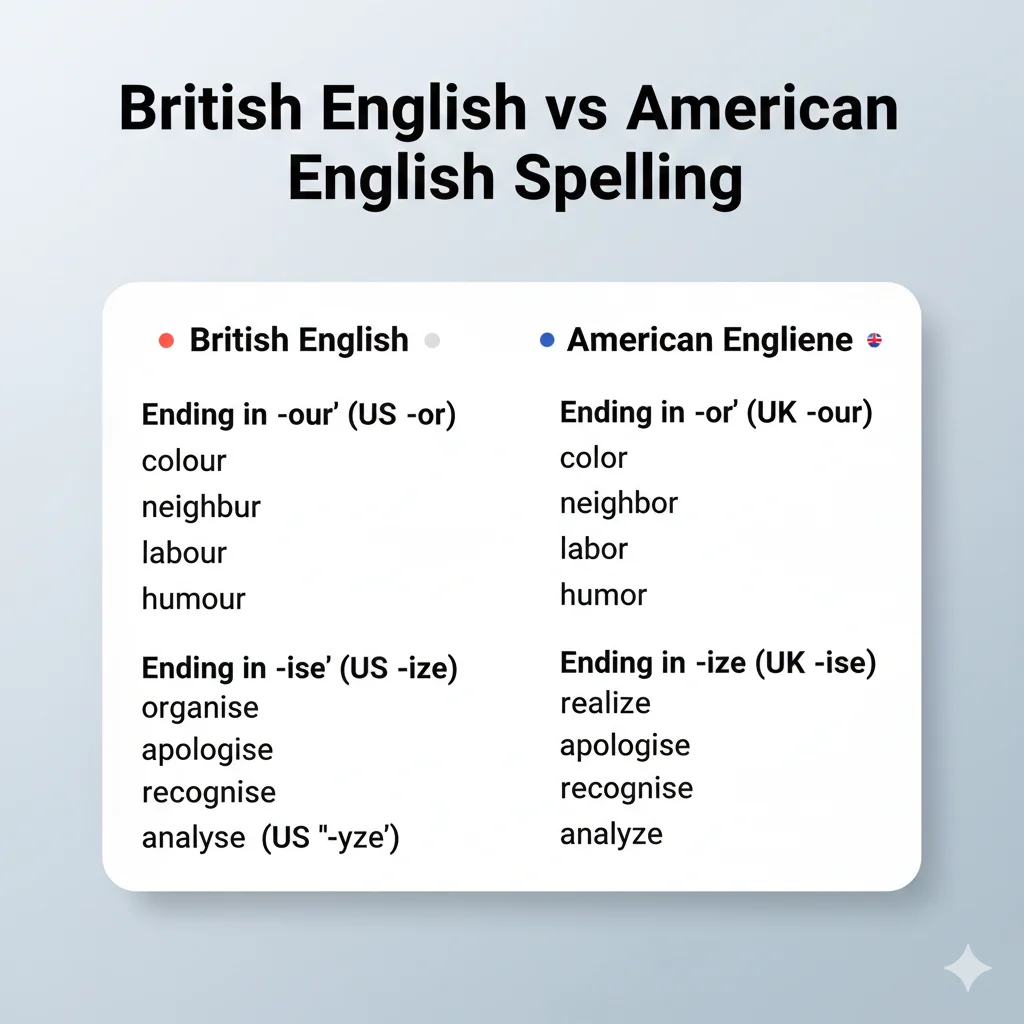
- Labour / Labor
- Humour / Humor
- Behaviour / Behavior
The rule applies to all related words as well. In American English, you write “neighborhood,” “neighborly,” and “neighboring.” In British English, you write “neighbourhood,” “neighbourly,” and “neighbouring” .
Here is a comparison table to make it crystal clear:
| Word Form | American English Spelling | British English Spelling |
|---|---|---|
| Base Word | Neighbor | Neighbour |
| Plural | Neighbors | Neighbours |
| Possessive (Singular) | Neighbor’s (e.g., My neighbor’s car) | Neighbour’s (e.g., My neighbour’s car) |
| Possessive (Plural) | Neighbors’ (e.g., The neighbors’ party) | Neighbours’ (e.g., The neighbours’ party) |
| Related Noun | Neighborhood | Neighbourhood |
| Related Adjective | Neighborly | Neighbourly |
Which Spelling Should You Use?
Choosing the right spelling depends entirely on your audience. Here is some professional advice to guide you:
- For a US Audience: If you are writing for Americans, or if you live in the United States, you should always use neighbor. Using the British spelling might look like a mistake or make your writing seem inconsistent. This includes writing for American companies, schools, or websites.
- For a UK, Australian, Canadian, or Commonwealth Audience: If you are writing for a British, Australian, or Canadian audience, or if you live in one of these countries, you should use neighbour. Using the American spelling in a British newspaper, for example, would be considered incorrect. Canada is a bit of a mix, but it officially follows British spelling conventions, so “neighbour” is the standard .
- For a Global Audience: If you are writing for an international audience, you have a choice. The most important rule is consistency. Pick one spelling and stick with it throughout your entire document, email, or website. Switching between “neighbors” and “neighbours” looks unprofessional. Many global companies choose American English because it is widely understood, but both are acceptable as long as you are consistent.
Common Mistakes with Neighbours or Neighbors
Even when you know the difference, a few common mistakes can trip you up. Here are the most frequent errors and how to avoid them.
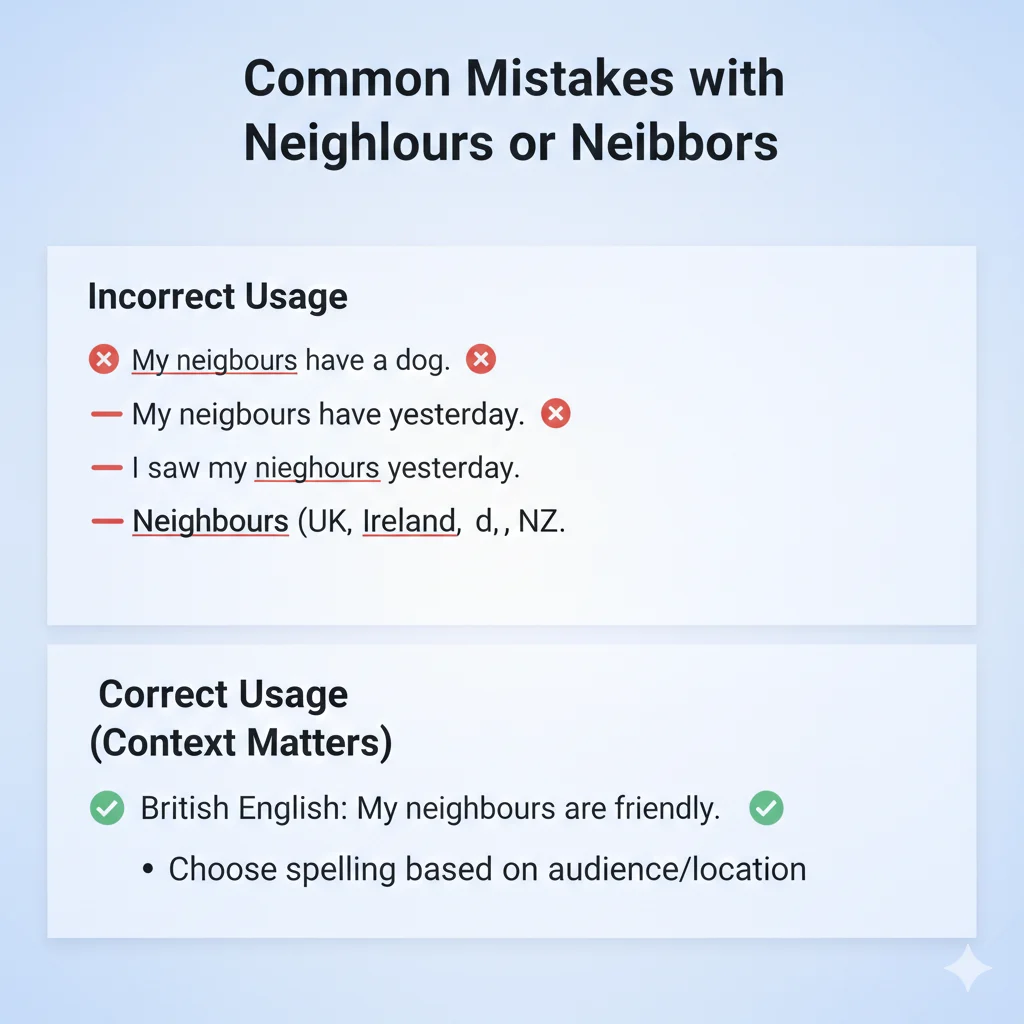
- Mistake 1: Mixing spellings in one document.
- Incorrect: My neighbors are nice, but my other neighbours are loud.
- Correct (US): My neighbors are nice, but my other neighbors are loud.
- Correct (UK): My neighbours are nice, but my other neighbours are loud.
- Mistake 2: Forgetting the possessive form.
- Question: What is the plural possessive? The answer depends on the spelling.
- Example (US): The neighbors’ dog (the dog belonging to multiple neighbors).
- Example (US): My neighbor’s dog (the dog belonging to one neighbor).
- Example (UK): The neighbours’ dog.
- Example (UK): My neighbour’s dog.
- Mistake 3: Applying the “I before E” rule incorrectly.
- The word “neighbor” is a famous exception to the “i before e except after c” rule. It’s spelled ei (nei-ghbor), not “ie.” This is true for both the American and British versions.
- Mistake 4: Spelling it “neightbour.”
- Don’t add an extra ‘g’ or ‘t’ sound. It’s neighbor, not neightbor or neighgbor.
Neighbours or Neighbors in Everyday Examples
Seeing the words in context is the best way to understand their usage. Here are examples of how they appear in different types of writing.

In Casual Writing (Emails, Texts, Social Media)
- US: “Just had a great chat with my new neighbor. They brought us cookies!”
- UK: “Just had a great chat with my new neighbour. They brought us biscuits!”
- Social Media (US): “How to deal with noisy neighbors? Send help!”
- Social Media (UK): “How to deal with noisy neighbours? Send help!”
In News and Formal Writing
- US News: “The community meeting addressed concerns about the new neighborhood watch program.”
- UK News: “The community meeting addressed concerns about the new neighbourhood watch program.”
- International Headlines: “Poland is a close neighbor of Germany.” (This is acceptable in both, as proper nouns can sometimes vary).
In Classic and Religious Texts
- Biblical Proverb: “Love thy neighbour as thyself.” (This is almost always quoted in the traditional British spelling, even in the US, because it comes from the King James Bible).
Neighbours or Neighbors – Google Trends & Usage Data
Data confirms that the spelling you use is a strong indicator of where you are from. According to usage data, the split is clear but not absolute, thanks to the internet.
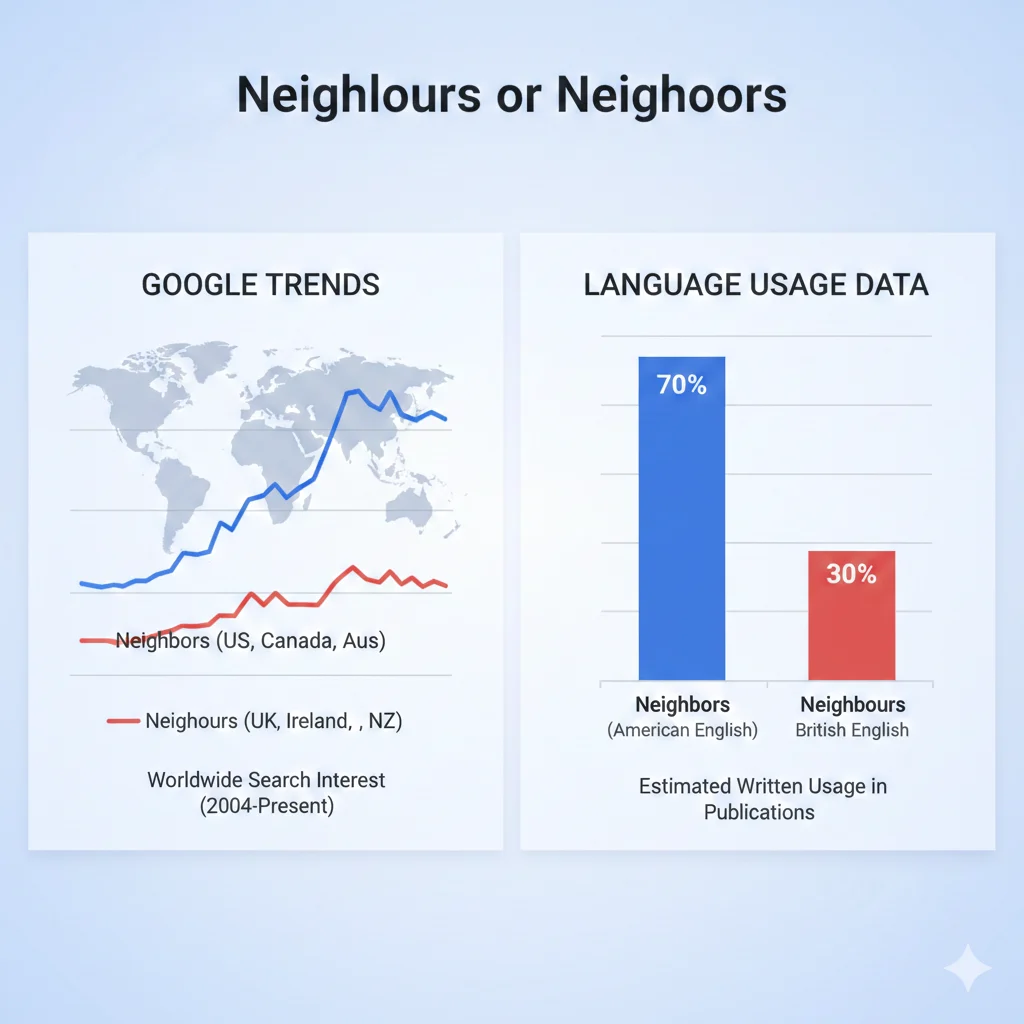
- United States: “Neighbors” is the overwhelming favorite, used nearly 100% of the time .
- United Kingdom: “Neighbours” is used about 93% of the time, with “neighbors” appearing in 7% of writing, likely due to exposure to American media .
- Canada: Canada is a fascinating middle ground. Usage is almost a 50/50 split. While “neighbours” (the British spelling) is slightly preferred, “neighbors” is also very common due to the country’s proximity and close ties to the US .
- Australia and New Zealand: These countries strongly prefer the British spelling “neighbours,” with usage rates over 90% .
- India: English writing in India leans towards the British spelling (“neighbours”), but American spelling is also very common due to the influence of US technology and business .
This data shows that while the rule is clear, the reality of a connected world means you will frequently see both spellings.
Frequently Asked Questions (FAQs)
Here are answers to the most common questions people have about this topic.
1. Which is correct, neighbor or neighbour?
Both are correct. “Neighbor” is the standard spelling in American English. “Neighbour” is the standard spelling in British English and other Commonwealth countries .
2. How do Americans spell neighbour?
Americans spell it neighbor. It is spelled without the ‘u’ .
3. What is the plural for neighbour?
The plural depends on the spelling. In American English, the plural is neighbors. In British English, the plural is neighbours .
4. What is the difference between neighbors and neighbors?
There is no difference in meaning. They are the same word, but one is spelled with a ‘u’ (neighbours) for a British audience, and one is without (neighbors) for an American audience.
5. Is it “bad neighbours or neighbors” for a movie title?
For the 2014 comedy film starring Seth Rogen and Zac Efron, the official title in the United States was “Bad Neighbors.” In the United Kingdom, Australia, and other markets, the film was titled “Bad Neighbours.”
6. How do you spell neighbor in Spanish?
The Spanish word for neighbor is vecino (masculine) or vecina (feminine). It is not related to the English spelling debate.
7. What is the neighbor plural possessive?
The plural possessive for a group of American neighbors is neighbors’ (e.g., the neighbors’ yard sale). For a group of British neighbours, it is neighbours’ (e.g., the neighbours’ garden party) .
Conclusion
So, neighbours or neighbors—which one should you choose? The answer is simple: it depends on where you are and who you are writing for. Think of it as being a good linguistic neighbor: use the spelling that your audience expects. If you are in the US or writing to an American, use “neighbor.” If you are in the UK, Canada, Australia, or writing to a British audience, use “neighbour.”
The most important rule is consistency. Once you pick a side, stay with it. Whether you are borrowing sugar from your neighbor or having a barbecue with your neighbours, the most important thing is the friendly relationship, not the spelling. Now you have the knowledge to write about them correctly every time.

“George Gissing, a humor-loving writer at PunsBlast, crafting witty puns and playful word magic to make readers laugh every single day.”