Do you ever find yourself typing away, only to pause and wonder, “Is it spelled ‘nap’ or ‘knap’?” You are not alone. This is a classic word puzzle that trips up many writers.
The confusion is understandable. When spoken, nap and knap sound exactly alike—they are homophones. However, their meanings couldn’t be more different.
People usually search for this topic because they are writing something and hit a mental roadblock. Are they trying to describe a cozy afternoon sleep, a fuzzy fabric, or the action of breaking a stone? The core confusion stems from not knowing that both spellings are correct but refer to entirely different things.
This article will clear up the nap or knap meaning once and for all. We will explore the origins of both words, break down how they are used, and provide you with simple tips to ensure you never mix them up again.
By the end, you will have the confidence to use each word correctly, whether you are writing a novel, a work email, or a text message.
Nap or Knap? means
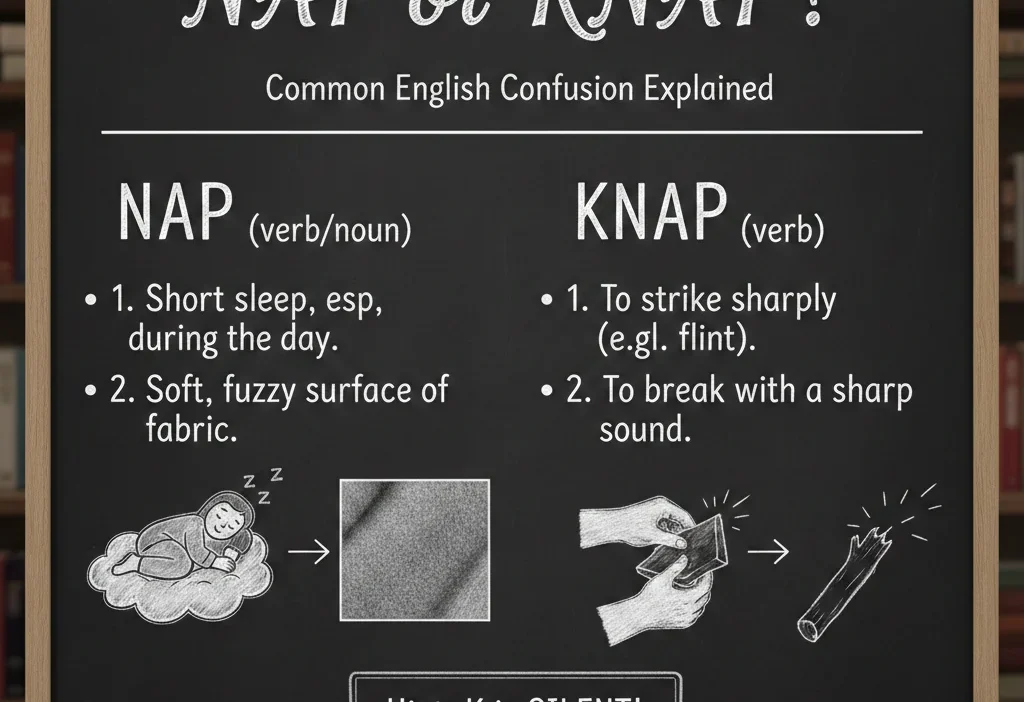
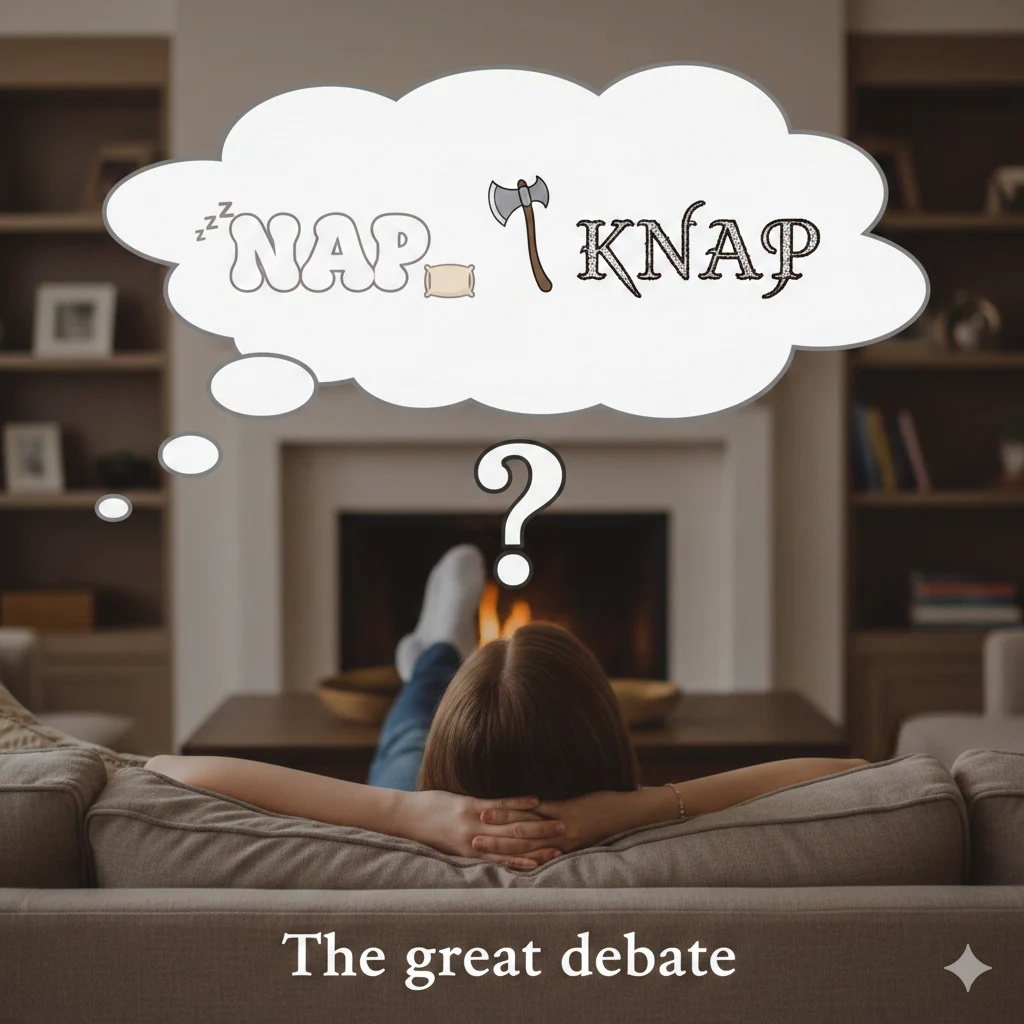
The simplest way to decide between “nap” and “knap” is to remember what you are talking about:
- Use
napwhen you are talking about:- Sleep: A short rest during the day. (“The baby needs a nap.”)
- Fabric: The soft, fuzzy surface on materials like velvet or carpet. (“Brush the carpet against the nap.”)
- Use
knapwhen you are talking about:- Breaking or chipping: To strike and break something, like stone or flint. (“He learned to knap flint to make tools.”)
- A hilltop (rare): An old word for the crest of a hill.
- The nape of the neck (in hairdressing): The point where the neck meets the skull. (“She trimmed the hair at the knap.”)
So, ask yourself: Does your sentence involve a cozy bed or a soft carpet? Use nap. Does it involve a hammer, a rock, or someone’s neck? Use knap .
The Origin of Nap and Knap
To truly understand the difference, it helps to look at where these words came from. Their distinct origins explain why they have different spellings despite sounding the same today.

Nap has two main origins.
- For sleep: The word “nap” in the context of sleeping comes from the Old English word hnappian, which means “to doze” or “to slumber.” This connection has been around for over a thousand years, showing that humans have always valued a good short sleep .
- For fabric: The use of “nap” to describe a fuzzy surface has a different root. It comes from the Middle Dutch and Middle Low German word noppe, meaning the nap of cloth. This term was adopted into English as fabric-making techniques evolved .
Knap has a much more physical origin. It is likely onomatopoeic, meaning the word sounds like the action it describes. “To knap” is to hit, chip, or break something with a sharp blow. Think of the sound of a hammer hitting a rock (“knap!”). This word has roots in the Dutch word knappen, meaning “to crack” or “to eat,” which also relates to the sound of something breaking or crunching . The spelling with a silent ‘k’ links it to other Old English words for hitting, like “knock.”
British English vs American English Spelling
Here is the good news: When it comes to nap or knap, the spelling rules are consistent on both sides of the Atlantic. The difference isn’t about country; it’s purely about meaning.
In both British English and American English:
- Nap is the standard spelling for a short sleep and the surface of fabric.
- Knap is the standard spelling for breaking stone and related terms (like the Knap of Howar).
However, context and usage can differ slightly. For example, a British archaeologist might talk about a “knapped flint tool,” while an American crafter might say they “knap arrowheads.” The words are the same. Here is a simple table to see the variations side by side:
Which Spelling Should You Use?
Choosing between “nap” and “knap” depends entirely on your audience and what you are trying to say. Since they are not regional variants, you don’t pick one for a UK reader and another for a US reader. You pick the one that matches the subject.
- For US Audiences: “Nap” is an everyday word for sleep. “Knap” will be less familiar and is mostly used in specific hobbyist communities (like flint knapping) or in historical contexts.
- For UK & Commonwealth Audiences: The usage is very similar. “Nap” is universal for sleep. “Knap” might be slightly more recognizable due to place names and historical sites, but it is still a specialized term.
- For Global/General Audiences: Stick to the core meaning. If you are writing for everyone, be extra careful. Unless your topic is archaeology, geology, or hairdressing, the word you are most likely looking for is nap. What does knap mean? It’s a great question, and the answer is very specific. If you aren’t talking about chipping stones, you don’t need the ‘k’.
Common Mistakes with Nap and Knap
Because these words are homophones, mistakes are easy to make. Here are the most common errors and how to avoid them.
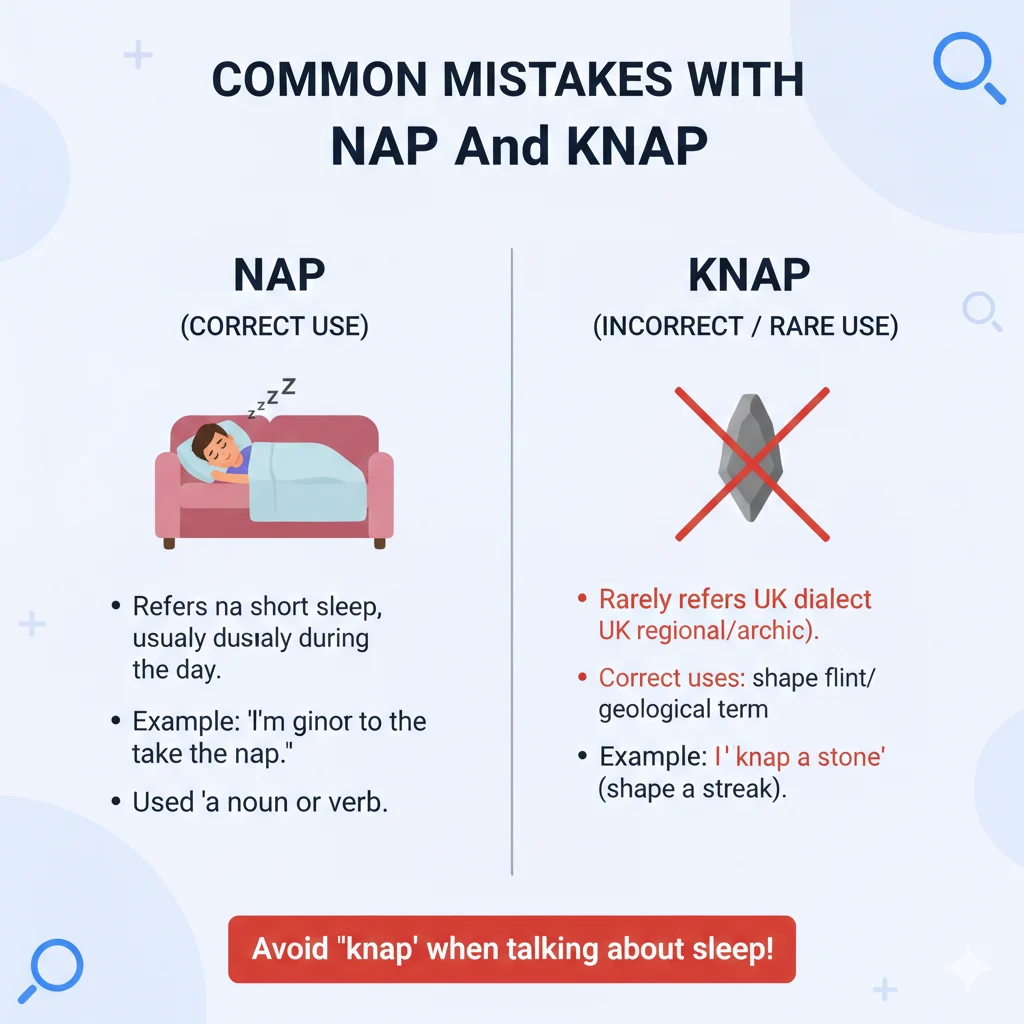
- Mistake 1: Using “knap” for sleep.
- ❌ Incorrect: “I think I’ll knap on the sofa.”
- ✅ Correct: “I think I’ll nap on the sofa.”
- How to fix: Remember that sleep is soft and cozy, just like the fabric nap. Both use a soft ‘n’, no hard ‘k’ needed.
- Mistake 2: Using “nap” for breaking stone.
- ❌ Incorrect: “He used a tool to nap the rock.”
- ✅ Correct: “He used a tool to knap the rock.”
- How to fix: Link the ‘k’ in knap with the word “knock.” You knock a rock to knap it.
- Mistake 3: Confusing “nap” (fabric) with “nape” (neck).
- ❌ Incorrect: “Her hair was short on the nap of her neck.”
- ✅ Correct: “Her hair was short on the nape of her neck.” (But in hairdressing, it is often called the knap).
- How to fix: The back of your neck is the nape (with an ‘e’). The specific hairdressing term for that bony area is sometimes knap (with a ‘k’) .
- Mistake 4: Misspelling the idiom.
- ❌ Incorrect: “The company was caught knapping.”
- ✅ Correct: “The company was caught napping.”
- How to fix: The idiom “caught napping” means to be caught off guard or unprepared. It always uses the sleep-related spelling.
Nap or Knap in Everyday Examples
Seeing these words in context is the best way to understand their proper use. Let’s look at how they appear in different types of writing and conversation.
- In an Email:
- “Hi Team, just a reminder that the conference room is available if you need a quiet place to take a quick nap during the long lunch break.”
- In the News:
- “An archaeologist discussing a new discovery might say, ‘The flint tools show clear evidence of skilled knapping techniques.'”
- “A headline about workplace wellness might read: ‘The Power of the Power Nap: Boost Your Afternoon Productivity.'”
- On Social Media:
- “This velvet dress is so shiny, the nap looks totally different depending on the light! ✨ #OOTD”
- “Trying to learn how to knap arrowheads. It’s a lot harder than it looks on YouTube! #stonetools #primitive skills”
- In Formal Writing:
- “Instructions for a sewing pattern might state: ‘This fabric has a nap. To ensure the color appears consistent, all pattern pieces must be cut in the same direction.'”
- “A history book might describe: ‘The inhabitants of the Knap of Howar, a Neolithic farmstead in Scotland, would have used basic tools.'”
Nap or Knap – Google Trends & Usage Data
While precise search volume is proprietary, we can make strong inferences about the popularity and context of these words based on their meanings.
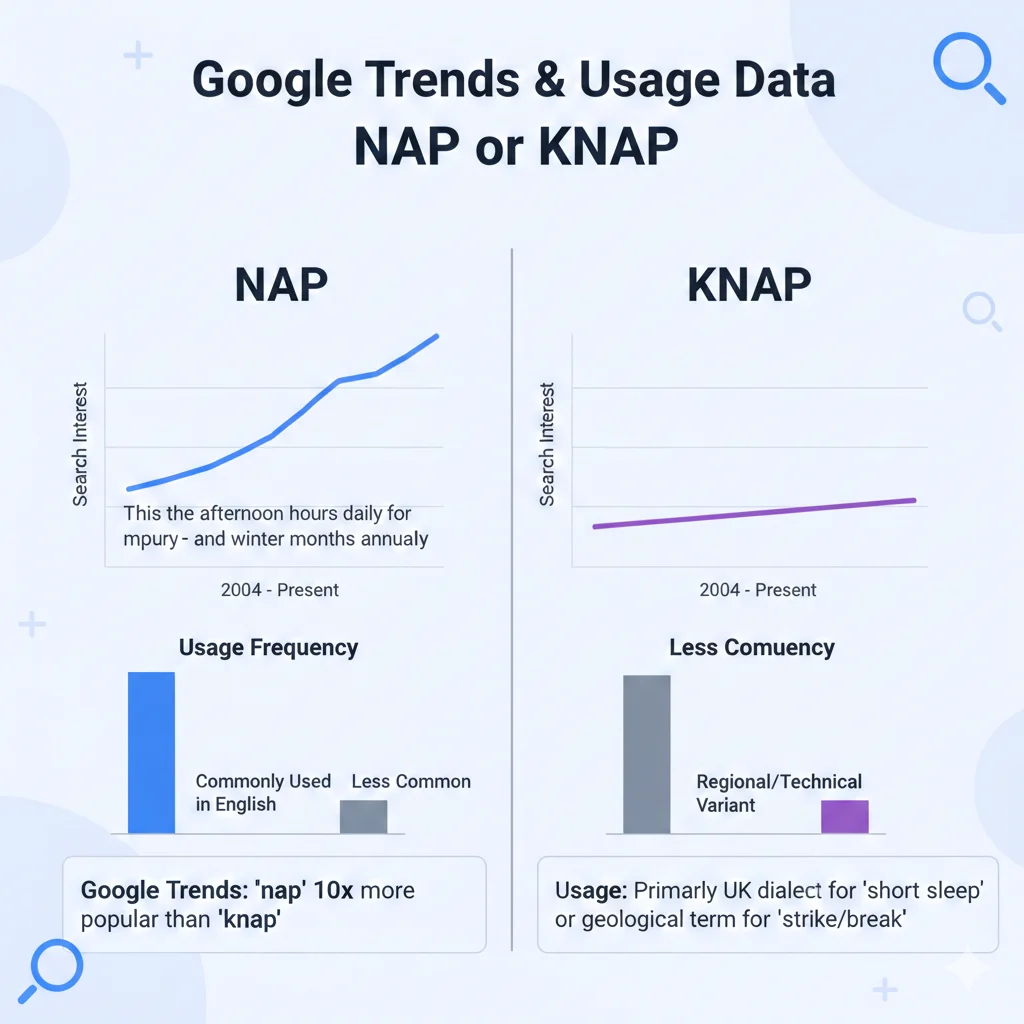
- “Nap” (for sleep) is overwhelmingly the most popular and frequently searched term. People search for queries like “how do you spell nap as in sleep”, “what is a nap”, and “is nap mean sleep” constantly. This is a common, everyday word used by everyone.
- “Nap” (for fabric) is a highly searched term in specific niches. Queries like “fabric nap” and “carpet nap” are common among hobbyists, seamstresses, interior designers, and people looking to clean or maintain textiles properly.
- “Knap” is a much rarer search term. It has very high “search intent” specificity. People searching for “knap meaning” are likely students, archaeology enthusiasts, or crafters. The search for “knap hair” comes from the beauty and hairdressing community, showing the word’s specialized use in that field . Searches for “Knap of Howar” are from people interested in history and Neolithic sites in Scotland .
In short, if you are writing for a general audience, “nap” will be your go-to word about 99% of the time. “Knap” is reserved for technical, historical, or hobbyist conversations.
Frequently Asked Questions (FAQs)
1. What does knap mean?
The primary meaning of “knap” is a verb meaning to shape a stone by striking it, or to break off fragments. It can also be a noun referring to a hilltop or, in hairdressing, the nape of the neck .
2. How do you spell nap as in sleep?
The correct spelling for a short period of sleep is N-A-P. For example, “I am going to take a nap.” .
3. What is a nap?
A “nap” has two main definitions. First, it is a short period of sleep, especially during the day. Second, it is the soft, fuzzy, raised surface on fabrics like velvet, corduroy, or carpet .
4. Is nap mean sleep?
Yes, absolutely. One of the most common and primary meanings of the word “nap” is a brief period of sleep .
5. What does “fabric nap” mean?
Fabric nap refers to the raised, fuzzy surface on certain textiles. It is created by brushing or adding extra fibers (pile) to the cloth. The nap often has a direction, making the fabric look lighter or darker depending on how you brush it .
6. What is the “Knap of Howar”?
The Knap of Howar is a Neolithic farmstead located on the island of Papa Westray in Orkney, Scotland. It is considered one of the oldest preserved stone houses in northern Europe, dating back to around 3700 BC .
7. What does “knap hair” mean?
In the hairdressing and barbering world, “knap” refers to the area at the back of the neck where the skull meets the spine. Stylists often use it to describe the point where they need to blend or trim hair .
8. How do you use “nap” and “knap” in a sentence correctly?
- Nap: “After a long morning of gardening, I lay down on the velvet sofa for a quick nap.”
- Knap: “The artisan used a deer antler to carefully knap the obsidian.”
Conclusion
The confusion between nap or knap is a perfect example of how the richness of the English language can lead to simple spelling mistakes. While they sound the same, their meanings are distinct worlds apart. One belongs to the quiet comfort of a bedroom and the soft touch of fabric, while the other belongs to the sharp crack of a hammer on stone and the ancient craft of toolmaking.
By now, the nap or knap meaning should be clear. Remember the quick check: is it soft and sleepy, or sharp and stony? If you can associate the fuzzy feel of a velvet nap with a cozy daytime rest, you will always spell that one correctly. And if you picture a prehistoric toolmaker giving a stone a sharp knap, you will remember the silent ‘k’.
So, the next time you are writing, don’t let this pair of homophones trip you up. Whether you are planning a quiet afternoon nap or researching ancient history, you now have the knowledge to choose the perfect word for the job. Now, you might even be ready to enjoy a good book on the napped surface of your favorite reading chair—without a single spelling worry in your head.

“May Sinclair, a playful wordsmith at PunsBlast, turning clever puns and witty humor into daily laughs that brighten readers’ days.”