Have you ever been typing quickly and paused, your fingers hovering over the keyboard? Should you write that a team needs to jell or gel? You’re not alone.
This spelling dilemma is a tiny linguistic speed bump that trips up millions of writers, from students to CEOs. People search for this keyword not because they don’t understand the meaning, but because English offers two tempting, nearly identical options.
The confusion lies at the fascinating crossroads of word history and the great divide between American and British English. Is there a difference, or are they just alternate spellings of the same idea? This article cuts through the sticky confusion.
We’ll provide the quick answer, explore the rich history behind the words, and give you clear, confident rules so you’ll never second-guess yourself again.
Whether you’re writing a formal report, a social media post, or simply want to know the correct term for hair styling products, we have you covered. Let’s settle the jell or gel debate once and for all.
Jell or Gel means
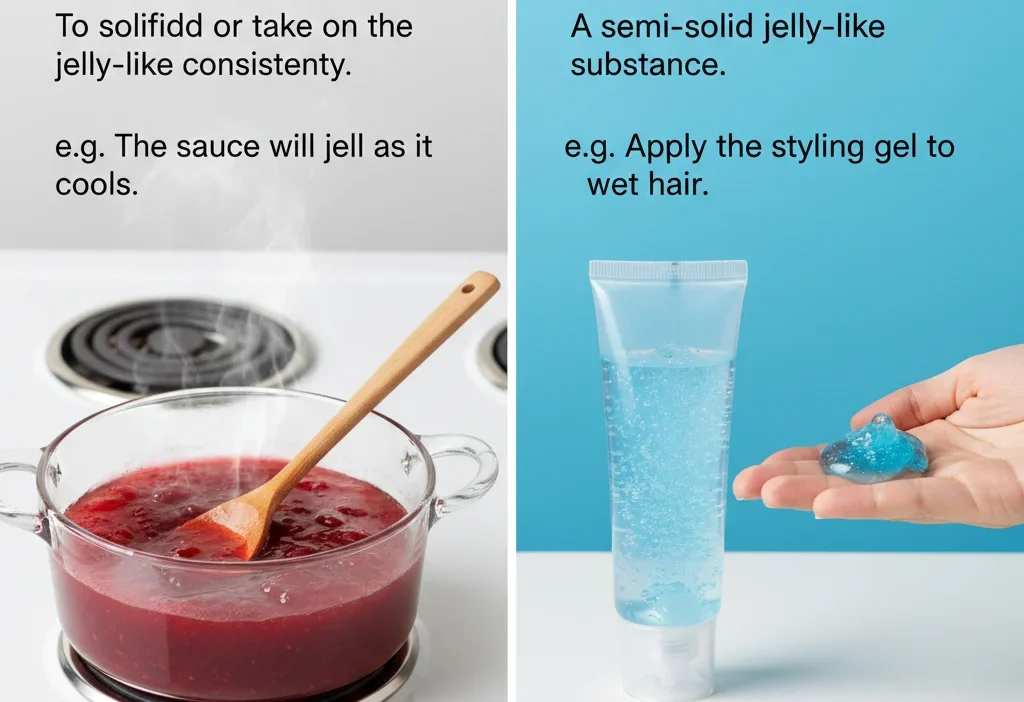
The quick answer is that both “jell” and “gel” can be correct, but they are used in different contexts. Think of it this way: “Gel” is the broader, more common term, while “jell” is a specific verb choice.
- Use “gel” as a noun for a semi-solid substance (like hair gel or aloe vera gel) and as the standard verb meaning to take shape or work well together.
- Noun: “He applied gel to his hair.”
- Verb: “Our team plans finally began to gel after the meeting.”
- Use “jell” almost exclusively as a verb, often preferred in American English for the metaphorical sense of ideas or groups coming together.
- Verb: “The new band didn’t jell until they found their sound.”
In short: All substances are gels. Ideas, teams, or plans can gel (generally) or jell (preferred in US English for this sense). When in doubt, “gel” is the safer, more universally accepted choice.
The Origin of Jell or Gel
The story of jell and gel begins with one Latin word: gelare, meaning “to freeze.” This root gave us “gelatin,” a substance that causes liquids to solidify. The word “jelly” also comes from this lineage. In the 19th century, scientists needed a term for colloidal semi-solids, and they coined “gel,” a shortening of “gelatin,” to describe the state of matter.

The verb form—meaning “to become a gel” or “to take definite form”—naturally followed. But where did “jell” come from? It’s a classic case of phonetic spelling. As people used the verb “to gel” in speech, some writers began spelling it as it sounded: “jell.” This variant was cemented (or gelled!) into the language, particularly in American English, to describe abstract concepts solidifying. The spelling difference exists not because of separate origins, but because English allows for variation, especially when a word crosses over from scientific jargon to everyday metaphor.
British English vs American English Spelling
The jell or gel choice is a clear example of the subtle differences between British and American English spelling conventions.
- American English: Has a strong preference for “jell” when using the verb in a figurative sense (e.g., teams jell, ideas jell). “Gel” is used for the noun and the literal verb sense (e.g., the mixture will gel as it cools).
- British English: Overwhelmingly uses “gel” for all meanings—noun, literal verb, and figurative verb. The spelling “jell” is rarely seen in modern British writing.
This table summarizes the key differences:
| Context | American English Preference | British English Preference |
|---|---|---|
| Noun (substance) | Gel (Hair gel) | Gel (Hair gel) |
| Verb (literal) | Gel (The pudding will gel.) | Gel (The pudding will gel.) |
| Verb (figurative) | Jell (The team needs to jell.) | Gel (The team needs to gel.) |
Which Spelling Should You Use?
Your audience should guide your choice:
- For a US Audience: Feel free to use “jell” for the figurative verb. It’s widely accepted and understood. Using “gel” for all cases is also perfectly fine and is becoming more common.
- For a UK/Commonwealth/International Audience: Always use “gel.” Using “jell” may look like a spelling error to these readers.
- For Global or Formal Writing (Science, Academia, Business): Use “gel” consistently. It is the standard scientific term and the safest, most professional choice that avoids regional confusion.
When asking “is it jell or gel?” for a global website, report, or academic paper, “gel” is the unambiguous winner.
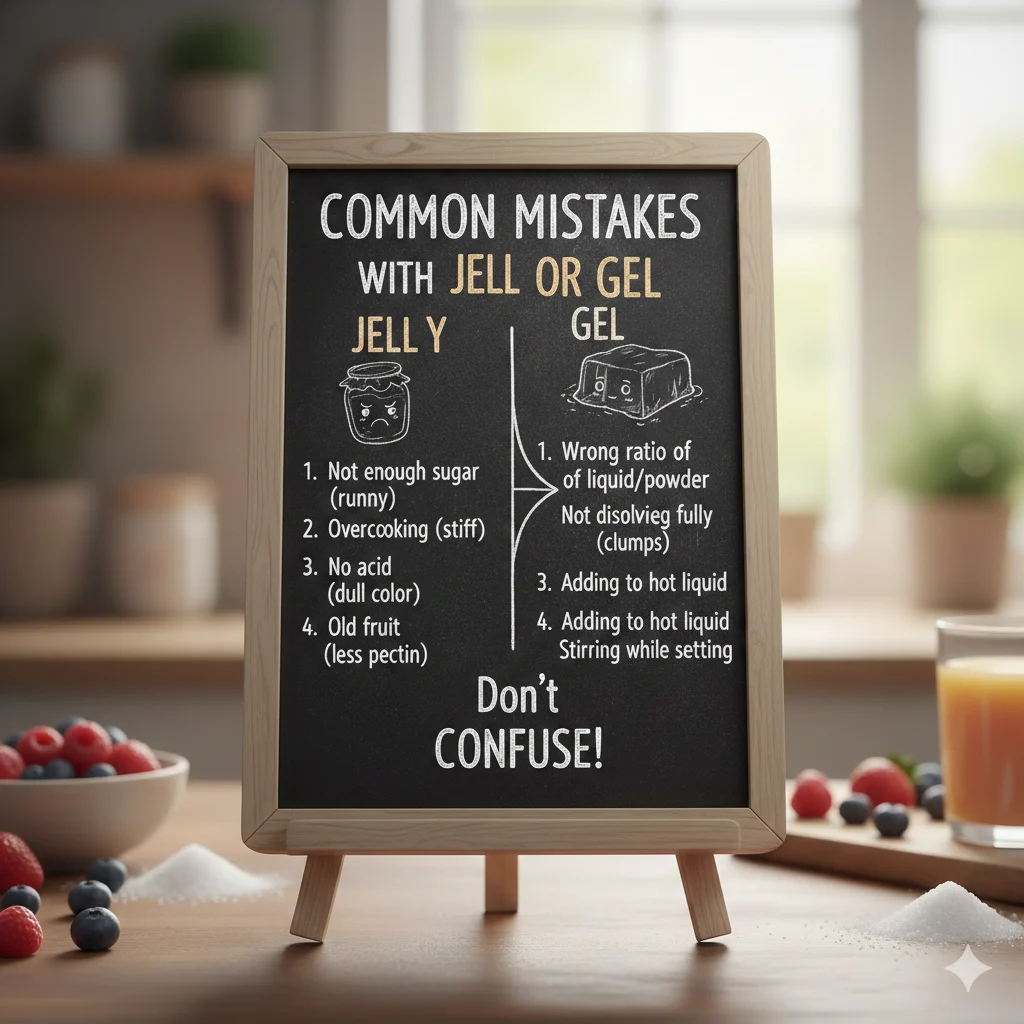
Common Mistakes with Jell or Gel
- Using “Jell” as a Noun: This is almost always incorrect. You don’t buy a tub of hair jell.
- Wrong: “She used a strong-hold jell.”
- Correct: “She used a strong-hold gel.”
- Confusing “Jell” with “Jelly”: While related, they are different. Jelly is a specific food product made from fruit juice and sugar. A gel is a scientific state of matter or a styling product. They are not the same thing.
- Wrong: “The medicine has a jelly consistency.”
- Correct: “The medicine has a gel consistency.”
- Overcomplicating the Verb: The core jell or gel meaning as a verb is the same: to come together. Don’t invent a difference. Whether you write “the team gelled” or “the team jelled,” the meaning is identical.
Jell or Gel in Everyday Examples
- Email/Professional: “We need another workshop for the new department to gel properly.”
- News Headline: “New Government Coalition Struggles to Gel Amid Policy Disputes.” (International press would use “gel.”)
- Social Media: “When your friend group finally jells with your partner. #GoodVibes” (Here, “jells” fits the casual, US-centric vibe.)
- Formal Writing: “The experimental solution was left to gel at room temperature for 24 hours.”
- Everyday Question: “Is it time to gel or jell?” For a project, you’d say, “It’s time for our plans to gel.”
Jell or Gel – Google Trends & Usage Data
Data from Google Trends and language corpora shows a clear picture. Worldwide, the search term and usage of “gel” is vastly more popular than “jell,” by a factor of over 10-to-1. This is because “gel” covers all noun uses (hair gel, shower gel) and most verb uses.
Interest in “jell” is primarily concentrated in the United States, spiking around sports seasons when commentators discuss if a team will “jell.” Searches for “jell or gel” peak in English-speaking countries, indicating it’s a common writing hurdle. The data confirms that “gel” is the dominant global form, while “jell” remains a niche, regionally-specific variant for the verb.
FAQs: Your Jell or Gel Questions Answered
Q1: Is a team gel or jell?
You can use either for the verb. In American English, “the team jelled” is slightly more traditional. Everywhere else, and increasingly in the US, “the team gelled” is standard.
Q2: Are gel and jelly the same thing?
No. Jelly is a specific type of food preserve. Gel is a scientific term for a semi-solid substance. While jelly is a gel, not all gels are jelly (e.g., hair gel, silica gel).
Q3: What does gel up mean?
“Gel up” is an informal phrasal verb meaning to become viscous or clumpy. For example, “The old paint had gelled up in the can.”
Q4: What is the meaning of “jell with someone”?
It means to form a smooth, understanding, and effective relationship with someone. It’s another way to say you connect or work well together.
Q5: Is there a difference between jelly vs gel hair products?
Yes. Hair gel is a styling product that provides hold and structure. Hair jelly is typically a lighter, more diluted product that gives definition and a wet look with less crunch.
Q6: What is gel in pharmacy?
In pharmacy, a gel is a medicinal preparation in a semi-solid state, often used for topical application (like antibiotic gel or pain-relief gel). It allows for controlled release of medication.
Q7: Can you say “gel together” or “jell together”?
Yes, both are used. “The ingredients gelled together to form a paste.” Figuratively: “The players jelled together as a unit.” The meaning is identical; the spelling is a regional preference.
Conclusion
The jell or gel puzzle is a fascinating glimpse into how language evolves. While their origins are shared, usage has carved subtle paths. The key takeaway is simplicity itself: “Gel” is your universal tool. It correctly names substances, describes scientific processes, and effectively conveys the moment ideas or teams coalesce. While “jell” holds a cherished place in American English for figurative use, its application is narrow. For clear, professional, and globally-understood communication, adopting “gel” for all noun and verb uses is the most effective strategy. So, the next time you wonder if your plans are starting to gel, you can write with absolute confidence, knowing your choice is solid—no matter who is reading.

“Witty McGiggles, PunsBlast’s resident pun master, spins clever wordplay and playful humor to turn every moment into a laugh.”