
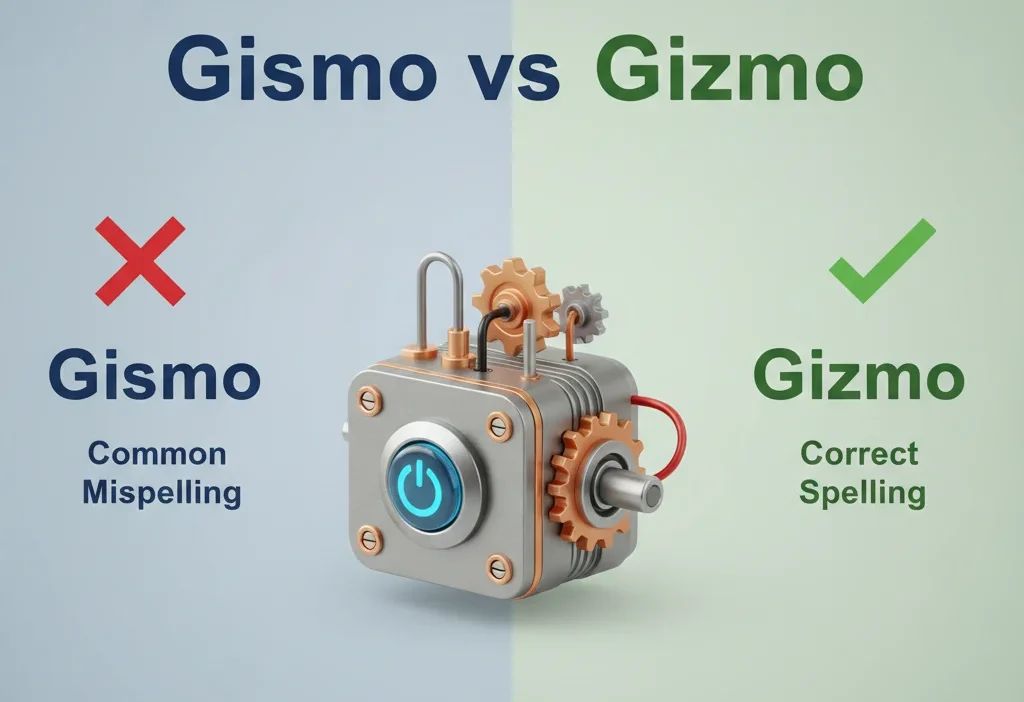
Is it a gadget in your pocket or a doodad on your desk? If you’ve ever wondered, “Is it spelled gismo or gizmo?” you’re not alone. This simple word for a small, clever device sparks surprising confusion.
People search for this keyword not just for spelling, but to understand what it truly means and how to use it correctly in writing and speech. This common query highlights a classic language puzzle: navigating the subtle differences between American and British English.
Is “gizmo” a proper word? Absolutely, but its variant “gismo” adds a twist. This article cuts through the uncertainty.
We’ll solve the spelling debate, explore the word’s playful origin, and provide clear guidelines so you can use “gizmo” or “gismo” with confidence, whether you’re writing an email, a product description, or a technical manual. Let’s demystify this handy term once and for all.
Gizmo / Gismo

The quick answer is that “gizmo” is the standard and far more common spelling, especially in American English. “Gismo” is an accepted variant, more frequently seen in British English. Both spellings refer to the same thing: a small, often novel device or object, especially one whose name you might not know or you consider overly technical. Think of it as a casual synonym for “gadget,” “widget,” or “contraption.”
Examples:
- “This new gizmo on my keychain can find my phone with a button press.”
- “He attached a clever gismo to the hose to stop it from kinking.”
- “What does this little gizmo do?”
The Origin of Gizmo

The etymology of “gizmo” is delightfully obscure, much like the mysterious gadgets it often describes. It first appeared in American English around the 1940s, likely as slang used by U.S. Navy sailors and mechanics. Its exact origin is unknown, but it’s thought to be an invented word—a “placeholder” name for a technical part or tool whose real name was forgotten or too complicated. This makes perfect sense for its meaning. Why do spelling differences exist? As the word spread from spoken slang into written language, people spelled it phonetically. The “z” sound can be represented by both ‘z’ and ‘s’ in English (think “buzzing” vs. “pleasure”), leading to the natural emergence of both “gizmo” and “gismo.” There’s no deeper historical reason; it’s simply a matter of how different writers first recorded the sound they heard.
British English vs. American English Spelling
The gismo or gizmo in English debate fits a familiar pattern. American English tends to favor more phonetic and simplified spellings, often sticking closer to how a word sounds. The “z” in “gizmo” clearly represents the /z/ phoneme. British English, however, is more varied and historically retains different spelling conventions. The use of ‘s’ to represent a /z/ sound is common in British English (e.g., “realise” vs. American “realize”).
Key Spelling Rule: In American English, when a vowel-consonant-vowel pattern creates a /z/ sound, it’s almost always spelled with a ‘z’ (e.g., realize, organize, analyze). “Gizmo” follows this rule. British English is more flexible, allowing both ‘s’ and ‘z’ in many such cases, which is why “gismo” is found there.
Comparison Table: Gizmo vs. Gismo
| Feature | Gizmo | Gismo |
|---|---|---|
| Primary Usage | Standard spelling, dominant worldwide. | Accepted variant, less common. |
| Regional Preference | Strongly preferred in American English. | Sometimes used in British/Commonwealth English. |
| Dictionary Status | Listed as the main headword in most dictionaries. | Listed as a variant spelling. |
| Global Clarity | Most widely recognized and understood. | May be seen as a misspelling in some contexts. |
| Example Sentence | “She loves testing the latest kitchen gizmo.” | “He found a useful gismo in the hardware shop.” |
Which Spelling Should You Use?
Your choice should be guided by your audience and context.
- For an American Audience or International/Business English: Always use “gizmo.” It is the unambiguous, standard choice. Using “gismo” in the U.S. might be viewed as a typo.
- For a UK or Commonwealth Audience (e.g., Australia, Canada): “Gizmo” is still the safest bet. While “gismo” may be understood, “gizmo” is globally prevalent and correct. In informal UK writing, “gismo” might appear, but it’s not the standard.
- For a Global or Online Audience: Use “gizmo.” It dominates online searches, product names, and media. To ensure maximum clarity and professionalism, “gizmo” is the superior choice.
Simple Rule: When in doubt, spell it g-i-z-m-o.
Common Mistakes with Gizmo
The most frequent error is directly tied to our main question: “How do you spell gizmo right?”

- Using “Gismo” in American Contexts: In U.S. technical writing, marketing, or formal documents, “gismo” will look incorrect.
- Incorrect: “Our new tech gismo will change your life!” (if written for a US company).
- Correct: “Our new tech gizmo will change your life!”
- Overcapitalization: Unless it’s a brand name (like the Gremlins character Gizmo), it should be lowercase.
- Incorrect: “I bought a new Gizmo for my car.”
- Correct: “I bought a new gizmo for my car.”
- Misunderstanding the Meaning: A gizmo is typically a small, physical object. Don’t use it for large machines or abstract software concepts.
- Poor Use: “The factory’s new manufacturing gizmo is the size of a bus.” (Use “machine” or “contraption”).
- Good Use: “This little gizmo helps me clean between my laptop keys.”
Gizmo in Everyday Examples
Seeing gizmo examples in context helps solidify proper usage.
- Email (Informal): “Hey Tom, can you bring that cable-organizing gizmo when you come over? It’s a lifesaver.”
- News Headline: “Startup’s Simple Gizmo Aims to Reduce Plastic Bottle Waste.”
- Social Media Post: “Just found the coolest kitchen gizmo for avocado slicing! #kitchenhack #gadget”
- Formal Writing/Product Description: “The device includes a proprietary mounting gizmo that ensures secure attachment to any surface.” (Even here, the word maintains a slightly informal, accessible tone).
Gizmo – Google Trends & Usage Data
Data confirms the clear dominance of “gizmo.” According to Google Trends and corpus analysis (like Google Ngram Viewer), “gizmo” is searched for and published over 10 times more frequently than “gismo” worldwide. Interest in the term “gizmo” is fairly consistent across English-speaking countries, with the United States, the United Kingdom, Canada, and Australia all showing significant search volume. Searches often spike around holidays (gift-giving seasons) and tech product launches, tying back to the gismo or gizmo meaning of a novel gadget. The data decisively supports “gizmo” as the mainstream spelling.
FAQs: Your Gizmo Questions Answered
1. Is it spelled gismo or gizmo?
Both are found in dictionaries, but “gizmo” is the standard and recommended spelling for almost all contexts. “Gismo” is a less common variant.
2. Is “gizmo” a proper word?
Yes, absolutely. It is a fully accepted noun in the English language, found in all major dictionaries.
3. How do you spell gizmo right?
The most universally correct spelling is G-I-Z-M-O.
4. What is a synonym for gizmo?
Common gizmo synonyms include: gadget, device, contraption, widget, doodad, thingamajig, apparatus.
5. How do you pronounce gizmo?
The gismo or gizmo pronunciation is identical: /ˈɡɪz.moʊ/ (GIZ-moh). The first syllable rhymes with “fizz,” and the second is like “mow.”
6. What is “gizmo” in Spanish?
The direct translation is “artilugio” or “dispositivo.” Like in English, “gizmo” can also be used conversationally in Spanish as a borrowed word.
7. Is a smartphone a gizmo?
Technically, yes, it’s a complex device. However, “gizmo” often implies a smaller, simpler, or more niche accessory rather than a primary, well-named device like a “phone” or “laptop.” You might call a new phone stand or stylus a “gizmo,” but you’d typically just call the smartphone itself a “phone” or “device.”
Conclusion
So, what’s the final verdict on the gismo or gizmo puzzle? The evidence is clear. While both spellings exist, “gizmo” is the dominant, standard form you should use for clear and effective communication. Its playful origin as slang for an unnamed gadget perfectly captures its meaning—a handy, often clever little device. Remember the simple guidelines: use “gizmo” for American and international audiences, and consider it the default choice even in regions where “gismo” might occasionally pop up. By choosing “gizmo,” you ensure your writing is professional, easily understood, and free from distracting spelling debates. Whether you’re describing a tech accessory, a kitchen tool, or a mechanical widget, you can now confidently name that nameless gizmo.

“George Gissing, a humor-loving writer at PunsBlast, crafting witty puns and playful word magic to make readers laugh every single day.”