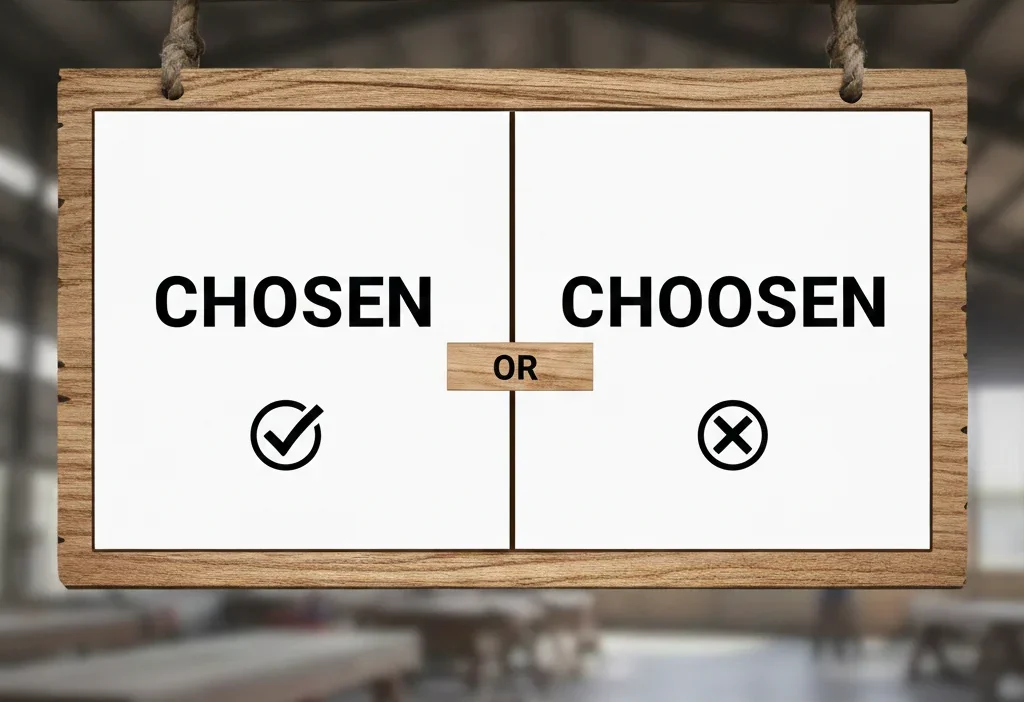
Have you ever paused while writing, your fingers hovering over the keyboard, wondering if it’s “chosen or choosen”? You are not alone.
This simple spelling doubt is one of the most persistent in the English language, creating confusion for students, professionals, and writers worldwide.
People search for this keyword not out of casual curiosity, but from a genuine moment of uncertainty—often when they are writing an important email, finishing a report, or completing an assignment.
They need a clear, definitive answer to avoid a mistake that could undermine their credibility.
This article solves that confusion directly. We will cut through the noise to give you the quick answer you need, followed by a deep dive into why this mistake happens.
We’ll explore word origins, compare British and American English rules, and provide practical advice based on who you are writing for.
By the end, you will never second-guess the correct spelling between “chosen” or “choosen” again, and you’ll understand the grammar behind words like “choose,” “chose,” and “chosen” with complete confidence.
Chosen or Choosen? means
The correct spelling is chosen. “Choosen” is always incorrect in standard English.
“Chosen” is the past participle of the verb “to choose.” It is used with helping verbs like “have,” “has,” or “had.” The simple past tense of “choose” is “chose.”
Examples:
- Correct: I have chosen the blue dress.
- Incorrect: I have choosen the blue dress.
- Correct: She chose that restaurant last week.
- Correct: They had chosen a new path for the company.
Remember: Choose (present) -> Chose (past) -> Chosen (past participle). There is no “choosen” in this sequence.
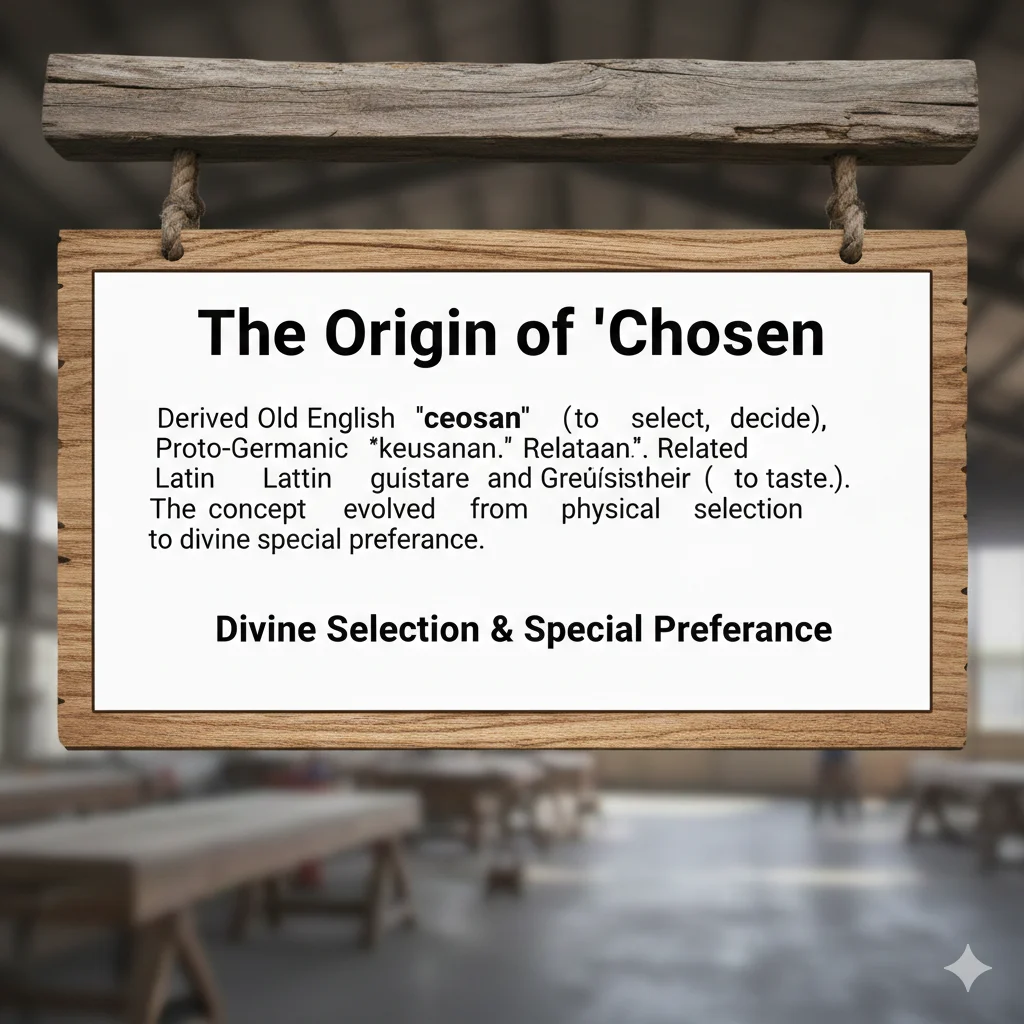
The Origin of “Chosen”
To understand why “chosen” is correct and “choosen” is a common error, we must look at its history. The verb “choose” comes from the Old English word “cēosan,” which meant to select or decide. Its past tense was “cēas,” and its past participle was “(ge)coren.”
Over centuries, English grammar evolved. For many “strong” verbs (those that change their vowel sound to show tense), the past participle often took an “-en” ending, like “spoken,” “broken,” and “chosen.” This “-en” is a relic of old Germanic grammar patterns.
The misspelling “choosen” likely arises from two sources:
- Overgeneralization: People apply the more common rule of adding “-ed” for the past tense (like “walked,” “answered”) to irregular verbs. Since “chosen” sounds like it could have two syllables (“cho-sen”), some assume an extra ‘o’ is needed.
- Pronunciation: In rapid speech, the “o” in “chosen” can sound elongated, blurring the line between one ‘o’ and two. This leads to the phonetic but incorrect spelling “choosen.”
The spelling “chosen” has been standardized for centuries, preserving its historical roots while “choosen” remains a frequent typo and error.
British English vs. American English Spelling
When it comes to the word “chosen,” there is no difference between British and American English spelling. Both varieties use “chose” for the simple past tense and “chosen” for the past participle. The confusion is not a dialect issue but a universal spelling error.
However, understanding general spelling differences between these two major English forms can help clarify why other words might cause similar doubts. British English often retains more traditional spellings, while American English, influenced by reformers like Noah Webster, simplified many.
| Word Type | American English | British English | Notes |
|---|---|---|---|
| Past Participle (This Verb) | chosen | chosen | Identical in both. “Choosen” is incorrect everywhere. |
| Color/Colour | color | colour | “-or” vs. “-our” suffix. |
| Traveled/Travelled | traveled | travelled | Single vs. double ‘l’ before a suffix. |
| Analyze/Analyse | analyze | analyse | “-yze” vs. “-yse” suffix. |
The key takeaway: you don’t need to worry about regional variations for “chosen.” It’s spelled the same way in London, New York, Sydney, and Toronto.
Which Spelling Should You Use?
You should always use “chosen.” The audience you are writing for does not change the spelling of this word. “Choosen” is not an accepted variant in any standard form of English.

Here’s how to apply this knowledge based on your context:
- For American Audiences: Use chosen. Spell-checkers set to US English will flag “choosen” as an error.
- For UK/Commonwealth Audiences (UK, Canada, Australia, etc.): Use chosen. Spell-checkers set to these dialects will also flag “choosen.”
- For Global or International English: Use chosen. It is the only globally accepted standard spelling for the past participle of “choose.”
- In Formal Writing (Academic, Business, Legal): The use of “chosen” is non-negotiable. Using “choosen” would be seen as a significant spelling error.
- In Informal Contexts (Texts, Social Media): While typos are more common, using the correct “chosen” still projects better literacy skills.
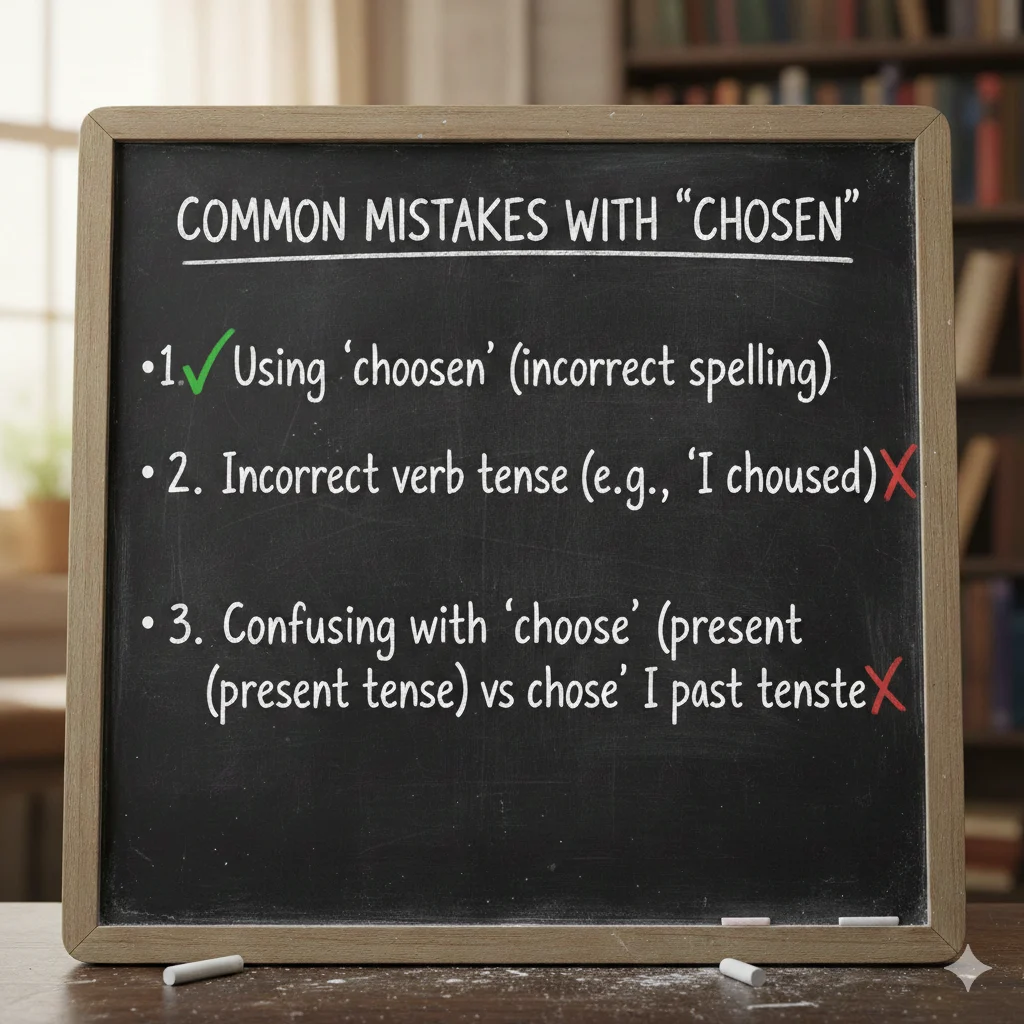
Common Mistakes with “Chosen”
The primary mistake is, of course, spelling it as “choosen.” But related errors involve confusing the three main forms of the verb: choose, chose, and chosen.
- Using “chose” instead of “chosen” (and vice versa).
- Incorrect: I had chose to stay. (Should use past participle “chosen” with “had”).
- Correct: I had chosen to stay.
- Incorrect: I chosen the red car yesterday. (Should use simple past “chose” without a helper verb).
- Correct: I chose the red car yesterday.
- Misspelling as “choosen.” This is the core error addressed by the keyword search “chosen or choosen.”
- Incorrect: The team was choosen for the finals.
- Correct: The team was chosen for the finals.
- Confusing “choose” with “chose” in the present tense.
- Incorrect: Please chose an option from the menu.
- Correct: Please choose an option from the menu.
“Chosen” in Everyday Examples
Seeing “chosen” in context helps cement its correct use.
- Email (Professional): “Thank you for your applications. We have chosen a candidate for the interview stage.”
- News Headline: “Voters Have Chosen a New Mayor in Historic Election.”
- Social Media Post: “So happy! We’ve finally chosen a name for our new puppy! #newfamily”
- Formal Writing (Report): “The methodology chosen for this study was a double-blind trial.”
- Everyday Conversation: “He wasn’t my first pick, but I’ve chosen to support him.”
Chosen or Choosen? – Google Trends & Usage Data
Analysis of search data reveals a clear story. Searches for the phrase “choosen” and comparisons like “chosen or choosen” are consistently high worldwide. This indicates ongoing and widespread confusion. The incorrect spelling “choosen” receives a significant percentage of search volume compared to the correct “chosen,” especially in regions with large non-native English speaker populations or where phonetic spelling is more common.
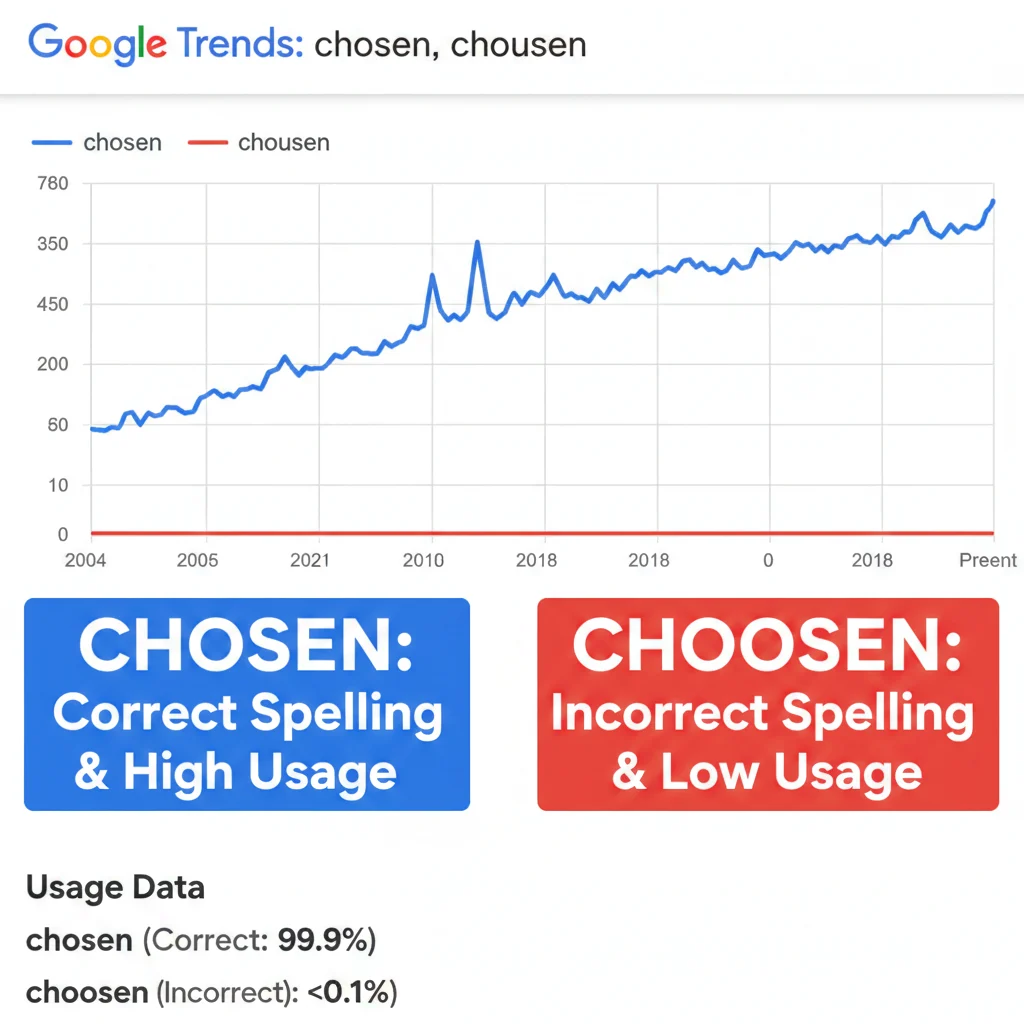
The United States, United Kingdom, India, the Philippines, and South Africa show notable search activity for these clarifying phrases. This isn’t about one country getting it wrong; it’s a universal English spelling hurdle. The data confirms that this is a high-value keyword for solving a real and frequent user problem—people are actively seeking authority to correct their grammar.
Comparison Table: Keyword Variations
| Correct Form (Verb) | Incorrect Form | Part of Speech | Example Sentence |
|---|---|---|---|
| Choose | – | Present Tense | I choose to be happy. |
| Chose | choosed | Simple Past Tense | Yesterday, she chose the steak. |
| Chosen | choosen | Past Participle | We have chosen our path forward. |
| Choosing | choosening | Present Participle | They are choosing a new logo. |
FAQs: Chosen or Choosen?
1. Is it “chosen” or “choosen”?
It is chosen. “Choosen” is an incorrect spelling.
2. What is the meaning of the word “choosen”?
“Choosen” has no meaning because it is not a word. The correct word is chosen, which means to have been selected from a number of possibilities.
3. Is it correct to say “chosen”?
Yes, absolutely. “Chosen” is the correct past participle of the verb “to choose.” You use it with helpers: have chosen, has chosen, had chosen, was chosen.
4. Has chosen or choosen?
The correct phrase is “has chosen.” Example: “The committee has chosen a winner.”
5. Is “chosen” past tense?
Not exactly. “Chosen” is the past participle. The simple past tense is “chose.” You use “chosen” with a helper verb (have/has/had) and “chose” by itself for a completed past action.
- Past: I chose (yesterday).
- Past Participle: I have chosen (now, as a result).
6. Can you give me a sentence with “chosen”?
“After much thought, the award for best design was chosen.”
7. What is the “choose” past tense?
The past tense of “choose” is “chose.” Example: “I chose the red tie this morning.”
Conclusion
The journey from confusion to clarity on “chosen or choosen” is a short one. The definitive answer is that “chosen” is correct and “choosen” is always a spelling error. This rule holds true across all major forms of English—American, British, and global. The mistake usually stems from a misapplication of regular verb rules or a phonetic misunderstanding, not from regional differences.
Remember the simple verb conjugation: choose (now), chose (then), chosen (with have/has/had). By mastering this, you not only solve this specific spelling problem but also strengthen your overall command of irregular English verbs. Whether you’re drafting a critical business proposal, writing an essay, or simply sending a text, using the correct form “chosen” ensures your communication is professional and accurate. Bookmark this guide, and you’ll never have to question this common spelling again.

“May Sinclair, a playful wordsmith at PunsBlast, turning clever puns and witty humor into daily laughs that brighten readers’ days.”