
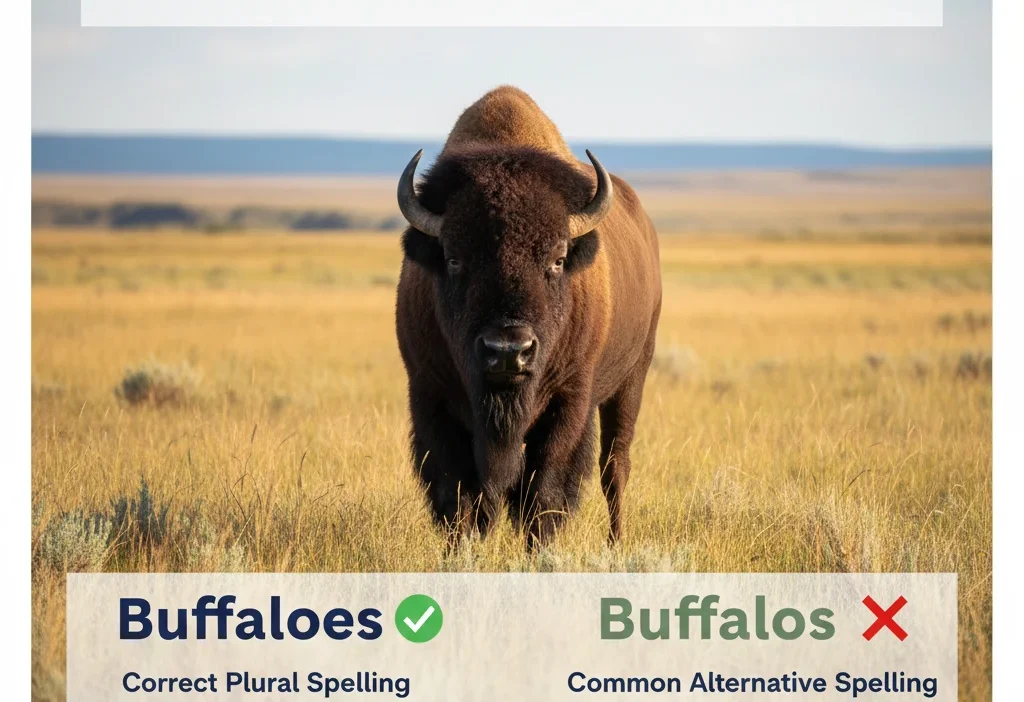
Have you ever typed “buffaloes or buffalos” into a search bar? You are not alone. This simple word causes a surprising amount of confusion. Is it “buffaloes” with an ‘es’ or “buffalos” with just an ‘s’?
People search for this because they are writing an email, a school paper, or a work report and want to get it right. They want to avoid a small spelling error that could make their writing look less professional.
This article will solve that confusion. We will give you a quick answer and then a deep look at the history and rules behind the word. You will learn why both spellings exist and which one you should use.
We will cover common mistakes, everyday examples, and even what the data says about how people use the word. By the end, you will never second-guess the plural of buffalo again.
Buffaloes or Buffalos
Both “buffaloes” and “buffalos” are correct spellings for the plural of “buffalo.” You can use either one. However, “buffaloes” is the more common spelling globally and is often preferred in formal writing.

If you are talking about the animal, either is fine. For example:
- We saw a herd of buffaloes near the river.
- The buffalos grazed on the open plain.
The verb “to buffalo,” meaning to confuse or intimidate, almost always uses “buffaloes” for the third-person present tense: “His tough talk buffaloes most people.” So, for a quick rule: use “buffaloes” when in doubt, especially for formal contexts.
The Origin of Buffalo
The word “buffalo” has a long and winding history. It came into English in the 1500s from Portuguese “búfalo,” which itself came from Greek “boúbalos,” meaning a type of antelope or wild ox. When English words end in -o, forming their plural has always been tricky. There is no single hard rule.
Some words from the past simply added “-s” (pianos, solos). Others took “-es” (potatoes, heroes). Why the difference? Often, it depended on how the word entered the language and what felt natural to speakers at the time. “Buffalo” fell into a group where both plural forms sounded acceptable over time. This is why the spelling difference exists today—it’s a natural variation in a living language.
British English vs American English Spelling
A common belief is that “-oes” is British and “-os” is American. This is partly true for some words, but not a firm rule for “buffalo.”
- British English tends to favor buffaloes. British style guides and publications more consistently use the “-oes” ending.
- American English widely accepts both, but “buffaloes” is still very common. Some American dictionaries even list “buffaloes” first.
Here is a look at how each dialect treats similar words:
| Word | Preferred British Plural | Preferred American Plural |
|---|---|---|
| Buffalo | Buffaloes | Both are used (Buffaloes common) |
| Volcano | Volcanoes | Volcanoes |
| Tornado | Tornadoes | Tornadoes |
| Mosquito | Mosquitoes | Mosquitoes |
| Cargo | Cargoes | Cargoes |
| Mango | Mangoes | Mangoes or Mangos |
As you can see, American English also uses “-oes” for many words. The idea that American English always shortens to “-os” is a myth. For buffaloes spelling, the main takeaway is that both forms are correct everywhere.
Which Spelling Should You Use?
Your choice can depend on your audience and purpose.
- For a US Audience: You have a free choice. “Buffaloes” might look slightly more traditional or formal, while “buffalos” can seem more modern or streamlined. Check if you have a style guide to follow.
- For a UK/Australian/Commonwealth Audience: Use buffaloes. This is the expected spelling and will look most correct to readers.
- For Global or Formal Writing (Academic, Business, News): Choose buffaloes. It is the more established and widely accepted plural form worldwide. It is the safer choice for important documents.
- For Informal Writing (Texts, Social Media): Use whichever you prefer! “Buffalos” is perfectly fine here.
Common Mistakes with Buffalo
- Using “Buffalo” for the Plural (Uncountable): Saying “I saw three buffalo” is actually not wrong. “Buffalo” can be a plural noun itself (like “deer” or “sheep”). But if you are adding a plural suffix, you must choose *-s* or *-es*.

- Uncommon: The buffalo are moving. (Correct)
- Incorrect: I photographed the buffalos. (Incorrect if you mean the spelling)
- Correct: I photographed the buffaloes/buffalos.
- Confusing the Animal with the City: Buffalo, New York, is always “Buffalo.” Its plural is “Buffalos” only when talking about multiple things from the city (e.g., “The Buffalos won,” referring to sports teams). You would never write “Buffaloes, New York.”
- Misusing the Verb: Remember, the verb “to buffalo” is different. Its third-person form is “buffaloes.”
- Incorrect: His glare buffalos me into silence.
- Correct: His glare buffaloes me into silence.
Buffaloes in Everyday Examples
Let’s see how to use the word in real contexts.
- Email (Work): “The report on waterhole usage by buffaloes is attached for your review.”
- News Headline: “Conservation Efforts See Rise in Wild Buffalo Population” (Using the uncountable plural).
- Social Media Post: “Amazing sighting of a massive herd of buffaloes on the safari today! #wildlife”
- Formal Writing (Academic): “The migration patterns of the African buffaloes (Syncerus caffer) were studied over five years.”
- Everyday Speech: “Did you know both ‘buffaloes’ and ‘buffalos’ are right? I always use ‘buffaloes.'”
Buffaloes – Google Trends & Usage Data
What does the data say? A look at Google search data and book databases shows a clear trend. Searches for “buffaloes or buffalos plural” are common, proving people are unsure. In terms of actual use, “buffaloes” is searched for and written about 3 to 4 times more often than “buffalos” globally.
This preference is even stronger in the UK, India, and Australia. In the US, the gap is smaller, but “buffaloes” still leads. This data supports the advice: “buffaloes” is the more common and dominant spelling worldwide, even in places where both are accepted.
Comparison Table: Keyword Variations
| Term | Part of Speech | Common Use | Example Sentence |
|---|---|---|---|
| Buffalo (Singular) | Noun | One animal. | A single buffalo stood apart from the herd. |
| Buffalo (Plural) | Noun | Multiple animals (uncountable plural). | A herd of buffalo blocked the road. |
| Buffaloes | Noun | The standard plural form (countable). | We counted twelve buffaloes at the watering hole. |
| Buffalos | Noun | An accepted variant plural form (countable). | The rancher raised ten buffalos on his land. |
| To Buffalo | Verb | To confuse or intimidate. | Don’t let his technical jargon buffalo you. |
| Buffaloes (Verb) | Verb | Third-person present of “to buffalo.” | His confident attitude buffaloes most of his opponents. |
FAQs on Buffaloes or Buffalos
What is the plural for buffalo?
The plural can be “buffalo,” “buffaloes,” or “buffalos.” “Buffalo” works like “deer.” “Buffaloes” is the most common spelling for the plural form, with “buffalos” as a correct variant.
What is the meaning of buffalos?
“Buffalos” is simply a spelling of the plural noun meaning more than one buffalo (the large, hoofed animal). It means the same as “buffaloes.”
Why is saying “buffalo” 8 times a sentence?
This is a famous grammar puzzle: “Buffalo buffalo Buffalo buffalo buffalo buffalo Buffalo buffalo.” It is a valid sentence using the city (Buffalo), the animal (buffalo), and the verb (to buffalo). It means: “Bison from Buffalo, that other bison from Buffalo intimidate, themselves intimidate bison from Buffalo.”
What do you call multiple buffalo?
You can call them “a herd of buffalo,” “many buffaloes,” or “several buffalos.” All are correct.
What does the Oxford Dictionary say about the buffalo plural?
The Oxford Dictionary lists the plural as “buffaloes” or “buffalos.” It notes that the plural can also be “buffalo,” especially when referring to a group as a single unit.
How do you pronounce buffalo?
It is pronounced /ˈbʌf.ə.ləʊ/ (BUH-fuh-loh). The plural forms “buffaloes” and “buffalos” are both pronounced /ˈbʌf.ə.ləʊz/ (BUH-fuh-lohz).
Can ‘buffalo’ be a verb?
Yes! To buffalo verb means to confuse, trick, or intimidate someone. Example: “He tried to buffalo me with his fancy contract terms.”
Conclusion
So, what is the final answer on buffaloes or buffalos in English? The key takeaway is freedom with guidance. Both spellings are correct. You will not be wrong using either one. However, “buffaloes” is the more traditional and widely used form. It is the preferred choice in British English, in global formal writing, and in most published works. “Buffalos” is a perfectly acceptable variant, especially in American English and informal contexts.
Remember the verb form “buffaloes” for confusing someone. And have fun with the famous eight-“buffalo” sentence! The next time you write about these powerful animals, you can do so with confidence, knowing you understand the simple nuance of their plural.

“Mary Elizabeth Braddon, a witty storyteller at PunsBlast, crafting clever puns and playful humor that turn everyday words into smiles.”