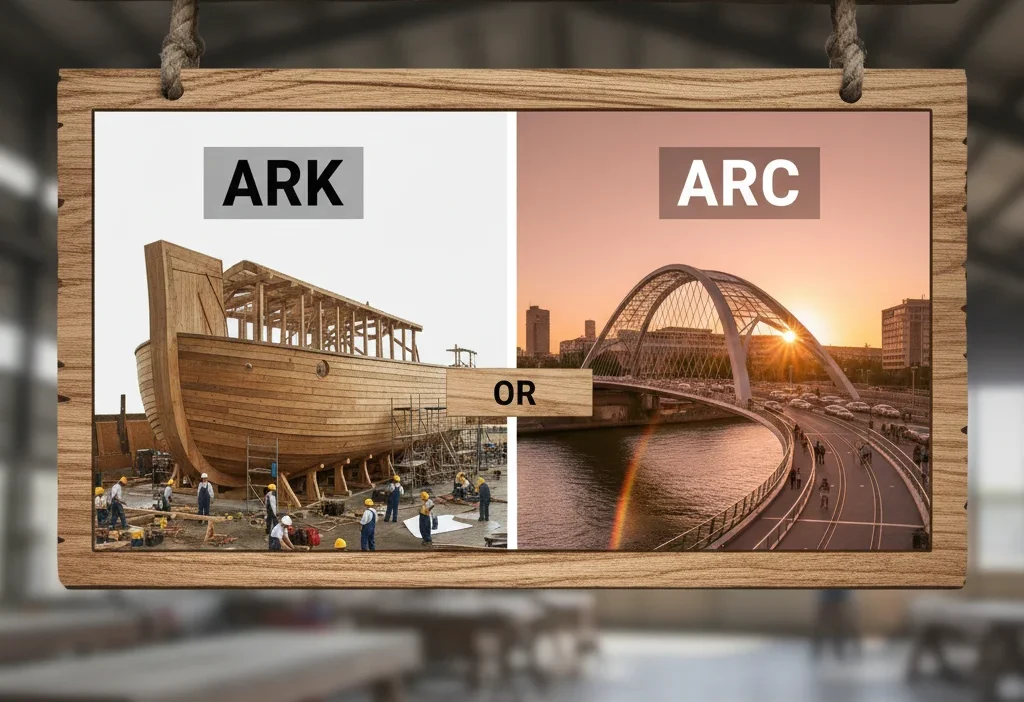
Have you ever paused mid-sentence, unsure whether to write about a character’s emotional “ark” or “arc”? You’re not alone. The confusion between ark or arc is a common language trap, stemming from identical pronunciation but vastly different meanings.
People search for this keyword to solve immediate writing dilemmas, to understand the correct usage in stories, religious texts, and even pop culture discussions like ark or arc in anime.
This search represents a quest for clarity: is it a vessel for survival or a curved line and a narrative journey? This article directly tackles that confusion.
We’ll provide the quick answer you need, explore the fascinating origins of each word, and deliver clear, professional advice on when to use ark vs arc.
Whether you’re finalizing a novel, writing a theological paper, or debating a character arc or ark in your favorite show, understanding this distinction is crucial for clear and effective communication. Let’s settle the ark or arc debate once and for all.
Ark or Arc means
The quick answer is that “ark” and “arc” are two completely different words. Choosing the correct one depends entirely on your meaning.
Use Ark when referring to:
- A large, protective vessel. The most famous example is Noah’s Ark or arc from the Bible.
- The sacred chest in the Bible called the Ark of the Covenant.
- A name for a place of refuge (e.g., wildlife ark).
Use Arc when referring to:
- A curved line or shape (e.g., the arc of a rainbow).
- A storyline in a novel, film, or TV series (e.g., a story ark or arc, a redemption ark or arc).
- The development or transformation of a character (e.g., a character arc or ark).
- A progression or trajectory (e.g., the arc of a career).
In short: For boats and Biblical chests, use ARK. For curves, stories, and character journeys, use ARC.
The Origin of Ark and Arc
Understanding why ark and arc sound the same but mean different things requires a trip through language history.
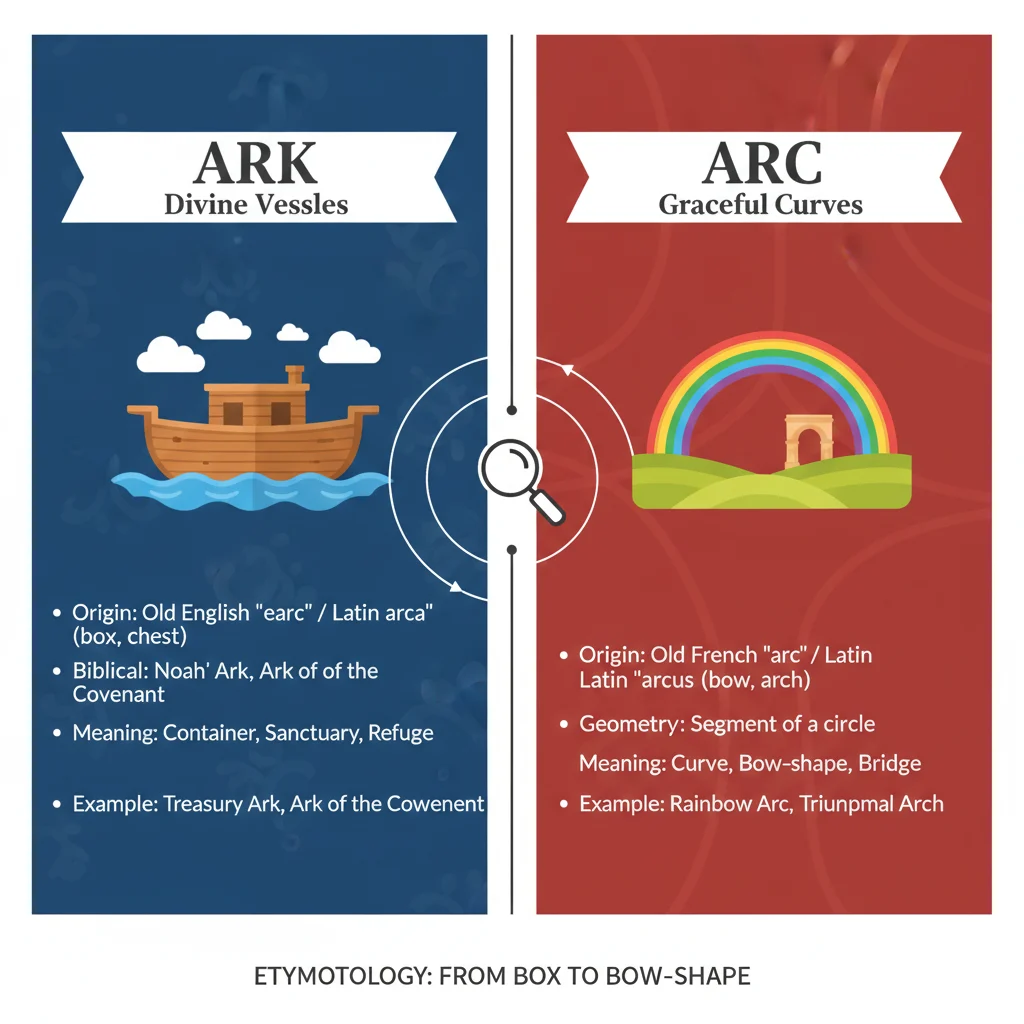
Arc comes from the Latin word arcus, meaning “bow” or “curve.” This root is evident in related English words like arch, archery (using a bow), and arcade (originally a series of arches). The word entered English through Old French, retaining its core idea of a curved shape. Over time, its meaning expanded metaphorically. Just as a bow curves, a story or a character’s development can be seen as following a curved trajectory—a beginning, a rise, a climax, and a resolution. This is why we now talk about a story arc or character arc.
Ark, on the other hand, comes from the Latin arca, meaning “chest, box, or coffer.” This term also came into English via Old French. Its meaning was always tied to a container. In the Bible, the Latin Vulgate used arca for both Noah’s ship and the sacred chest holding the Ten Commandments. This solidified “ark” in English religious vocabulary for these two specific, monumental containers.
The spelling difference exists because they descended from two distinct Latin words (arcus vs. arca). The confusion in modern English is purely a homophone phenomenon—two words that evolved to sound identical but kept their separate spellings and meanings.
British English vs. American English Spelling
Here’s a critical point of clarity: the ark or arc distinction is not a difference between British and American English. Both dialects maintain the same spelling separation.
- Both use “Ark” for Noah’s vessel and the Ark of the Covenant.
- Both use “Arc” for a curved line and a narrative journey.
The real transatlantic spelling difference involves a related word: arch. While ark vs arc vs arch are all distinct, “arch” can sometimes be part of similar compounds. For instance, the architectural term is always “arch.” However, the confusion never crosses into swapping “ark” for “arc.” Whether you’re in London or Los Angeles, a character has an arc, and Noah built an ark.
| Term | American English | British English | Meaning |
|---|---|---|---|
| Ark | Ark | Ark | A large boat (Noah’s Ark) or sacred chest. |
| Arc | Arc | Arc | A curved line or a narrative storyline. |
| Arch | Arch | Arch | A curved structural support (noun); mischievous (adj.). |
Which Spelling Should You Use?
Your choice depends on your audience and context, not geography.
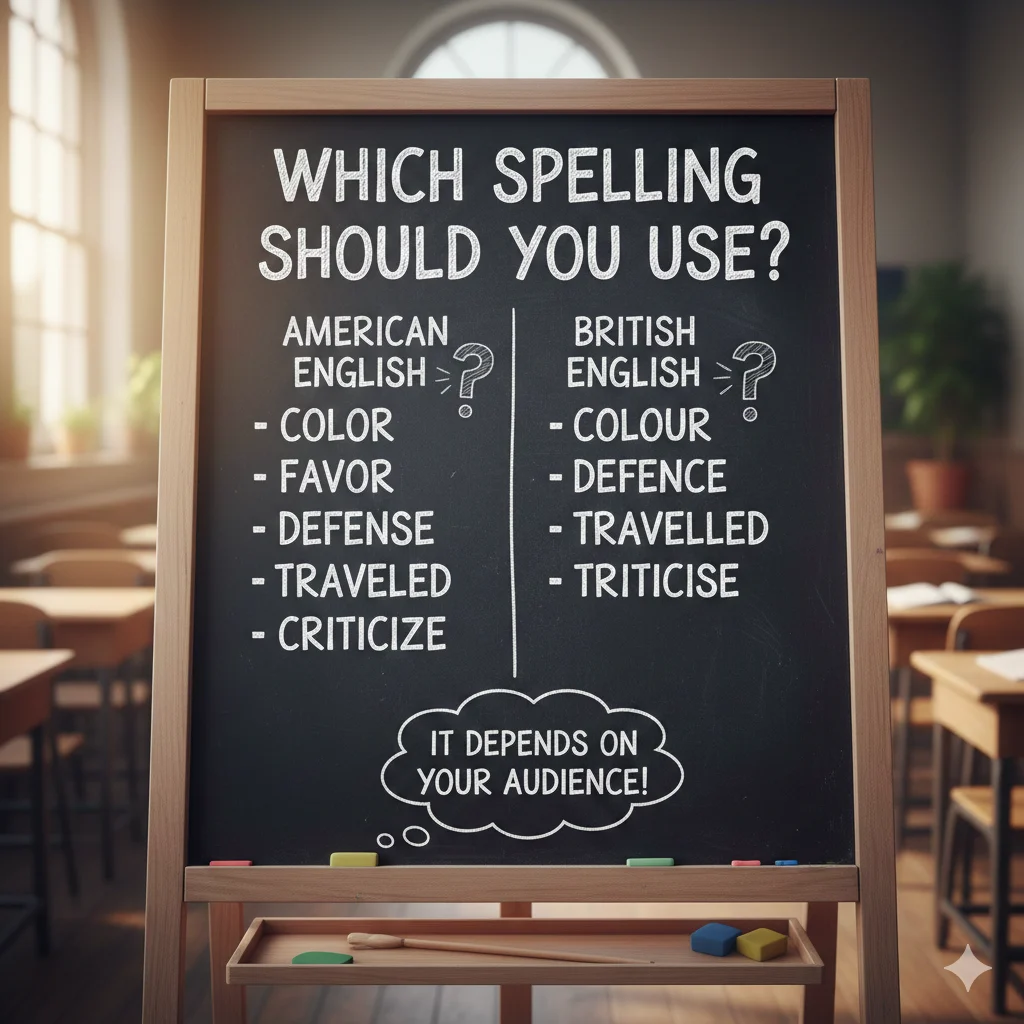
- For a US Audience: Use ark exclusively for Biblical references. Use arc for all narrative, character, and geometric contexts. The phrase redemption arc is standard.
- For a UK/Commonwealth Audience: The same rule applies. Ark for the boat/chest; arc for the curve/story. The spelling rules are identical to American English here.
- For a Global or Online Audience (Social Media, Forums, Gaming): This is where confusion blooms, especially in fandoms discussing ark or arc in anime or video games. Always use “arc.” The Dragon Ball Z “Cell Arc,” the “Infinity War Arc” in the MCU, and a game’s story arc are all correct with “arc.” Using “ark” in these contexts is a clear mistake that will be noticed by savvy readers.
- For Religious or Academic Writing: When discussing the Bible, ark is non-negotiable (Noah’s Ark, Ark of the Covenant). Using “arc” here would be a serious error.
Universal Rule: When in doubt about a story ark or arc, it is always “arc.”
Common Mistakes with Ark and Arc
The most frequent error is using “ark” when “arc” is meant, likely because “ark” feels more intuitive or is subconsciously linked to the famous Bible story.
- Incorrect: “The hero’s redemption ark was beautifully written.”
- Correct: “The hero’s redemption arc was beautifully written.”
- Incorrect: “The manga is entering a new story ark.”
- Correct: “The manga is entering a new story arc.”
- Incorrect: “What does this ark mean for the plot?” (when asking about a storyline).
- Correct: “What does this arc mean for the plot?”
- Incorrect: “They built an arc to survive the flood.” (Unless it was a very strangely shaped boat!).
- Correct: “They built an ark to survive the flood.”
Remember: If it’s about a story, journey, or curve, the correct spelling has a ‘c’—arc.
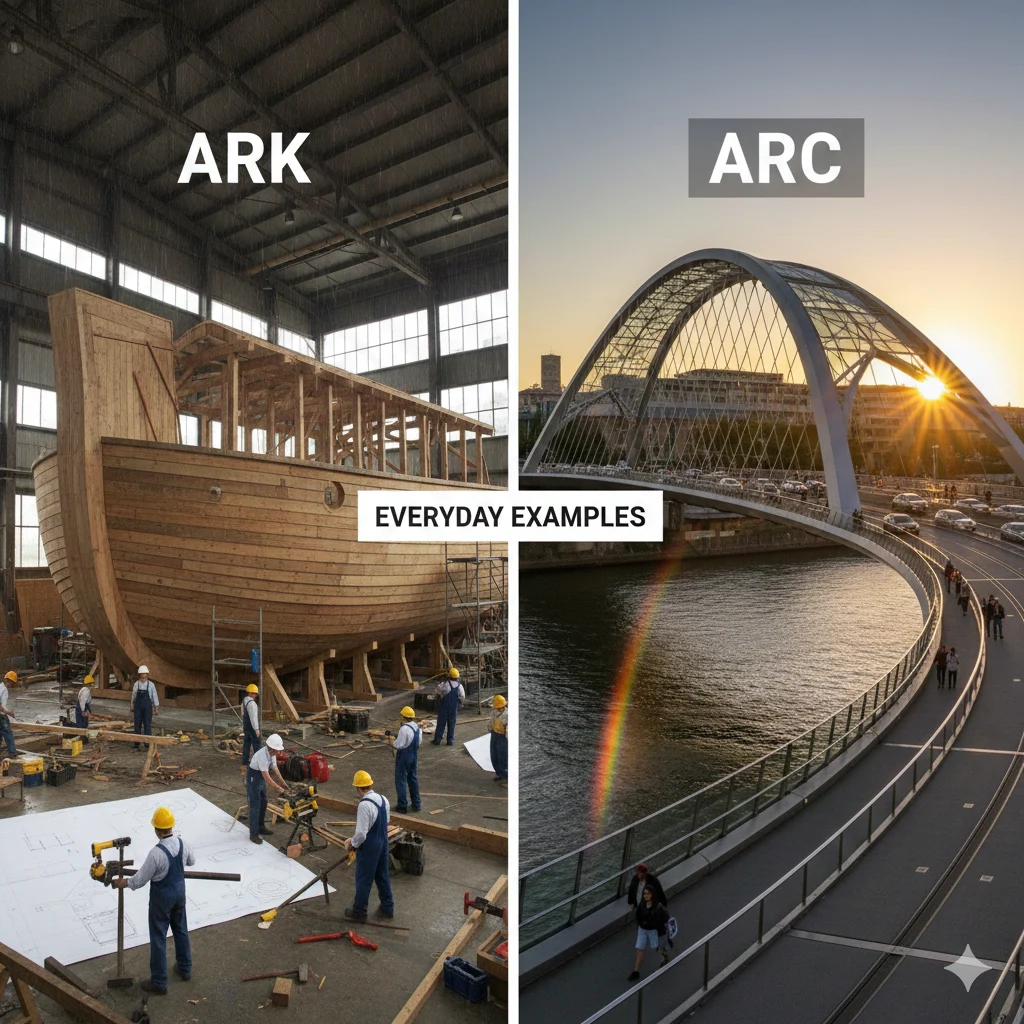
Ark and Arc in Everyday Examples
Seeing words in context cements understanding. Here’s how ark and arc are used correctly across different mediums.
In a Professional Email:
“Attached is the document outlining the project’s development arc over the next quarter. We’ll need to navigate these challenges carefully—almost like building a modern ark for our data security.”
In a News Headline:
“Local Artisan Crafts Replica of Noah’s Ark; Film Festival Highlights Director’s Career Arc.”
On Social Media (e.g., Anime Forum):
“Just finished the Chimera Ant Arc in Hunter x Hunter. The moral complexity of Meruem’s character arc is incredible! #anime” (Note: arc is used twice, correctly).
In Formal Writing (Literary Analysis):
“Shakespeare expertly employs a tragic arc for Macbeth, tracing his descent from noble general to tyrannical ruler. This narrative structure serves as the ark that carries the play’s central themes of ambition and guilt.”
Ark or Arc – Google Trends & Usage Data
Data reveals clear patterns in public confusion and interest. Google Trends analysis for search terms like “is it ark or arc” and “story ark or arc” shows consistent, global searches, indicating perennial uncertainty.
Searches for “character arc” vastly outnumber “character ark,” showing correct usage is dominant. However, the persistent searches for the incorrect phrase prove the dilemma is real. Interestingly, searches related to “Noah’s Ark or arc” spike around religious holidays or when the story is featured in media, showing people double-checking the spelling of the proper noun.
Geographically, the searches are evenly distributed across English-speaking countries, reinforcing that this is not a regional issue but a universal homophone challenge. The data confirms that the primary user intent behind the keyword “ark or arc” is to solve a spelling and meaning problem, especially in the context of modern storytelling.
Keyword Comparison Table
| Keyword | Correct Spelling | Primary Meaning | Common Use Context |
|---|---|---|---|
| Storyline | Arc | The narrative path of a plot. | “The fantasy novel has a thrilling adventure arc.” |
| Biblical Ship | Ark | The vessel built by Noah. | “The story of Noah’s Ark is found in Genesis.” |
| Character Journey | Arc | The transformation of a character. | “Her arc from villain to hero was compelling.” |
| Sacred Chest | Ark | The Ark of the Covenant. | Ark or arc bible studies focus on the Ark. |
| Curved Line | Arc | A segment of a circle’s circumference. | “The ball flew in a high arc through the air.” |
FAQs: Your Ark or Arc Questions Answered
Q1: Is it story ark or arc?
It is story arc. This term describes the curved progression of a narrative plotline.
Q2: What does “arc” mean?
Arc has two main meanings: 1) A curved line or shape. 2) A sustained storyline or development, as in a character’s arc or plot arc.
Q3: Is it character arc or ark?
It is character arc. This refers to the inner journey and transformation a character undergoes throughout a story.
Q4: Noah’s Ark or Arc?
It is Noah’s Ark. This is the proper name for the vessel in the Biblical story. “Noah’s Arc” would be incorrect.
Q5: How do I remember the difference?
Link Ark with the K in “Kist” (German for chest/box) or “Kayak” (a boat). Link Arc with the C in “Curve,” “Character,” and “Comic book story.”
Q6: Is “ark” ever used in modern contexts?
Yes, metaphorically. Conservationists might call a protected habitat an “ark” for endangered species, invoking the idea of a protective vessel.
Q7: What about “redemption ark or arc”?
The correct phrase is redemption arc. It describes a storyline where a character seeks redemption for past wrongs.
Conclusion
The ark or arc dilemma is solved by remembering their core, unchanging meanings. Ark is a container—a monumental boat or a sacred chest, forever anchored in religious and historical context. Arc is about curvature and progression—be it the literal path of a thrown ball or the metaphorical journey of a story or person. In your writing, for any narrative, developmental, or geometric purpose, arc is your word. For references to the Biblical vessels, ark is mandatory. This distinction holds true globally, in both American and British English. By mastering this simple spelling rule, you eliminate a common error and communicate with precision, whether you’re analyzing a character arc in a film, discussing Noah’s Ark in a seminar, or debating the best arc in your favorite anime. Clarity, after all, is the ultimate goal of good writing.

“M.R. James, a playful storyteller at PunsBlast, crafting sharp puns and clever humor that turn everyday words into unforgettable laughs.”